Tag: PDA

  • Avoiding an ATU as a PDAer

    Ways NHS 111 have supported me:

    The moment I tell them ‘bear with me I’m autistic’ they do know how to alter their communication. If you’re lucky enough to have a diagnosis with a PDA modifier, they actually do have a degree of understanding of what that means.

    They will likely still be quite demanding to call – but if you are facing a dangerous crisis and don’t fancy heading to hospital, try and meet them. They take the “least restrictive option” and as in my case, can treat you in your own home.

    It’s best to lean on friends and family, but if it’s the middle of the night and things have *worsened*, call 111 every time something gets worse. Short of that, SHOUT is textcare, and there are multiple email support lines: saneline, samaritans being just a couple. There’s loads of suicidal crisis lines, papyrus, CALM, samaritans – but these need you to be actively suicidal. You can also contact the PDA Society helpline if you need PDA specific advice – but they are not a crisis line and will respond at a delay. The NAS also have webpages on where to turn in crisis – I would link but the website is currently down.

    Yes! All of this is demanding!

    BUT: all of this is better than any length of time in a psychiatric unit as a PDAer. They are restrictive, demanding beyond belief and very controlling. If you need to be in one, they’ll help – but if you can do any of this and stay at home, you’ll keep your control and autonomy.
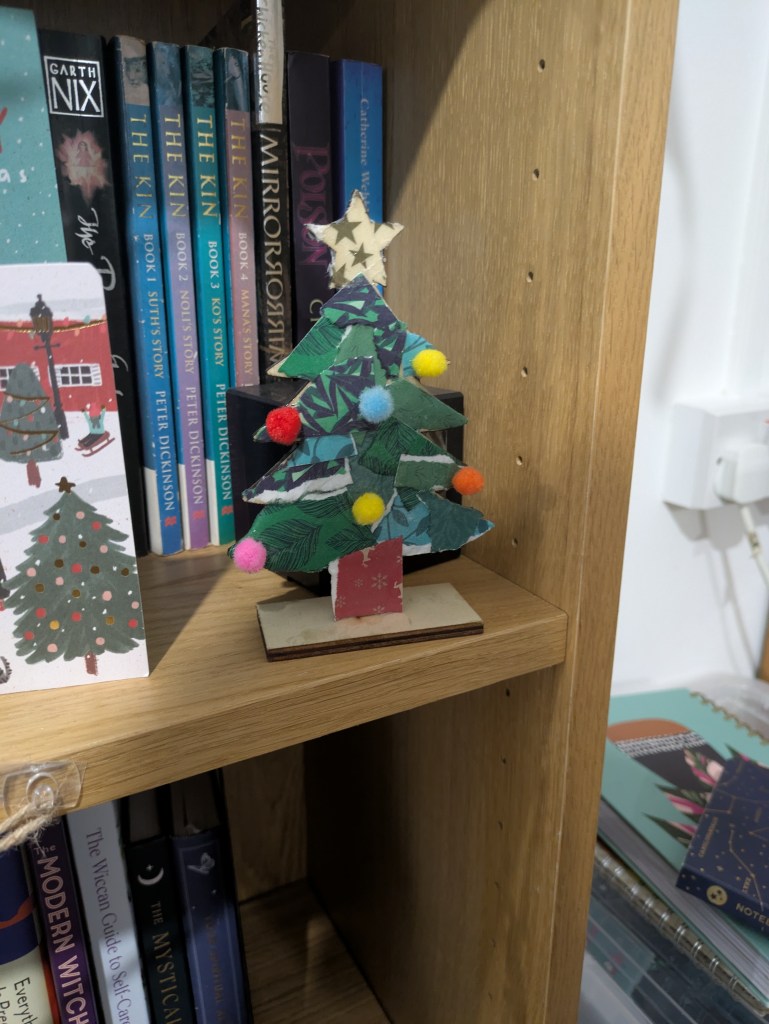
  • Neurodivergent distress coping

    I made this christmas tree decoration on a night I was really struggling:

    Now that’s not a brag. It was actually completely the wrong coping mechanism – it lead to my becoming so distressed I toppled my Christmas tree! No damage done, to me or the tree, so nevermind but still. Trees are not playthings!

    So I had to rethink the ways I was trying to cope: too much tv, crafting, distraction.

    What I needed:

    • stimming
    • sensory items like my weighted blanket
    • lava lamp
    • radio music
    • spotify music
    • taking a break from christmas
    • opposite action: opening some of my own presents that I’d bought for myself/one my mum got for me
    • radically accepting
    • a little clock for my kitchen so I could be aware that time is passing
    • engaging in special interests – and strewing them around the room for a low demand way to spark interest

    Using these methods has helped me work better with the home treatment team. With good communication about my being autistic and PDA with them, they did an excellent job of adapting their approach, and I’ve impressed a lot of them.

    You can cope with distress and crisis as a PDAer – you just need to work with your brain and not against it!

  • Friendship gets easier with practice

    Recently I made a post on my instagram about one of my biggest autistic traits is difficulty making, and keeping friends. I’d now state that as biggest PDA trait – but also I’m finding that contact with 111 option 2 is helping me shift my communication, boundaries and locus of control.

    That is to say, I am more aware of what I can control and what I can’t – which really helps with intolerance of uncertainty. It also reduces the anxiety driven need for control.

    I am also better able to stand up for myself but also take responsibility for my own actions, because 111 definitely expect that of you. Once you start doing that, they are very able to work with PDA and autism, actually. They will adapt their communication, and expectations as far as a non-autism specialist service can.

    The outcome of all this is that I am much more selective in who I keep in my life – which makes for friends who actually want to check in on me and see me in person (which as a socially motivated PDAer, I need! )

  • Life planning

    Now I have the meds I need, I can calmly think through life planning as a positive activity.

    To do this, I never use smart goals, they confuse me. Let alone the demands of the requirements they have!

    So instead, I just do very informal notes:

    Learn to drive

    • autonomy
    • need to concentrate
    • need to not dissociate

    I do this via different categories, e.g. bipolar and goals, ADHD and goals. Yours may vary, if you wish to give this a try.

    Following that, I review some time later – probably quite some time later, as in years. I cross off the things that no longer matter, tick off progress, throw away things that have been completely solved. It gives me such a sense of achievement!

  • “Radio days”

    This is something I’ve discovered today after putting radio one on in the morning, keeping it on after my mum came to see me, and then returning to the radio when we got back. I’ve actually kept it on into the evening, so it’s been a whole day of radio shows.

    It’s actually very regulating for me. It’s like having background company, which reduces loneliness. It’s also lower demand than tv – you can tune your attention in and out. Pay close attention to the funny chat, let a song be pretty in the background.

    One thing is that sometimes you do have to ignore a song you don’t particularly enjoy. I found the giggles from the commentary made that worthwhile today.

    I think I will try and make time for radio days, much like I do for demand free time. I think they may become equally important for my mental health.

  • Update: struggling a little

    Recently I’ve been very lonely. I don’t see my friends in person very often, nor do I have that many. Where I live is only a small town. All the activities are attended by women in their 50s and 60s.

    My care coordinator said it best when he said ‘there’s nothing to do in X for 30 year olds, unless you like drink or drugs’. Suffice to say, I don’t intend to take up substance abuse to gain social connections!

    I struggled making friends at university in Cardiff. So it feels like if I couldn’t manage whilst surrounded by 30k students my own age, how do I expect to make friends in home counties small town? It leaves me feeling like the problem is me – that there’s something wrong with me.

    This loneliness and low mood has been making food a particular struggle at the moment. It’s feeling far too demanding to decide what meets my sensory needs, shop for it, store it appropriately, prepare it, cook it, eat it and clean up afterwards. I’m tempted to survive of Huel and toast for a while – low spoons food. Nut butter for protein, toast for carbs, Huel for vitamins and minerals. Not the best diet, but better to be consuming something at least, and it would be easiest with my spoon level and sensory needs at present.

    Hopefully things will get easier soon. I am very glad to be spending a Christmas with family, in the community, doing all the usual Christmas things. I missed out in a big way last year, and I have a lot to be thankful for that I’m well (not psychotic) this time around.

  • Neutral

    I made a post on my instagram about how sometimes I do not like being neurodivergent. Recently I’ve been struggling with being autistic, ADHD, (likely) dyspraxic, dyscalculic – and especially, bipolar. That it feels like it just makes life more difficult, causes more struggles and loneliness.

    My journaling tonight leads me to reflect that I would not wish for my neurokin to be self-hating.

    So I asked myself, are there good things to being different in this way. Maybe right now I’m just not seeing them, because I’m finding it really hard to create an answer to that question that lists any positives.

    But if I don’t want my neurokin to be self-hating I shouldn’t put that on myself either.

    Maybe then I can take a neutral stance, like I’ve seen many others adopt. That neurodivergence can just be neutral. It just is. It’s ok that it is, it’s a variation that is, that happens.

    And it’s ok.

  • Module begins

    It’s the first week of the module, and I’m a week ahead. That’s because the website opens before the module commences, not because I’m superhuman and studied two weeks in the first week of term.

    It definitely feels better to be a week ahead. There’s less sense of pressure, and if I can keep up this way, I can take a rest week if I need to. I’m not sure if it’s going to be possible to get any further ahead with this module. Every week involves a lot of notetaking, so cramming two weeks into one would be very intense.

    I feel more confident now that I’ve managed a week of study in an actual week. Prior to the module starting it had taken me two or so weeks to complete the first weeks study – I think having the actual time pressure helped me register the importance.

    I like that this module moves frequently between sciences, that will keep my brain engaged and curious. I have to think about it little bit by little bit, because thinking all the way to May makes me feel rather overwhelmed. Instead, I’m trying to think in terms of tutor marked assignment (TMA), by TMA. Taking each one in turn, and focusing on the work each one needs as they come up.

    The TMAs on this module are lengthier than I’ve been used to on my previous module – rather more demanding! With gentle self care, perseverance and persistence, I shall tackle each one with mindfulness of demand anxiety. I foresee a lot of demand free time in my future!

  • How does a PDAer study?

    I have a lot of demand anxiety about studying right now, so I’m going to avoid by making a post about what usually helps me to study. This may or may not work for you, or it may help you think on what would work for you to be a student – take or leave whatever does or doesn’t feel right.

    1. ‘Just prepping’
      • This involves getting the layout of the desk right. Loading my OU page that I need. Writing out the title, date etc on the page. Sometimes telling myself ‘I’m just gonna prep’ gets me going (and today, it wasn’t enough.)
    2. Just do five minutes
      • Set a timer for 5 minutes. I promise myself I can definitely stop after 5 minutes – but I try and get that amount done. I’ll have 5 minutes more work done than I would, I might find my flow.
    3. Avoid one study task with another
      • Too anxious to make new notes? I review some old ones. Or type up handwritten notes into new. Or work on a different section of the course – the OU is very useful for this, because you can leave something you avoided unchecked, so I know to return when I feel able.
    4. Set a flexible study calendar
      • I find it best to put loads of potential sessions into a schedule, and then use flexibility with them.
    5. Study at the Open University
      • Lower social demands. Eased me into studying in the first module. Flexibility on when and where to study – no requirement to attend lectures in person. Not even a requirement to attend tutorials unless I think it’ll help. I also get to study the Open Degree, where I can freely choose my modules (Undergrad and Masters available.)
    6. Following my passions
      • For me this ties into the Open Degree. I don’t have to force myself to study any modules that aren’t truly interesting to me. This could also look like studying your dream subject.
    7. Pomodoro
      • This is a technique of studying for X amount of time, and then a break. Usually it’s 25 minutes, can be 50. Could be much less if that’s what I need.
    8. Twitch study with me streams
      • I love these. You get a little community to chat with on breaks, gentle study music playing to keep you focused, and the sight of someone actively studying as you go. Very helpful with ADHD-blocks.
    9. I believe the OU will have some study with me sessions as well, and they have an Study With Me discord.

    These little ideas help keep me on track most of the time. And writing this has me feeling more inspired to Study!

  • Demand cup update

    I haven’t posted about how full my “demand cup” feels for a while. This is based on Tomlin Wilding’s concept here: http://tomlinwilding.com/the-demand-cup/

    Right now, living in my own home on my own provides a lot more autonomy than I’ve had in a long time. I can do things on my own terms for the most part.

    I also have the support of carers for activities of daily living, which takes a lot of demands off my plate. That’s super helpful a lot of the time, though I need to be careful it doesn’t make the demands harder to meet in the long term. If you’re struggling as a PDAer, you’ve a right to a Care Act Assessment, if you have an autism diagnosis. Talk to the PDA society enquiry line to find out more about this if you think it would help you.

    I’m managing university study – I think because this fits into my “PDA flow”. It’s a very autonomous choice to be a student, and I’m on a very autonomous degree. It’s enabling me to study areas of specific interest in depth. I find I actually study better with a bit of guidance, and structure – I actually find autodidactic learning more demanding at times, as I have to provide all the structure and content for myself. I also like knowing that my learning leads to a useful outcome.

    I’m managing to get outside a lot more than I used to. I’m trying to avoid impulsive spending, though this is a real struggle.

    All in all, for most of the time, things are going well. However, I do get times when I hit a brick wall of no demand capacity. This is particularly when trauma symptoms are bad at the moment. I’m hoping therapy and my new mental health team can help me with that over time. For right now, things can be somewhat difficult with that. Mostly though, this is an ideal living arrangement for me, that protects my demand cup from overflowing.