Category: mania

  • Equalising and wards

    Equalising is a commonly discussed term when it comes to PDA kiddos. I’m not sure though, that adults are entirely “above” doing so, when under enough stress.

    As in, for me, being on wards induces exactly this. There’s a known “us and them” effect on wards, especially NHS wards. Staff are the Us, patients are the Them. We, who are Well, Those who are Unwell.

    As a PDAer, I am effectively allergic to this entire environment. It’s so stressful. I can barely cope with hierarchy at the best of times, and definitely not completely arbitrary “we’re the Staff, you are the patients” attitudes. (This forms part of my personal thinking about PDA is that we seem to come in three stripes: eglatarian, communicator or negotiator, based on which of the criteria we have most strongly. This isn’t based on anything overly scientific, just a feeling I get from observing, interacting with, and being a PDAer. I might post more on this in the future – depending on what happens with demand avoidance!) I definitely really relate to descriptions around intolerance of authority and hierarchy – as a constant trait, compared to my demand avoidance which can actually fluctuate quite dramatically.

    As a result, these environments cause me to equalise. This can take a more benign form of addressing everyone in the place as a human who might be friendly, it can take the form of giving a staff member a screaming dressing down. It’s not fun, it does get me in trouble. It’s why I really need to make a big push now to stay out of psych wards, because well, they SUCK. They’re not a fit environment for any PDAer, no matter what mental health problems we have going on – far too overly restrictive. When you mix that with a poor mental state, everything goes haywire.

    This is a big reason I would say, if you know you do have severe mental health problems and suspect PDA: it is very worth saving for that specific modifier in your diagnosis. Unfortunately, the NHS is only willing to include a PDA modifier in children (in some trusts). My Dr Gloria Dura Vila diagnosis has changed my life as a person living with bipolar type 1. It means the wards know they need to add support in, and that I can justify that that support needs to work very differently than they might expect. It backs up my self-advocacy efforts, and that’s invaluable – otherwise who could understand an equalising adult?

    Equalising is not “good behaviour”, and I find the best thing I can do as an adult is seek out the environments that don’t provoke it. Living in my own place, in the community, with greater control over the environments I find myself in is a big part of this. For me that’s going to mean, complying with my clopixol injections and doing my best to thrive now. It’s been a rough few years, but here’s hoping I can head onwards and upwards now!
  • Finally home for good!

    NOTE: THIS POST IS AFFECTED BY THE REMANTS OF A SEVERE MOOD DISORDER, AND AS SUCH THE CONTENT VARIES FROM MY USUAL POSTING

    Oh gosh I felt so trapped on that ward. I literally had to run away from my discharge meeting because of that feeling – I needed to move, move move move move.

    Thankfully I know that coffee helps my brain, but that ideally it should not have milk in it (obviously!).

    Now I have my sensible meds, a sensible care co (lovely woman, B), sensible times to take them, a sensible psychiatrist in the community – and a sensible way to get diagnoses I need.

    I’ve had to defer a module at the OU which genuinely makes me very upset – but no worries, I can restart and do better than I was. It was a “bridge” module between level one and level two, which only makes me all the more determined – I will graduate this time, and probably in double time. I’ve studied full time before, I can do so again haha. For now I just need to finish the module I started and focus on the *maths content* – because everything else from that module is revise-able.

    Genuine study advice for anyone struggling: build in time to review. That’s what gets things into long term memory. My maximum working memory is literally SIX, and that’s where I get stuck – I have trouble holding things in my working memory to get to short term, to long term. My verbal working memory is better than my numerical as well, which might literally be stuck at 3 (working memory is 5 +/- 2, after all).

    As it goes, I’ll keep typing about specifically my life – here, substack, instagram, facebook. That’s all I can offer, my experience, my ways to cope: PDA style.

  • Second day of leave

    NOTE: THE CONTENT OF THIS POST IS ALTERED BY A BIPOLAR MOOD EPISODE, AND DIFFERS FROM MY USUAL POSTING STYLE

    Wow, life with bipolar and PDA is hard.

    Life with bipolar, PDA, chronic pain, scoliosis, chiari malformation, probable EDS?

    Yes. Very much a disabled adult here. At the time I was under the RNOH, EDS was considered “zebra” – looking for zebras, when you hear hoofbeats and not thinking “horse”.

    I dislocate far, far too easily. I have congenital scoliosis. I had a brilliant surgery on my spine at 20 years old, and as a result am around 1-3″ taller than I would have ever been (genuinely not sure, people guess my tallest to be around 5’2″, I was 4’11”?) Standing tall as I can, I’m now about 2cm taller than I was – 150cm.

    Dyscalculia, I’d guess that makes my full height 5’1″? Yeah who cares lol. Doesn’t matter – I’m teeeeeny. Suffice to say, I’m 34, and full of disability.

    My honest advice, on this time to talk day, is: ALWAYS keep an eye on mood disorder symptoms in your kids. Do not assume ‘oh this is rejection sensitive dysphoria’, ‘oh this is PDA’ ‘oh this is ADHD’ ‘oh this is teenager time’. All kids are at risk of depression at the very least, all kids are vulnerable to abuse – of any kind, from anyone – and honestly, psych wards are a last resort type of place, for people at risk of SELF-neglect.

    You don’t want your 19 year old in such a place, trust me, let alone your vulnerable 24 year old.

    You definitely don’t want your teenager in a CAMHS unit.

  • TW: SEXUAL ASSAULT

    Writing this after a trauma processing dream (not quite a nightmare thankfully)..

    One of the worst parts of mania is hypersexuality. You really want that type of activity at just the time you really can’t have it – because you’ve lost capacity.

    To put it bluntly, it’s not sex it’s rape.

    Do not have get sexual with a person who has not slept for 2 or more days. Especially do not if they’ve been awake for 4 or more: it is the same as if they were drunk, they CAN NOT consent.

    And quite frankly, at that point it’s obvious. At that length of time awake, anyone, bipolar or not will be clearly loopy.

    So yeah, mania is as traumatic as anything, and I’m left processing all of this.

  • Avoiding an ATU as a PDAer

    Ways NHS 111 have supported me:

    The moment I tell them ‘bear with me I’m autistic’ they do know how to alter their communication. If you’re lucky enough to have a diagnosis with a PDA modifier, they actually do have a degree of understanding of what that means.

    They will likely still be quite demanding to call – but if you are facing a dangerous crisis and don’t fancy heading to hospital, try and meet them. They take the “least restrictive option” and as in my case, can treat you in your own home.

    It’s best to lean on friends and family, but if it’s the middle of the night and things have *worsened*, call 111 every time something gets worse. Short of that, SHOUT is textcare, and there are multiple email support lines: saneline, samaritans being just a couple. There’s loads of suicidal crisis lines, papyrus, CALM, samaritans – but these need you to be actively suicidal. You can also contact the PDA Society helpline if you need PDA specific advice – but they are not a crisis line and will respond at a delay. The NAS also have webpages on where to turn in crisis – I would link but the website is currently down.

    Yes! All of this is demanding!

    BUT: all of this is better than any length of time in a psychiatric unit as a PDAer. They are restrictive, demanding beyond belief and very controlling. If you need to be in one, they’ll help – but if you can do any of this and stay at home, you’ll keep your control and autonomy.

  • Neurodivergent distress coping

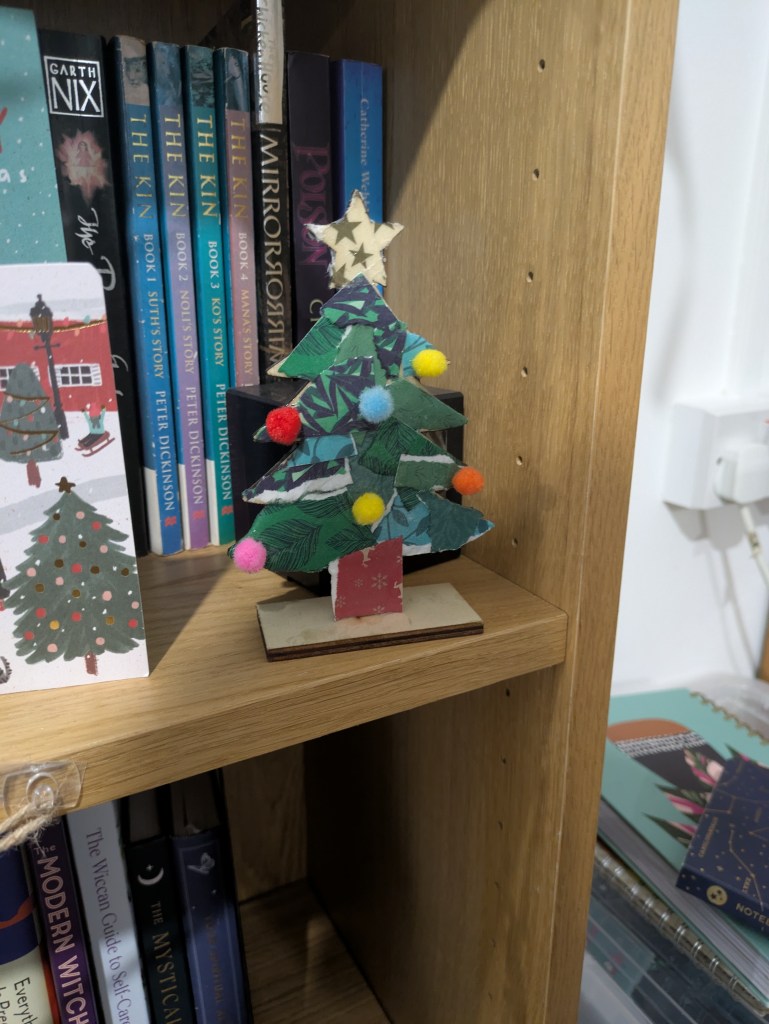
    I made this christmas tree decoration on a night I was really struggling:

    Now that’s not a brag. It was actually completely the wrong coping mechanism – it lead to my becoming so distressed I toppled my Christmas tree! No damage done, to me or the tree, so nevermind but still. Trees are not playthings!

    So I had to rethink the ways I was trying to cope: too much tv, crafting, distraction.

    What I needed:

    • stimming
    • sensory items like my weighted blanket
    • lava lamp
    • radio music
    • spotify music
    • taking a break from christmas
    • opposite action: opening some of my own presents that I’d bought for myself/one my mum got for me
    • radically accepting
    • a little clock for my kitchen so I could be aware that time is passing
    • engaging in special interests – and strewing them around the room for a low demand way to spark interest

    Using these methods has helped me work better with the home treatment team. With good communication about my being autistic and PDA with them, they did an excellent job of adapting their approach, and I’ve impressed a lot of them.

    You can cope with distress and crisis as a PDAer – you just need to work with your brain and not against it!

  • responsibility update

    Still hitting the mark on responsible (apart from one or two minor wobbles). I saw the section 12 drs and aced it! So now I have all the meds I actually need and I feel calm and sleepy.

    Just managed a basic dinner, so that’s food in me.

    I’m doing pretty good!

  • How I take responsibility through mania

    I have a ten year plan: buy a flat with two bedrooms and adopt a kid (likely allistic, to lower demands on myself! Gotta do what’s right for the kid!)

    So, when I have bipolar 1 with psychosis, obviously that means a LOT of self-responsibility.

    Turns out, I’m capable of that! I’ve been calling 111 every time my mental health noticeably worsens, and aiming to only do so then.

    In between I’ve been brainstorming autism/neurodivergence related means of coping:

    • colouring
    • reading autism books
    • stimming
    • demand free time
    • listening to an audiobook
    • my kindle

    NOT:

    • crafting
    • knitting
    • TV

    They need to be low concentration, high stimulation for my ADHD. This is a very hard balance to find!

    That said, I am doing very very well. I managed to communicate my needs to a local community hub, telling them about the need for an ambulance, and also to a local charity shop I wish to volunteer for. I also emailed for a dyspraxia lived experience role, admitting to my period of illness and hoping it’s brief.

    All in all, I’ve been very successful in looking after myself through a thankfully mild mixed episode. Clopixol is my wonder drug!

  • OT needs assessment… and no sleep

    It’s not even 4am right now, but tonight I don’t seem to be able to get sleepy. I think it’s because I am starting my occupational therapy needs assessment later today, with a trip to a supermarket, and a cooking exercise.

    I’m nervous.

    I’m nervous because… I feel like I’m handing information to an unknown someone else to make decisions for me, without my input based on how I perform. I’m nervous about getting what I need, but also what I *want* from the decisions they make – more nervous about this actually. I want to be able to say ‘I want XYZ’ and have them find the funding. My OT explained that a lot of people would overestimate their need, and then be handed far too much if it worked like that, which I can understand. Even so, it’s still stressful to wait on someone else’s decision.

    Last time I was in this position I had much more faith in supported housing as an option. The let down of my supported housing, their refusal to work with my PDA profile adequately, however has left me very wary. I’d want autism specific supported housing this time, and I am not sure that exists within my local area. I could be moved to a different area within my county, but then I lose my care co-ordinator, end up under a different CMHT… far too much change and uncertainty. I know my current care co-ordinator is happy to provide my depot by thigh injections for example, which is the only delivery method available that I’m comfortable with. I also don’t want to face the risk of the decision that I don’t need a care co-ordinator because I “seem well” and have supported housing, after a move to a new area – it happened last time, I transferred from one region to another, and the new CMHT deemed me as not needing a community psychiatric nurse to act as a care co-ordinator.

    What I’d ideally like is my own place, under my own autonomous control, with support visiting me. I’d love to train myself a psychiatric service dog, to alert to manic episodes, ground me through delusions, racing thoughts alert to irritability, and rising demand anxiety. Something that might be particularly useful would be grounding through rising states of emotion and panic in response to demand anxiety.

    I am very anxious that the decision makers will deny me access to this, based on a version of me on paper. Or that housing where a dog in training won’t be possible to find. I’m also against the idea of supported housing, as it would very likely not be possible to have a dog/puppy live there whilst training.

    I really hate these situations of waiting in wards for an answer to a housing crisis. There’s pros this time, I’m on a much nicer ward, I have the distraction of starting my university studies, better support from the ward manager/care co-ordinator/psychiatrist/discharge co-ordinator/occupational therapist/nurses to move things forward quicker. I just am not so keen on how things feel so open ended and uncertain in terms of what type of accommodation and support might be decided on as meeting my needs.

  • Delusions.

    As part of my bipolar manias, I experience psychosis. This is primarily experienced through delusions for me, though possibly I get hallucinations (if I do, I am not aware of the perceptual experience as being hallucinatory at the time). I don’t hear voices, which I am grateful for.

    The main delusions types I experience are: grandiose, paranoid and “pronoia” (which refers to delusions of being aided or helped). They centre around military intelligence and my history of trauma. During each manic episode, events going on at the present time will inform the delusions, shaping them into a narrative specific to that mania. I also find that my delusions pull in the people around me, giving them roles in a narrative they are unaware of – often thankfully so, especially when the delusion is a paranoid one!

    I often find these delusions embarrassing once I return to “consensus reality”, and have found this time that it has helped to laugh at them. After all “vampire marriage night”, without consent from the poor groom, and with the presence of vampires that looked oddly just like staff and patients is quite a creative one, I feel. They behaved well, biting no one, just getting grumpy that being on a locked ward prevented them reaching the portal back home – to hell – in the courtyard. One staff member even got the starring role of being the devil himself! I don’t usually have such a religious content to my delusions, so that’s a new aspect for this mania.

    Perhaps it feels inappropriate to laugh at such a serious psychological phenomenon, but for me, having survived it, doing so feels the best way to respond. Most of it is patently ridiculous, and it takes the edge off that which is scary, intense (usually to others) and relieves embarrassment very well. It’s been good spending time with fellow patients who experience strange beliefs, and realising that I’m not alone with these.