Tag: neurodivergence

  • Mania recovery milestone

    During my mania last year, I lost all my saved music on Spotify, because paranoid delusions caused me to delete my account.

    It royally fucking sucked.

    Finally, I’ve started finding music that makes me feel as good as the music I had before. It had been a dreary year listening to music that only half ‘worked’. Trying yet another playlist, saving the best that I could find. Hoping my discover weekly would catch on to my taste.

    My friend recommended that I search for a song and then let it autoplay – so much better results!

    An hour in, and I’m back to my dance stimmy, sensory seeking self!

  • Not everything applies

    Whenever people talk about their experiences of their neurodivergence, there’s always something that doesn’t quite resonate with me. Most autistics speak of socialising overload, but for me I get lonely very easily and can find it very difficult to be alone. That often makes me feel like a ‘weird autistic’, sometimes it makes me worry that somehow I tricked my assessor.

    With ADHD I don’t relate to gaining a sudden, new obsession with a topic or hobby, only to lose it a short time later. I suspect this might be because of my PDA making any hobby feel demanding, and possibly the effect of past trauma – I don’t experience ‘interest’ the way I did when I was younger anymore. When I was little I had intense interests in space and dinosaurs, to the point of doing things like self-teaching myself evolution at the age of 8. Over my teen years and 20s, I lost that experience, struggling to find interest in anything and definitely not maintaining any hobbies. It’s not a lie to say that I started to live entirely online, engaging mostly in forums. That might partly explain why I find alone time so difficult, as I struggle to have anything meaningful to fill that time.

    Another experience I struggle to relate to is aiming to carry out one task, only to realise that another needed doing, going to another location .. and finding another task. In general, I’m not sure I relate to many of the inattentive symptoms, though I am still waiting on my report to find out what type of ADHD I have. I suspect it will be hyperactive/impulsive.

    I suppose it’s worth remembering that we don’t need to relate to every single possible trait or aspect before we can claim a neurodivergent identity for ourselves. For example, I’m clearly bipolar, but do not tend to go on big spending sprees when manic.

  • PDA, at it’s simplest

    Things I should be doing: a. specific physio exercises. b. general, low impact, workouts

    Things I therefore can not do: a. specific physio exercises. b. general, low impact, workouts

  • sensory logging initial findings

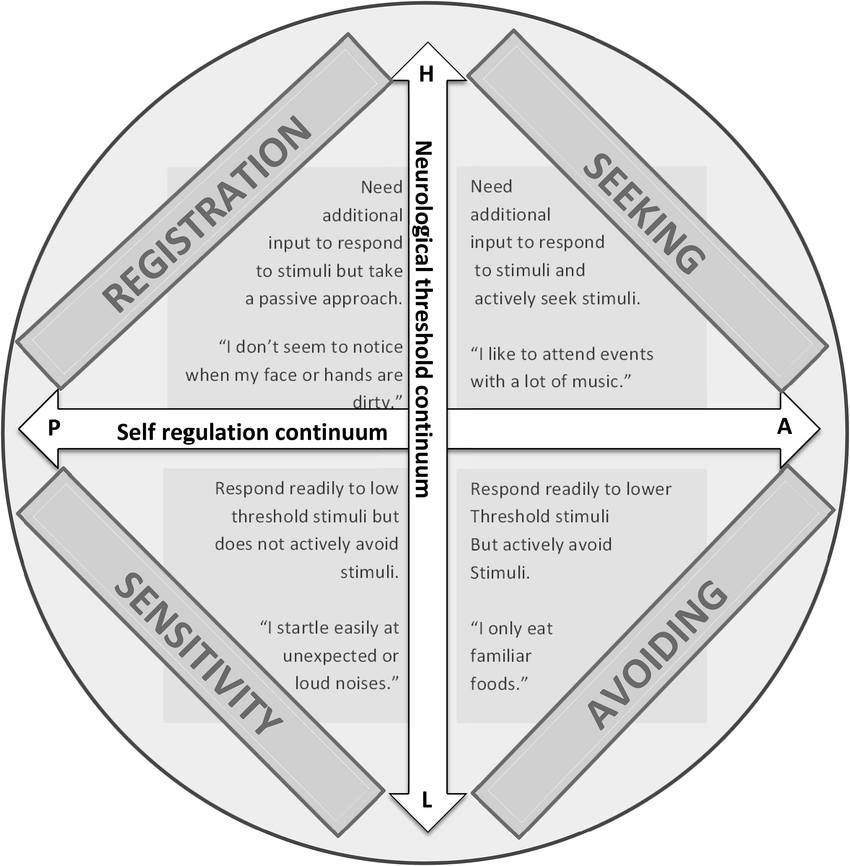
    What I’m noticing so far is that I’m a lot more either sensory sensitive, or low registration, than sensory seek or avoid. This seems inline with my therapist’s suggestion that if I’m those first two, and not actively using strategies to manage sensory input, then life becomes stressful and unenjoyable.

    We noticed that I hadn’t recorded much proprioceptive content. There were a few vestibular things I picked up on, such as being very nerve-y on stairs, struggling to balance, and swaying when sitting. The first of those, I had thought was linked to a trauma, but I suppose now it may not be. We also noticed a few items suggesting visual sensivity.

    Going forward, she’s encouraged me to focus on sense each day to capture more detail, and to hopefully with that focus notice more things involving that sense that happen each day.

  • Let me join in, in my own time

    This is something I wish everyone understood about me: that in group activities, please just let me sit and observe initially. Please don’t encourage, pressure, push or expect engagement. Usually, after a period of being allowed to do nothing but observe, the lack of expectation means I’ll get curious/bored and start to engage. It allows me the freedom of engaging on my own terms.

    An example of this working successfully happened on the ward in an OT session. Annie, the OT, had brought polymer clay for people to be creative with. My first response to this type of activity is always self-doubt, feeling whatever I create will be shit. I was so glad when she allowed me to just sit and watch.. which lead to feeling curious, and finding a simple design I thought was both cute and acheiveable. I still have my little polymer clay owl, and it’s special to me.

    Tonight was an example of the opposite to this. My supported housing is holding Christmas crafting sessions in the evenings on Thursdays and Fridays this month. Tonight was devoted to decorating the office space. Unfortunately, my friend and the support worker were very expressive in their expectation that I contribute rather than observe. Immediate demand anxiety ensued. It’s now some time later, and I’m left with low demand capacity even now. It’s interesting to note, having questioned in earlier posts, that I did feel the demand anxiety in response to external demands. I responded with half resistance, half fawning, and the knowledge that I need to communicate my need to be allowed to observe until I’m ready to staff. I’m really hoping that when I receive my report from Dr Gloria Dura Vila’s team, that it will really help them to understand PDA better.

  • Late diagnosis benefits

    I’ve been struggling recently to find life enjoyable. I thought this was because my life was lacking things I needed for fulfilment/satisfaction/contentment and that I needed to find things to add to my life. This was in spite of having a meaningful job, friends at my supported living scheme, meetup groups that I’ve started attending, Christmas to look forward to and secure housing.

    My therapist posited that this might mean it’s not that I need to add anything. Instead, she suggested that, it might be that the unconscious processes of managing demands, sensory needs, energy levels and stimulation levels might be so draining that’s what’s making life hard to enjoy. That was definitely something I hadn’t thought of, but seems worth considering. So, to begin addressing this, she suggested bringing these processes into conscious awareness. I’m starting with sensory needs, recording what I’m over and under responsive to each day. The aim is to move from passive self-regulation, to gaining more ways to actively self-regulate, either sensory seeking or avoiding.

    I’m really hoping that we’re onto something here. Struggling to enjoy life has been a long term problem historically, often only interrupted by the early stages of a manic episode, in which I can entertain myself with my own thoughts. I think in part it’s affected by my tendency to spend a lot of time in low moods. Unfortunately, I can’t take anti-depressants as they will induce a manic episode. Having not been aware of my neurodevelopmental differences for 30 plus years, I had had no way to consider the effects of demands, sensory input and under stimulation. This is where identification of these factors is invaluable, as I can now pay attention and take action directed at these specifically.

    For example, I’ve recently started making use of ear defenders in public. I love that these make me visibly autistic. It’s a neuroaffirming experience to be open and proud of my neurodivergencies, instead of ashamed, masking and feeling weird. Another accommodation we discussed was around meal times. I tend to avoid the fact that I’m eating whilst doing so, essentially dissociating from eating. As a result of our discussion, I gave myself permission to order some ready made Huel meal drinks. We also discussed blending meals, and drinking them rather than eating as a possible way to remove texture based sensory overwhelm.

    It’s so good to finally be able to identify, accept and meet my own needs.

  • Keeping house while drowning

    If you’re on tiktok, you might have come across K.C. Davis’s account, DomesticBlisters. You might even be aware of her book, ‘How to Keep House While Drowning’. Or this might be the first time you’re hearing of them.

    I’d known of them for a while, but wasn’t sure if they’d be helpful when it comes to PDA style issues with keeping house. I was persuaded to get the book when my therapist endorsed KC’s methods. KC has ADHD, and post-partum depression, and her advice feels to me as thought it’s very, very useful for those reasons to be struggling to keep house. It focuses on self-compassion and seeing care tasks (usually known as chores) as morally neutral, rather than something that defines you as good or bad. Great perspective when you’re struggling with low self-esteem, low motivation and low mood. She also has a lot of simple, clear explanations that help with poor executive functioning, e.g. her five things tidying method. This breaks a messy room into five categories: trash, laundry, dishes, things that have a place and things that do not have a place. She advises dealing with each category in turn in order to resolve a messy room. This is a brilliant antidote to the ADHD experience of looking at a messy room and seeing nowhere to begin, something I have frequently experienced.

    I do wish there was a book on keeping house for PDAers. Perhaps it would be the ‘small book of housekeeping demands’ and we’d all avoid even reading it? I feel I’d find it useful to have a resource which included strategies tailored to the PDA experience. It’s tempting to consider a goal of working towards creating that resource, as I find myself wanting to work in adult ND peer support and this would constitute a form of it.

    That sets me to thinking what would be included in such a book. I think Harry Thompson’s concept of table tops and table legs would have to be part of it. I’m not sure a PDAer would manage care tasks on a regular basis if they didn’t form a table leg towards a driving, autonomous PDA current. They are, after all, the very definition of a demand. Something you really should do, something you have to do in life. Something a PDAer is going to therefore avoid like the plague, because having to threatens our personal sense of control.

    I suppose something else I’d put a strong focus on would be outsourcing the care tasks. I would try and encourage people to be self-compassionate about needing to live in supported living, needing a carer or a house-keeper. PDAers need support in life (we all do), and perhaps drafting someone in better suited to meet those demands is the best solution. It might even be so for me, after I move out of supported living, though I’m not sure yet if I’d be allocated the funding for a carer after living here. Maybe over time that will have to be explored, because it would probably be deeply useful for me to have access to that support long term.

    Rest is something I would strongly emphasise. To be fair, KC already includes this in her book, which is good. Everyone needs and deserves rest. PDAers often have a strong need for downtime to recuperate after meeting demands, or to prepare for meeting demands. In particular, demand free time is useful. I would also talk about Tomlin Wilding’s concept of the demand cup, and the corresponding emotion cup. I would want to find some methods in which we can look after the state of both, in order to free up some demand capacity for keeping house.

    But alongside the goal of creating demand capacity for keeping house, I would echo KCs ethos that our space exists to serve us, not us our space. As a PDAer, we’re not going to want to focus all our demand capacity on housekeeping in order to keep up standards (unless, that’s where our PDA current lies, I suppose.) I would place my focus on how we can keep our space functional enough, and how we can accept ourselves and offer ourselves compassion when we just do not have the demand capacity to cope, That’s my favourite thing about KC’s approach: we’re worthy of love, support, and compassion where we are now. We don’t need to meet societal standards of tidy, hygienic, clean, perfect to be worthy. Care tasks are neutral.
  • Hobbies

    I’d love to have a little set of hobbies I regularly return to. Unfortunately I find sustaining engagement in hobbies really, really difficult. I suppose because I want to engage in them, that very desire causes them to become demands – I want to engage in them, and to fill that want, I need to engage with them. Additionally at times, it may be a ‘want to want’, something I want to be in my PDA flow, but actually isn’t. At least, at the moment. Possibly also ADHD may be involved in these difficulties.

    Something I manage to do on a semi-regular basis is knit. Last Christmas I knitted a wreath with the help of my mum, largely over the course of Christmas eve and day. Unfortunately, I didn’t have a lot of demand capacity at the time and was living in a very PDA unfriendly mental health rehab ward, so meeting the demands involved led to me running out of capacity entirely and being discharged back to an acute ward. Or perhaps, not so unfortunately, as that lead to me moving to the supported accommodation which is a much better fit for me.

    At the moment, I’m trying to work on knitting squares to eventually be knitted into a blanket. It’s a very slow going process. I’m focusing on allowing it to be an imperfect project, accepting the mistakes I make as I go. I’m currently on my second ball of wool, having started in around July.

    I’d like to spend time learning to draw, relearning maths and french, and possibly learn some basic BSL. I enjoy embroidery, thought it takes a lot of concentration and I tend to completely balls up eventually. Baking is another pastime that I’ve enjoyed in the past and would like to get back to. I like board games, but don’t have much space to keep many more than I already have (and playing the same ones gets old after a time). There’s a TTRPG called Ironsworn that can be played individually that I want to play through some time. I have a mirrorless camera and get a lot of enjoyment from photography, but rarely know what I could use as a subject for that art. I used to read endlessly, but now struggle to commit to reading, and I’d like to engage in writing more poetry.

    So, we can see that I’m not short of ideas for hobbies. I’m just short on follow through and sustaining them.

  • Resources I found useful when learning about PDA

    I did a lot of research when discovering PDA in 2021 and there were a number of sources that had helpful information.

    Primarily amongst these was the pda society. I made a lot of use of their helpline throughout 2021, and would sincerely recommend their support to anyone struggling to understand or cope with PDA, adults PDAers included. Paula was very supportive and remembered my case after months of delay when I was too ill to be in contact with them, which I was very impressed with. The website is the first port of call for learning about the PDA profile with a wealth of information. This page is a great place to start learning, with a rundown of what exactly demand avoidance is.

    Facebook has a number of useful groups for PDAers, which I’ll list here:

    These groups are great places to find community and connect with fellow PDAers. I discovered that interacting with PDAers made me feel more understood and ‘at home’ than I had ever felt before.

    Harry Thompson was one of the first PDAers I learnt of. He’s written a lot on PDA, and maintains a facebook and instagram presence. Not everyone agrees with everything he says, he tends to aim to be a little controversial. Other PDAers that helped me learn were: Sally Cat, Tomlin Wilding, Kristy Forbes (great for parents), PrismCat and Riko. Having a range of perspectives is really beneficial, because PDA is a spectrum that presents a little differently in everyone. People have varying views on topics such as whether anxiety leads to demand avoidance, or just comes alongside it. PDA being so little understood, none of this has been pinned down exactly so there’s a lot of room for debate.

    Edited 8/3/23 I no longer recommend Harry Thompson as a resource.

  • When nowhere is safe

    I’ve mentioned a couple of times now that I tend to resort to ‘fawning’ in response to external demands from other people. What does that mean exactly?

    Harry Thompson offers a good explanation.

    In his post, he describes the situation where the child is safe at home to retain control through demand avoidance. That wasn’t my situation. My parents went to greater lengths to force compliance than my school did (and my primary school teachers went far enough), including the use of violence.

    As a result, I’m an adult PDAer who doesn’t feel like I now meet the criteria of being skilled in social approaches to avoid demands. These never worked for me as a child, every adult I was in contact with would force compliance through abusive methods. So now, I don’t feel like these social methods ‘work’, nor do I usually feel safe to attempt to demand avoid. Instead, I learnt to fawn for control in all situations.

    Edited 8/3/23: I no longer recommend Harry Thompson as a resource.