Tag: demand anxiety

  • Low demand language

    I’m right at my beginning of learning how to use low demand language. I made a mistake with Sally Cat, for which I apologise! Sorry Sally Cat! I have to remember: don’t tell PDAers how to view their situation, they won’t appreciate it!

    My therapist is recommending declarative language:

    • I notice
    • I wonder
    • I get to
    • I have time to
    • I get to take a break from X by doing Y

    These are just little baby steps to changing from the demanding language I grew up with, to the language that will benefit me – and benefit my relationships with fellow PDAers!

  • Module begins

    It’s the first week of the module, and I’m a week ahead. That’s because the website opens before the module commences, not because I’m superhuman and studied two weeks in the first week of term.

    It definitely feels better to be a week ahead. There’s less sense of pressure, and if I can keep up this way, I can take a rest week if I need to. I’m not sure if it’s going to be possible to get any further ahead with this module. Every week involves a lot of notetaking, so cramming two weeks into one would be very intense.

    I feel more confident now that I’ve managed a week of study in an actual week. Prior to the module starting it had taken me two or so weeks to complete the first weeks study – I think having the actual time pressure helped me register the importance.

    I like that this module moves frequently between sciences, that will keep my brain engaged and curious. I have to think about it little bit by little bit, because thinking all the way to May makes me feel rather overwhelmed. Instead, I’m trying to think in terms of tutor marked assignment (TMA), by TMA. Taking each one in turn, and focusing on the work each one needs as they come up.

    The TMAs on this module are lengthier than I’ve been used to on my previous module – rather more demanding! With gentle self care, perseverance and persistence, I shall tackle each one with mindfulness of demand anxiety. I foresee a lot of demand free time in my future!

  • Demand cup update

    I haven’t posted about how full my “demand cup” feels for a while. This is based on Tomlin Wilding’s concept here: http://tomlinwilding.com/the-demand-cup/

    Right now, living in my own home on my own provides a lot more autonomy than I’ve had in a long time. I can do things on my own terms for the most part.

    I also have the support of carers for activities of daily living, which takes a lot of demands off my plate. That’s super helpful a lot of the time, though I need to be careful it doesn’t make the demands harder to meet in the long term. If you’re struggling as a PDAer, you’ve a right to a Care Act Assessment, if you have an autism diagnosis. Talk to the PDA society enquiry line to find out more about this if you think it would help you.

    I’m managing university study – I think because this fits into my “PDA flow”. It’s a very autonomous choice to be a student, and I’m on a very autonomous degree. It’s enabling me to study areas of specific interest in depth. I find I actually study better with a bit of guidance, and structure – I actually find autodidactic learning more demanding at times, as I have to provide all the structure and content for myself. I also like knowing that my learning leads to a useful outcome.

    I’m managing to get outside a lot more than I used to. I’m trying to avoid impulsive spending, though this is a real struggle.

    All in all, for most of the time, things are going well. However, I do get times when I hit a brick wall of no demand capacity. This is particularly when trauma symptoms are bad at the moment. I’m hoping therapy and my new mental health team can help me with that over time. For right now, things can be somewhat difficult with that. Mostly though, this is an ideal living arrangement for me, that protects my demand cup from overflowing.

  • Unmasking when PDA

    I saw this post: https://www.instagram.com/p/C_lcEEEOSI3/?img_index=1 as a repost (I’ve linked the original here).

    I think it’s a pretty good list of suggestions for ways to unmask. I definitely do a lot of them, especially fidgeting and stimming in ways that feel comfortable. Connecting to the autistic community online has been like a homecoming for me, meeting fellow PDAers felt like I finally made sense as a person. I also work more to meet my sensory needs and to communicate these to others and ask for help to meet them.

    However, this isn’t the full picture for me. PDA requires some other things to be unmasked.

    A big start for me was tuning into my demand anxiety. I noticed that I met all the criteria for PDA, but couldn’t identify that feeling of anxiety at demands at first – but I knew I was very dissociative. With the help of brain spotting, I’ve become much less dissociative and I’ve become able to notice that bodily feeling of demand anxiety.

    That leads me to actively avoid rather than fawn. Fawning was a trauma response developed as the only way to maintain control and felt safety in times of abuse and trauma. It wasn’t healthy though, and lead to further traumatisation. Leaning into my desire to avoid, and to be in control of my choices has lead to a much more autonomous life. It also enables me to live openly as a PDAer

    Doing that means communicating about my experience of demand anxiety. Part of that recently has been creating my PDA flip chart (which you can see photos of here: https://www.instagram.com/p/C4ftcawsQuq/?img_index=1), which helped explain this experience to staff on my psychiatric ward. I talk to my mum about PDA as well, and she understands me a lot better now. I can advocate for myself much better now, which I am really glad for – it helps me protect myself.

    Ultimately, the biggest form of unmasking is looking for that autonomous, low demand lifestyle. It’s why I wasn’t happy to accept supported housing for a second time. It’s why having my own independent flat is lifechanging for me – I can do as I want, when I want. Equally, having carers really reduces demands on me, which makes life much healthier.

  • Moving demand anxiety

    Recently I’ve experienced so much demand anxiety about moving, that I’ve mostly been sleeping and hiding.

    There’s been so much to do and arrange – carpets, paint, electricals, electric, gas and water, television license, and internet. It’s been so stressful. It’s a little better now some of it’s getting sorted, I’m finally managing to feel a little excitement.

    I’m very lucky, it’s a great flat, with a lot of storage. It’s going to be so good to get away from the restrictive environment of the ward, and away from some of the repetitive conversation with ill patients. There’s a nice communal garden, and a little yard outside my flat where I can grow some plants if I wish.

    I just wish that moving didn’t come with so many intense demands. It’s really quite a lot to take on, but it’s going to be worth it to no longer be living in supported housing.

  • The demand of wanting to

    As mentioned on pdafae on instagram, I really want to read my Baye’s Theorem book. During the course of my psychosis, I started developing a special interest in perception. I think through the muddling nature of illness, I was reflecting on my past studies and realising that perception was the area I find most fascinating in psychology.

    It’s lasted since I’ve regained touch with reality. A patient was kind enough to purchase me my uni’s perception textbook to cheer me up, and I’ve read most of – that too has become slightly a demand to finish. Baye’s theorem is very relevant to perception, particularly autism and perception as I’ve mentioned before.

    It would do me good to engage in a special interest, but because it is a special interest that I’m really interested by, my PDA is responding to that with a lot of avoidance. I suppose there’s a big sense of “should” and “want”, and I need to find a way to relieve that.

    Something that might work is to just allow myself to ignore it for long enough, because that tends to remind me that I don’t have to engage with something.

    Alternatively, I could try just reading small amounts? I think I need to find a way to be in my flow. I’m really eager to study the signals and perception module at the OU, and that might be because it’s possible it’ll be difficult for me to do so – whereas the books are readily available. Possibly therefore, putting them accessible but out of sight might also help, because it may be that seeing them regularly is increasing the demands.

  • PDA lies in the accommodations needed

    Sometimes, even now with an official diagnosis, keeping this blog and my instagram, having connected with the PDA community…

    … I still sometimes doubt that I’m PDA.

    Sometimes I have quite a lot of demand capacity, and these times can last for long durations – days/weeks.

    In these times, I feel little demand anxiety. I am able to meet requests. I am unbothered, or much less noticeably bothered by the expectations of others foisted onto me.

    I can offer to do things, that I could easily avoid.

    I can meet my own expectations for myself, and my bodily needs.

    In these times, it feels unlikely that I truly have PDA.

    However, in these times, my demand cup is being emptied by something.

    It might be someone else’s support. Or getting good sleep. Or having had a restful enough period, or enough demand free time, or a reduction in anxiety. Or I am spending enough time engaging in special interests (this is my recent situation – I have been reading a lot about queerness, perception, baye’s theorem, spending a lot of time on instagram reading about autism and ADHD).

    The fact that I need these things to cope with expectations and demands is part of PDA itself.
  • Encouragement is my PDA anathema

    I’ve read far more about PDAers hating praise, and wondered why it doesn’t seem to bother me – a cause of imposter syndrome at times. However, with praise, I can view it as a response to an act, not a request to repeat the act.

    Encouragement however, has always led to my digging my heels in to a refusal. I don’t know how I only just realised that, but it was only recently I realised that that was the reason I couldn’t exercise.

    When I first learnt about PDA, I identified with every part but couldn’t see the avoidance. I assumed though, correctly, that likely the demand avoidance was there but I was disconnected from it. I used to be very dissociative and this has happened much less since I realised this and attuned to my demand anxiety.

    I learnt to fawn, because of responses to my demand avoidance, so that aspect of PDA had become very masked.

    However, I have always refused with more intensity the more I am encouraged. That realisation has dispelled any imposter syndrome that I had somehow tricked my assessor.

  • PDA and agency

    It strikes me that PDA impairs agency.

    When we respond to ‘you should’ or hunger or really wanting to do something with a hard no.. we have lost our agency.

    I feel this might actually be more central than autonomy seeking, as not all PDAers claim to experience a drive for autonomy. Responding to expectation with avoidance however, always affects our agency.

    Interestingly, realising this.. makes me feel controlled. For example, I have been reacting to encouragement to exercise with a hard No, you can’t make me. I.e. I’m being a typical PDAer. But I’m also being a PDAer who is being controlled.

    My therapist stated that a healthy PDAer acts from choice and at the time I wasn’t convinced. Thinking about agency makes that make sense though: avoiding is being just as controlled as complying, just in the opposite direction.

    So I suppose the work is to learn to respond to encouragement with ‘I will do it if I want to’ rather than ‘You can’t make me’.

  • Sensory logging

    Back in December I wrote about my intial findings from the sensory log my therapist recommended I keep.

    I never got around to sharing what I found as a result.

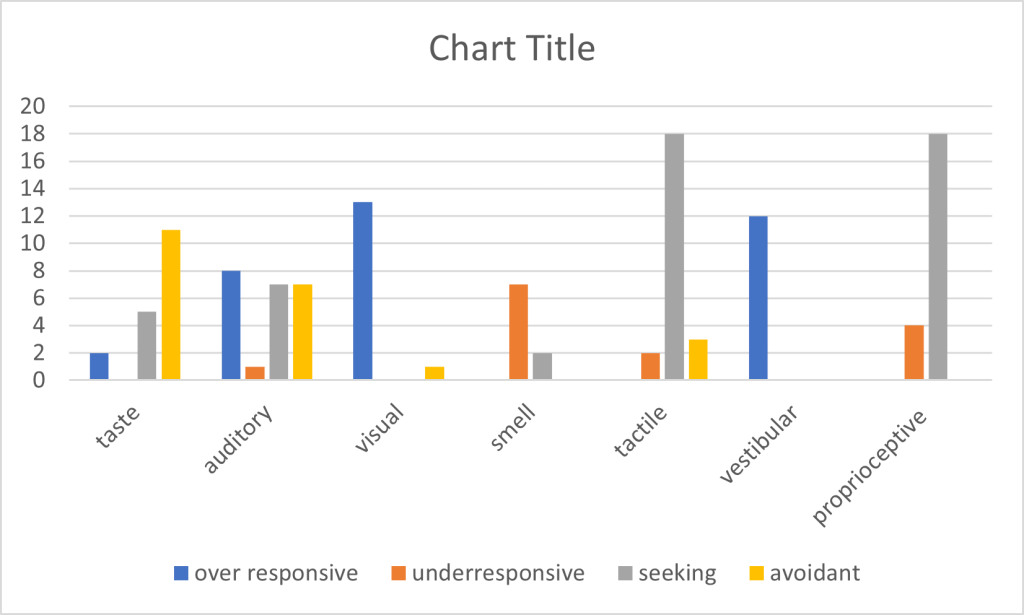
    As this shows, I’m over-responsive/avoidant in all my senses, except for smell (which is severely underresponsive for me), tactile and proprioceptive, where I tend to seek out sensory experiences.

    In my auditory sense, I seek out experiences that are under my control, and avoid sensory input that is not under my control – or easily experience overwhelm. My sense of taste is similar, but mostly I am avoidant.

    It seems I would benefit from learning how to be visually and vestibular avoidant, in particular. I’m not sure how to do this though.