Tag: bipolar

  • Working with my brain, not against.

    The first benefit of discovering PDA and realising it applied to me was finding I could finally work “with” my brain. Meaning I could approach life in a way that didn’t leave me fighting with myself every step of the way. Dissociating from demand anxiety. Beginning to learn not to fawn (still working on this). Advocating for myself. Taking demand free time.

    This is true for my other neurodivergences as well (neurodevelopmental or otherwise).

    With dyspraxia, I find it easier to make progress on a craft when I work on a repetitive project. In knitting that was my blanket squares, in crochet it’s doing rows of double crochet that will eventually become an infinity scarf. (See my latest instagram post!) This drills the basic steps into my procedural memory (“muscle memory”). I also try to only learn one new stitch at a time with new projects, or maybe just one new skill – like a joining technique.

    I also focus on physical activity I find easier to coordinate. I don’t worry about team sports where I tend to let the team down. In fact, I don’t tend to bother with competitive sport at all.

    With dyscalculia, long before my diagnosis (but well after my suspicions), I learnt stats procedures “in words”. That is, I learnt the concepts in verbal form, rather than running the formulas over and over. This isn’t as easy to apply to numeracy (it’s hard to write out the concepts of the procedure for calculating a percentage I find.) It helped that Cardiff University taught the procedural concepts thoroughly. This meant I was able to verbalise the steps of a formula, rather than just being given the procedure as formulas. I probably need to practice looking at a formula and breaking it down into it’s constituent verbal concepts.

    With ADHD, it’s things like K.C. Davis’s “five things cleaning”. I struggle to sequence my actions, and approaches like this finally make it possible for me to tidy my room. It can also mean making sure I get more physical activity as this slows down my mind.

    When it comes to bipolar, it’s about working to get enough sleep. Taking meds religiously. Watching for warning signs.. but also keeping enough factors that promote well-being in your life.

    It’s also about meeting your sensory needs. I now know I find visual input very over-stimulating for example. So I wear sunglasses on sunny days. I go to smaller supermarkets where there’s fewer products and aisles. I allow myself to eat in a way that meets my sensory needs and don’t apologise for it.

    And on top of that, it’s allowing myself to stim and fidget. I was forever told to “sit still”, “stop fidgeting” as a kid. Now I know it’s a neurological need, and I meet it.

    Knowing you’re neurodivergent really is more than half the battle.
  • Struggles and self care

    Recently I’ve been struggling a little. Not so much with mood, more with anxiety, chronic understimulation (and comparative overstimulation), insomnia, and resulting distress. I am worried that the insomnia in particular will eventually affect my mood. Me and my psychiatrist do have a planned med to add in if my mood does wobble. He’s not a fan of polypharmacy, so is choosing to keep to just lamotrigine for now.

    Why just lamotrigine? Clopixol injections became way too much for me. Partially because I found it more demanding than tablets, partially because travel is making me increasingly anxious. Mainly though, because I have a lot of medical trauma and injections were causing me increasing distress.

    The anxiety is caused largely by my loneliness. I guess I forgot to mention that earlier. I feel, though it’s likely not true, that I struggle more than the average autistic person with making and sustaining connections. This is based on seeing most Autistic people talk about their romantic partner, their handful of close friends, and suchlike. I have none of those. I’ve also met a handful of people recently, and just can not form a bond with them. Maybe it’s six of one, half a dozen of the other (literally, equally our faults). It’s hard not to feel, though, that it’s solely because of everything listed in my autism report that concluded with “another reason El will struggle to make and keep friends”.

    This anxiety centres on the worries that:

    • nothing about this will ever change
    • is it because there is something inherently wrong with me
    • how will I ever enjoy life or find meaning

    Finally, the chronic understimulation of spending all my time alone when I am at home. Additionally, much of my time outside the house is spent alone, aside from around 4 hours at the local community hub. I have a pet theory that this severe understimulation is leading to an intolerance to any level of increased stimulation that occurs, whilst also in itself deteriorating my situation. I am not sure though, certainly I don’t expect there to be any research out there that would confirm that this is a phenomenon.

    So the end result of this is that last night I ended up experiencing a lot of distress. I had spent my sunday in a new way: getting a taxi ride to spend time in the local costa and entertain myself around people. A taxi because there is no bus provision here on Sundays. Very expensive, and not just because of the taxis.

    Overstimulation in comparison to my norm, for one. Also seeing a lot of people in groups, heightened my loneliness. I then tried reaching out to the few internet connections I had, but struggled with feeling to negative. Mainly because people responded in a way that suggested that. I texted a helpline, which vaguely helped.

    In the end, at 10pm I called my mum and she helped me co-regulate. This made the rest of my night awake – yes, the full night till 6am – manageable. Still awful though. I had been awake since 3:30pm the previous day, and had burnt through my ‘try this now to pass time’ capacity. So I spent numerous hours doing nothing but feeling crappy.

    I can see that now as taking much needed low demand time. Not quite “demand free” because my emotions felt demanding. However, it also meant I managed to “sit with” my emotions. I can recognise both of these as self-caring responses. Eventually I felt able to start to do little things to pass the time, and became sleepy at 6am.

    My self-care has continued today. I spent some time with family, and as planned, my mum is here with me now sleeping over the night. I have taken some demand free time. I have tried to move my tiktok feed to a more positive one. I also spent about half an hour simply sitting and playing with my collection of stim toys. I often forget how important stimming is to ADHD and autistic nervous systems. I’ve also spent time journalling.

    So tonight is a lot more bearable, even if I am still awake at the wrong time.

  • Mood update

    Recently I’ve been feeling pretty terrible. My mood episode that started at the end of last year has settled into a pretty standard depressive episode.

    It’s not helped that I am so socially isolated, with little opportunity for addressing this. There’s nothing out there, where I am, for isolated 30 somethings to meet each other. I’m spending most of my time around people 20 – 30 years older than me! It’s not good for me at all, I need friends my own age.

    I’ve always struggled with interpersonal relationships though. This feeds into my “feeling terrible”, in particular “feeling terrible about myself”. I feel like I’m somehow defective that I can’t forge lasting connections with other people. It feels that my current circumstances are somehow a reflection on myself – that if I was someone else, I wouldn’t even find myself in this position.

    I’m also seriously doubting my ability to achieve anything in life, beyond living on benefits and just existing. I’m starting to feel that I will inevitably end up back in hospital in the not too distant future, and that this is what my life looks like going forward.

    There’s a lot of repair to do, evidently, from these last five years. Ever since lockdown was first announced, my life was turned upon its head. The stress has caused my mood disorder to worsen severely. Everything has been turbulent and unstable. It’s very hard to imagine any sense of stability could return, particularly after this latest episode.

    I have to hope that we find the right medication, at the right dose, that offers me quality of life without being life shortening. It’s very easy to feel that a life with bipolar is a life not worth living at the moment – everything I might have wanted, I barely have.

  • Equalising and wards

    Equalising is a commonly discussed term when it comes to PDA kiddos. I’m not sure though, that adults are entirely “above” doing so, when under enough stress.

    As in, for me, being on wards induces exactly this. There’s a known “us and them” effect on wards, especially NHS wards. Staff are the Us, patients are the Them. We, who are Well, Those who are Unwell.

    As a PDAer, I am effectively allergic to this entire environment. It’s so stressful. I can barely cope with hierarchy at the best of times, and definitely not completely arbitrary “we’re the Staff, you are the patients” attitudes. (This forms part of my personal thinking about PDA is that we seem to come in three stripes: eglatarian, communicator or negotiator, based on which of the criteria we have most strongly. This isn’t based on anything overly scientific, just a feeling I get from observing, interacting with, and being a PDAer. I might post more on this in the future – depending on what happens with demand avoidance!) I definitely really relate to descriptions around intolerance of authority and hierarchy – as a constant trait, compared to my demand avoidance which can actually fluctuate quite dramatically.

    As a result, these environments cause me to equalise. This can take a more benign form of addressing everyone in the place as a human who might be friendly, it can take the form of giving a staff member a screaming dressing down. It’s not fun, it does get me in trouble. It’s why I really need to make a big push now to stay out of psych wards, because well, they SUCK. They’re not a fit environment for any PDAer, no matter what mental health problems we have going on – far too overly restrictive. When you mix that with a poor mental state, everything goes haywire.

    This is a big reason I would say, if you know you do have severe mental health problems and suspect PDA: it is very worth saving for that specific modifier in your diagnosis. Unfortunately, the NHS is only willing to include a PDA modifier in children (in some trusts). My Dr Gloria Dura Vila diagnosis has changed my life as a person living with bipolar type 1. It means the wards know they need to add support in, and that I can justify that that support needs to work very differently than they might expect. It backs up my self-advocacy efforts, and that’s invaluable – otherwise who could understand an equalising adult?

    Equalising is not “good behaviour”, and I find the best thing I can do as an adult is seek out the environments that don’t provoke it. Living in my own place, in the community, with greater control over the environments I find myself in is a big part of this. For me that’s going to mean, complying with my clopixol injections and doing my best to thrive now. It’s been a rough few years, but here’s hoping I can head onwards and upwards now!

  • Limitations

    It goes without saying that life with disability, is a life lived with limitations. And I suppose also, it’s worth noting that that is every life lived, ever. No one is capable of every single thing ever.

    I’m struggling at the moment though, to accept the very real limits on my capacity, my chances, my opportunities – my ability to live my life as I would fully, authentically choose. I guess that’s part of being a PDAer, we don’t take well to having that taken from us. For me, my chronic pain and my bipolar (and my undiagnosed traumatic stress) really do take that autonomy from me.

    Hopefully over time I can go from strength to strength. Hopefully I can build a robust, and real, support network. Hopefully clopixol is as good a drug for me as I think it could be. Hopefully I can quit being a revolving door patient now we’re five years on from 2020.

    It’s all just “hopes” though. Progress is slow, and so uncertain. It’s so hard not to get lost in the “if only” and the anger. The grief. The rage at mental health teams that seriously let me down in my 20s. I first communicated my complex trauma at 22, at 34 I still do not actually have any trauma diagnosis – I find this frankly ridiculous. The closest I ever came was “it’s mild trauma, therefore BPD”… which just, uh, no. I’m angry that I had to spend thousands of pounds of savings to get a PDA modifier that was the only reason they ever changed their tunes, and started actually *listening* to me.

    What do you even do with that amount of anger? It’s only worthwhile if it’s used to channel towards something. I’ll always value fellow psychiatric survivors/patients/service users, of any stripe.

    On that note, I’mma quit rambling, and share one small thing I’m doing to try and help make a difference:

    El’s Feel Good Fundraise

    Raising money for mind is a small way I can channel myself, my experiences and my emotions right now – please, if you can, help me take a stand for those of us in society living with mental distress.

  • Advice for the teens

    Hi, you teeny terror tots

    • learn to accept deadlines as a way to channel your passions
      • whether that’s uni, starting a business, cleanliness, whatever: deadlines are a part of life. Don’t take them too seriously, because the only ultimate one is actual death, but still
    • learn to tidy AND learn to clean
      • Anyway you can, anyway how
      • These are the skills that truly prevent self-neglect
    • I bet you’re a better cook than I am!
      • If not, start out with baking
    • Embrace your own personal form of brilliance
    • Learn to use some form of AAC
      • A big part of PDA is the language aspect, and AAC helps all humans communicate
      • even if it’s just a ‘I’m ok, I’m NOT ok’ wristband – you’ll help all your interpersonal relationships
    • Learn to be ok with your own company, and learn when you’re getting too intense about one specific person
      • No one loves being the focus of a special interest/a favourite person – not even your partner
    • Forge your own paths, please: we’ve all got ways to shine.
    • Also; let’s teach this world the beauty of stimming, eh?
  • Second day of leave

    NOTE: THE CONTENT OF THIS POST IS ALTERED BY A BIPOLAR MOOD EPISODE, AND DIFFERS FROM MY USUAL POSTING STYLE

    Wow, life with bipolar and PDA is hard.

    Life with bipolar, PDA, chronic pain, scoliosis, chiari malformation, probable EDS?

    Yes. Very much a disabled adult here. At the time I was under the RNOH, EDS was considered “zebra” – looking for zebras, when you hear hoofbeats and not thinking “horse”.

    I dislocate far, far too easily. I have congenital scoliosis. I had a brilliant surgery on my spine at 20 years old, and as a result am around 1-3″ taller than I would have ever been (genuinely not sure, people guess my tallest to be around 5’2″, I was 4’11”?) Standing tall as I can, I’m now about 2cm taller than I was – 150cm.

    Dyscalculia, I’d guess that makes my full height 5’1″? Yeah who cares lol. Doesn’t matter – I’m teeeeeny. Suffice to say, I’m 34, and full of disability.

    My honest advice, on this time to talk day, is: ALWAYS keep an eye on mood disorder symptoms in your kids. Do not assume ‘oh this is rejection sensitive dysphoria’, ‘oh this is PDA’ ‘oh this is ADHD’ ‘oh this is teenager time’. All kids are at risk of depression at the very least, all kids are vulnerable to abuse – of any kind, from anyone – and honestly, psych wards are a last resort type of place, for people at risk of SELF-neglect.

    You don’t want your 19 year old in such a place, trust me, let alone your vulnerable 24 year old.

    You definitely don’t want your teenager in a CAMHS unit.

  • TW: SEXUAL ASSAULT

    Writing this after a trauma processing dream (not quite a nightmare thankfully)..

    One of the worst parts of mania is hypersexuality. You really want that type of activity at just the time you really can’t have it – because you’ve lost capacity.

    To put it bluntly, it’s not sex it’s rape.

    Do not have get sexual with a person who has not slept for 2 or more days. Especially do not if they’ve been awake for 4 or more: it is the same as if they were drunk, they CAN NOT consent.

    And quite frankly, at that point it’s obvious. At that length of time awake, anyone, bipolar or not will be clearly loopy.

    So yeah, mania is as traumatic as anything, and I’m left processing all of this.

  • Avoiding an ATU as a PDAer

    Ways NHS 111 have supported me:

    The moment I tell them ‘bear with me I’m autistic’ they do know how to alter their communication. If you’re lucky enough to have a diagnosis with a PDA modifier, they actually do have a degree of understanding of what that means.

    They will likely still be quite demanding to call – but if you are facing a dangerous crisis and don’t fancy heading to hospital, try and meet them. They take the “least restrictive option” and as in my case, can treat you in your own home.

    It’s best to lean on friends and family, but if it’s the middle of the night and things have *worsened*, call 111 every time something gets worse. Short of that, SHOUT is textcare, and there are multiple email support lines: saneline, samaritans being just a couple. There’s loads of suicidal crisis lines, papyrus, CALM, samaritans – but these need you to be actively suicidal. You can also contact the PDA Society helpline if you need PDA specific advice – but they are not a crisis line and will respond at a delay. The NAS also have webpages on where to turn in crisis – I would link but the website is currently down.

    Yes! All of this is demanding!

    BUT: all of this is better than any length of time in a psychiatric unit as a PDAer. They are restrictive, demanding beyond belief and very controlling. If you need to be in one, they’ll help – but if you can do any of this and stay at home, you’ll keep your control and autonomy.

  • Neurodivergent distress coping

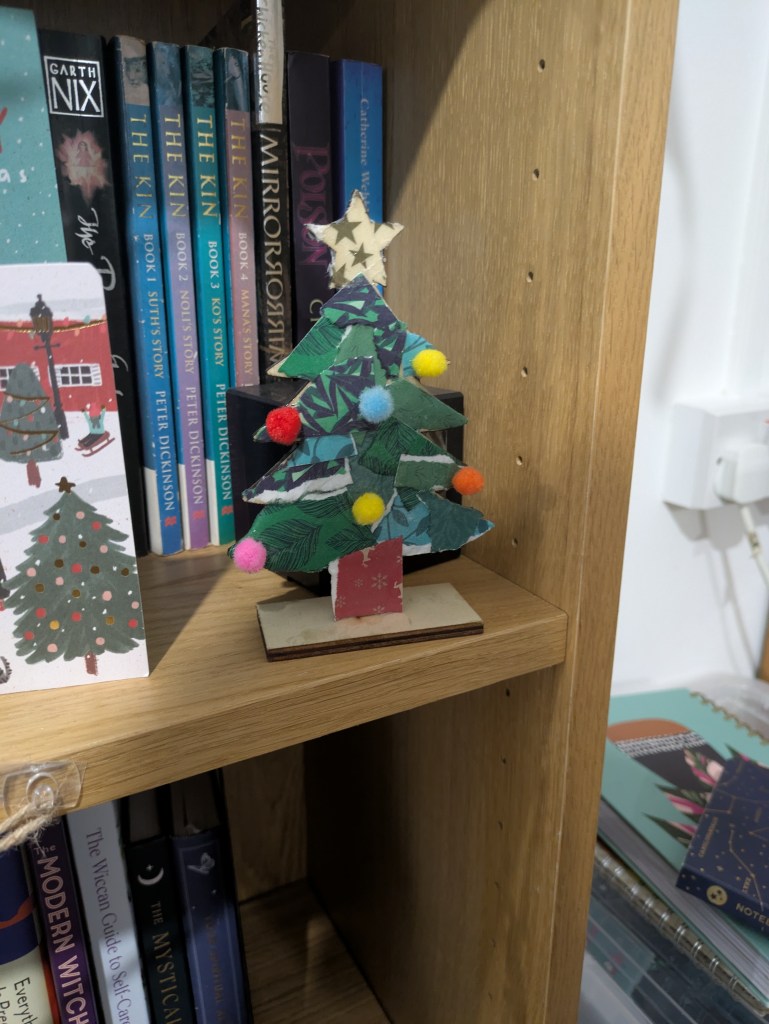
    I made this christmas tree decoration on a night I was really struggling:

    Now that’s not a brag. It was actually completely the wrong coping mechanism – it lead to my becoming so distressed I toppled my Christmas tree! No damage done, to me or the tree, so nevermind but still. Trees are not playthings!

    So I had to rethink the ways I was trying to cope: too much tv, crafting, distraction.

    What I needed:

    • stimming
    • sensory items like my weighted blanket
    • lava lamp
    • radio music
    • spotify music
    • taking a break from christmas
    • opposite action: opening some of my own presents that I’d bought for myself/one my mum got for me
    • radically accepting
    • a little clock for my kitchen so I could be aware that time is passing
    • engaging in special interests – and strewing them around the room for a low demand way to spark interest

    Using these methods has helped me work better with the home treatment team. With good communication about my being autistic and PDA with them, they did an excellent job of adapting their approach, and I’ve impressed a lot of them.

    You can cope with distress and crisis as a PDAer – you just need to work with your brain and not against it!