Tag: autism

  • sensory logging initial findings

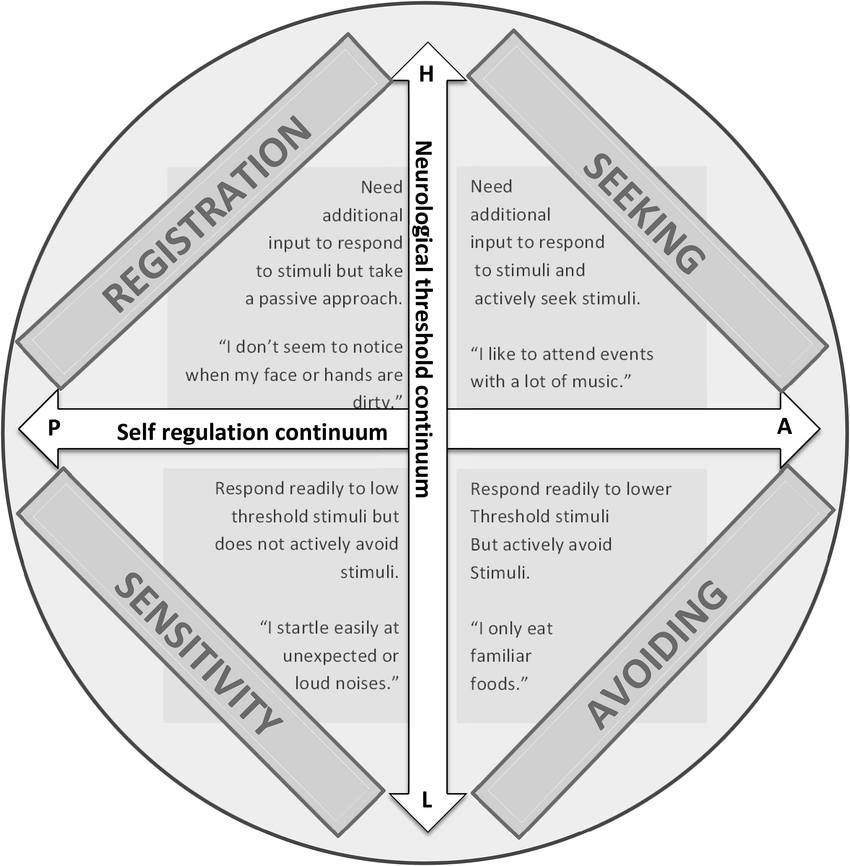
    What I’m noticing so far is that I’m a lot more either sensory sensitive, or low registration, than sensory seek or avoid. This seems inline with my therapist’s suggestion that if I’m those first two, and not actively using strategies to manage sensory input, then life becomes stressful and unenjoyable.

    We noticed that I hadn’t recorded much proprioceptive content. There were a few vestibular things I picked up on, such as being very nerve-y on stairs, struggling to balance, and swaying when sitting. The first of those, I had thought was linked to a trauma, but I suppose now it may not be. We also noticed a few items suggesting visual sensivity.

    Going forward, she’s encouraged me to focus on sense each day to capture more detail, and to hopefully with that focus notice more things involving that sense that happen each day.

  • Let me join in, in my own time

    This is something I wish everyone understood about me: that in group activities, please just let me sit and observe initially. Please don’t encourage, pressure, push or expect engagement. Usually, after a period of being allowed to do nothing but observe, the lack of expectation means I’ll get curious/bored and start to engage. It allows me the freedom of engaging on my own terms.

    An example of this working successfully happened on the ward in an OT session. Annie, the OT, had brought polymer clay for people to be creative with. My first response to this type of activity is always self-doubt, feeling whatever I create will be shit. I was so glad when she allowed me to just sit and watch.. which lead to feeling curious, and finding a simple design I thought was both cute and acheiveable. I still have my little polymer clay owl, and it’s special to me.

    Tonight was an example of the opposite to this. My supported housing is holding Christmas crafting sessions in the evenings on Thursdays and Fridays this month. Tonight was devoted to decorating the office space. Unfortunately, my friend and the support worker were very expressive in their expectation that I contribute rather than observe. Immediate demand anxiety ensued. It’s now some time later, and I’m left with low demand capacity even now. It’s interesting to note, having questioned in earlier posts, that I did feel the demand anxiety in response to external demands. I responded with half resistance, half fawning, and the knowledge that I need to communicate my need to be allowed to observe until I’m ready to staff. I’m really hoping that when I receive my report from Dr Gloria Dura Vila’s team, that it will really help them to understand PDA better.

  • Late diagnosis benefits

    I’ve been struggling recently to find life enjoyable. I thought this was because my life was lacking things I needed for fulfilment/satisfaction/contentment and that I needed to find things to add to my life. This was in spite of having a meaningful job, friends at my supported living scheme, meetup groups that I’ve started attending, Christmas to look forward to and secure housing.

    My therapist posited that this might mean it’s not that I need to add anything. Instead, she suggested that, it might be that the unconscious processes of managing demands, sensory needs, energy levels and stimulation levels might be so draining that’s what’s making life hard to enjoy. That was definitely something I hadn’t thought of, but seems worth considering. So, to begin addressing this, she suggested bringing these processes into conscious awareness. I’m starting with sensory needs, recording what I’m over and under responsive to each day. The aim is to move from passive self-regulation, to gaining more ways to actively self-regulate, either sensory seeking or avoiding.

    I’m really hoping that we’re onto something here. Struggling to enjoy life has been a long term problem historically, often only interrupted by the early stages of a manic episode, in which I can entertain myself with my own thoughts. I think in part it’s affected by my tendency to spend a lot of time in low moods. Unfortunately, I can’t take anti-depressants as they will induce a manic episode. Having not been aware of my neurodevelopmental differences for 30 plus years, I had had no way to consider the effects of demands, sensory input and under stimulation. This is where identification of these factors is invaluable, as I can now pay attention and take action directed at these specifically.

    For example, I’ve recently started making use of ear defenders in public. I love that these make me visibly autistic. It’s a neuroaffirming experience to be open and proud of my neurodivergencies, instead of ashamed, masking and feeling weird. Another accommodation we discussed was around meal times. I tend to avoid the fact that I’m eating whilst doing so, essentially dissociating from eating. As a result of our discussion, I gave myself permission to order some ready made Huel meal drinks. We also discussed blending meals, and drinking them rather than eating as a possible way to remove texture based sensory overwhelm.

    It’s so good to finally be able to identify, accept and meet my own needs.

  • Resources I found useful when learning about PDA

    I did a lot of research when discovering PDA in 2021 and there were a number of sources that had helpful information.

    Primarily amongst these was the pda society. I made a lot of use of their helpline throughout 2021, and would sincerely recommend their support to anyone struggling to understand or cope with PDA, adults PDAers included. Paula was very supportive and remembered my case after months of delay when I was too ill to be in contact with them, which I was very impressed with. The website is the first port of call for learning about the PDA profile with a wealth of information. This page is a great place to start learning, with a rundown of what exactly demand avoidance is.

    Facebook has a number of useful groups for PDAers, which I’ll list here:

    These groups are great places to find community and connect with fellow PDAers. I discovered that interacting with PDAers made me feel more understood and ‘at home’ than I had ever felt before.

    Harry Thompson was one of the first PDAers I learnt of. He’s written a lot on PDA, and maintains a facebook and instagram presence. Not everyone agrees with everything he says, he tends to aim to be a little controversial. Other PDAers that helped me learn were: Sally Cat, Tomlin Wilding, Kristy Forbes (great for parents), PrismCat and Riko. Having a range of perspectives is really beneficial, because PDA is a spectrum that presents a little differently in everyone. People have varying views on topics such as whether anxiety leads to demand avoidance, or just comes alongside it. PDA being so little understood, none of this has been pinned down exactly so there’s a lot of room for debate.

    Edited 8/3/23 I no longer recommend Harry Thompson as a resource.

  • When nowhere is safe

    I’ve mentioned a couple of times now that I tend to resort to ‘fawning’ in response to external demands from other people. What does that mean exactly?

    Harry Thompson offers a good explanation.

    In his post, he describes the situation where the child is safe at home to retain control through demand avoidance. That wasn’t my situation. My parents went to greater lengths to force compliance than my school did (and my primary school teachers went far enough), including the use of violence.

    As a result, I’m an adult PDAer who doesn’t feel like I now meet the criteria of being skilled in social approaches to avoid demands. These never worked for me as a child, every adult I was in contact with would force compliance through abusive methods. So now, I don’t feel like these social methods ‘work’, nor do I usually feel safe to attempt to demand avoid. Instead, I learnt to fawn for control in all situations.

    Edited 8/3/23: I no longer recommend Harry Thompson as a resource.

  • Realising I’m PDA part 1

    I had started working with a peer support provider, L, at https://www.chimetothrive.com/, hoping to get help with advocacy in the mental health system to get them to properly address my trauma symptoms. Unfortunately, due to my manic episode I didn’t manage to achieve this before L had to give up advocacy work, switching to solely peer support.

    What did come from my work with L was identifying my PDA autism. I had one session, and afterwards we both independently realised that neurodivergence was something that I needed to explore. I compiled a list of traits I felt I met, and she came back to me in the next session and said ‘yes I definitely felt that neurodivergence was something that was present when we met’ (or words to that effect, it’s been over a year).

    I was lucky enough to live with a speech and language therapist that worked in the field of autism diagnosis, and I discussed my suspicions with her. I noticed that the one area of autism I didn’t seem to meet was routines and need for sameness and this puzzled me. I find routine very constraining and restrictive. The thought of living days in the same pattern for a long time makes me feel trapped (I’m already struggling with the sameness of my days since starting work).

    I also noticed that I wasn’t typical in my use of imaginative play as a child, and that many people had felt that whilst yes, I lacked social skills, I couldn’t be autistic. I didn’t struggle that much. Except, I do because I meet the criteria for PDA, which includes superficial social skills. It also explains my comfortable use of imaginative and role play.

    The part I really related to was ‘intolerance of uncertainty’ and ‘anxiety driven need for control’. I’ve always known these things about myself. Feeling out of control is really not tolerable for me. Feeling uncertain about an outcome, or unable to control an outcome makes me very anxious. I like to be sure of things, and in control of myself and my surroundings.

    Perhaps oddly, the part I had to do some introspecting about was actually the obsessive avoidance of everyday demands. I’d learnt to fawn due to trauma. I also masked heavily. I believe I learnt to dissociate from my own experience of demand anxiety. I’ve actually noticed that since I clued into my demand anxiety, I’m experiencing a lot less depersonalisation and derealisation. I had to start to pay close attention when demands occured, and when as I did so, I noticed the initially subtle tension that demands on me induced. I realised that I definitely do experience demand anxiety. Since noticing it, it has sometimes become harder to meet demands, because the anxiety is aversive. I can more easily feel my nervous system saying No, and it’s hard not to listen.

    Unfortunately, due to stresses in my shared house and not being on bipolar medication, in the summer of 2021 I became psychotic. This created a lengthy pause in my exploration of my neurotype. L did write to the doctors of the first ward I was on to advocate around my PDA. I also advocated for myself, despite my manic state which I am quite proud of. L says that when I was manic I was perceiving demands in everything, which was making me very agitated and often angry. Certainly by the time I was on the ward, this was the case and I had some spectacular meltdowns.

    It was a year later that I received my official diagnosis, which I will talk more about in a later post.
  • Choice

    In a previous post, I asked ‘what does healthy look like for a PDAer?’

    My therapists opinion is that healthy looks like having choice. Freedom to choose to avoid or comply, rather than being ruled by nervous system activation and trauma responses.

    I suppose that means then, that it must always be an option to say no. There’s only true choice if you have the freedom to choose to refuse. I often don’t trust that there will be that freedom in interactions with other people, because so often growing up it was absolutely not an option. Perhaps practicing saying no more frequently would help me trust that I can do that.

    I wonder if I learnt to say ‘No’ more often, if it would help me choose to take on other demands in life as I’d feel more in control.

  • Therapy

    I’m lucky enough to have an autistic therapist, and it’s the most affirming thing I could imagine. I must have found her details a long time ago, they’d been lurking in my bookmarks for years until, during the process of understanding my PDA neurotype, I messaged therapists with a pretty strict set of requirements. Most baulked at them, but my current therapist understood completely and I knew she was the person I needed to be working with.

    She makes me feel ok to be me. Ok to be autistic, ADHD, PDA. Different. It’s so good to work with someone who doesn’t just affirm neurodiversity in the theoretical, but actually lives a neurodivergent life. Someone who understands what it’s like to be a little unidentified autistic kid, and the way that affects you as an adult.

    Something she shared recently really stuck with me: autistic distress doesn’t look like neurotypical distress and therefore it tends to go ignored. Adults believe the neurotypical kid in a dispute, doctors don’t realise how badly your past is affecting you as an adult.

    To me this feels like a small part in a larger bias against autistic people. I really struggled with this last year, before I was hospitalised – it was “autism awareness month” right at the beginning of my self-discovery journey which really didn’t help. It doesn’t feel to me that this world is very good at accepting autistic people as they are. Obviously, there’s things like ABA as an example of that.

    I think the reason I feel it so acutely is that when I was a kid, the adults around me did not like, let alone value, my autistic ADHD self. Compliance was forced, stimming and hyperactivity were stamped out of me, sensory issues were ignored. At primary school, I was ostracised and bullied, including by the teachers. Home wasn’t necessarily any better, or safer, and I learnt to mask constantly. I learnt, without even knowing, that who I actually was, was bad.

    So, I’m grateful to have a professional that sees me for who I am, and values that completely because she shares my autistic experience. Talking with her makes me feel so seen, as if for the first time. For an hour, I’m in a little bubble where we celebrate our autistic selves, whilst validating everything that can make autistic life so hard. If you can, find a therapist who shares your neurodivergence, it’s invaluable.

  • My demand cup

    ‘What is a demand cup?’ I hear you ask. If you’ll tolerate a link, the best explanation is here: https://tomlinwilding.com/the-demand-cup/. Tomlin’s website is an excellent resource for learning about PDA, I highly recommend checking out more than just that page.

    Right now my demand cup is recuperating from my time in hospital. It’s capacity is slowly expanding, but is still somewhat restricted. I’m finding it hard to have faith that it will expand large enough for me to be able to handle more everyday demands than I can at the moment.

    I have a lot more autonomy here at the supported living than I did at a mental health rehab ward I got referred to late last year. That experience made very clear that autonomy empties my demand cup, and lack of it fills it right up. The autonomy of doing work (SEN TA) that interests me really helps me meet the demands of that work.

    I’m also doing a lot better emotionally, which really helps as well. I could probably benefit from taking more defined demand free time; I remember the first time I purposefully took some, it was complete bliss.

  • Continued success

    In further ‘tidy only one thing’ success, my dining table has a lot more free space on it now.

    This rule isn’t freeing up enough demand capacity to get this entire tiny flat sorted, but just enough to do one small piece on my own. I’m still recovering my demand capacity after my hospitalisation from August 2021 to April 2021- having to only meet the demands of ‘sleep at night, take meds when asked, eat enough to not worry us’ actually really depleted my demand capacity. There’s a video on youtube of a young boy talking about his PDA who says that allowing himself to avoid a demand makes it harder to return to meeting it later. I would say this year was a big example of that.. I left hospital thoroughly painfully understimulated, but with so little demand capacity that it took about a month of just watching tv on my laptop to repair the understimulation and start repairing my demand capacity.

    It’s been 6 months now. In many ways I’ve come on leaps and bounds – I’ve started a teaching assistant apprenticeship at a local SEN school. So obviously I can now meet an awful lot more demands than 6 months ago! It doesn’t feel like a truly accurate reflection of my capacity though, because that work fits exactly my PDA flow. I’m working with autistic learners, I’m very interested in education and the autistic experience of it after my year spent learning about autism as I realised I was PDA.

    So is that work ‘demanding’? Arguably not.

    Outside of work, I’m still struggling.

    But for tonight, one small success.