Tag: adhd

  • Neurodiversity Acceptance Month 2

    Something from this weeks themes that stood out to me was “Explain how mental illness is neurodivergence and why that’s important to acknowledge.”

    Neurodivergence is a purposefully non-pathologising, non-medical model term for any brain that differs from the typical. This can be neurodevelopmentally (Autism, ADHD, dyslexia, dyscalculia etc), it can be acquired (traumatic brain injury), and it can be through mental illness. It isn’t about why we’re different, or how we came to be, what matters is that for some reason our brain diverges.

    From the creator of the term: https://twitter.com/UVGKassi/status/1306062363305615360

    A lot of the time I see the time used it’s in a neurodiversity-lite way, where the terms have been repurposed for the medical model, and then it’s limited to the neurodevelopmental. Unfortunately this seems to becoming the widely understood version.This sucks the power from the word, which should stand in opposition to models based around disorder and deficit.

  • Stimming

    I’m genuinely surprised I haven’t already written about this. I think one of the biggest parts of my mask was suppressing my stims (and hyperactivity) – in truth I am a wriggly, fidgety stimmy being. Forever drumming my fingers, bouncing my left leg, spinning a fidget spinner. Oh how I wish I’d had fidget spinners as a child!

    I’m not sure if I ever flapped my hands as a child. I started to when I was dating an Autistic woman who had this stim, before I even realised I was Autistic. I would apologise for copying her, but find joining in irresistible. If we’d known about the ways the PDA profile differs from non-PDA autism, I think I’d have gained a diagnosis much sooner (as it was, she said.. “you definitely have sensory processing issues, but you lack the rigidity I’d expect”). Nowadays I tend to shake my hands rather than flap them, as I find that more satisfying.

    Unfortunately, a cost of masking my stims as a kid was developing a skin picking stim. Everything else got me told off, but an actually self-injurious stim was apparently fine? I will never understand. Since I was eight, I have literally skin picked every single day of my life. It’s proven near impossible to stop. I had been making an effort to pre-hospital and I probably ought to try again. I do use multiple much healthier stims now as well, and I hope that’s building an armoury against this stim. It seems to be helping me use the self-injurious stim less, but not yet stop using it at all.

    I’m so glad I rediscovered the joy of stimming. It should be an Autist’s birthright.

  • Impatience

    I’m feeling a sense of diffuse impatience tonight. There’s nothing specifically I’m impatient for, which is a bit strange. It’s a general eagerness to start making progress on my goals. To start gaining research experience, to start making progress in working to better the lives of my fellow AuDHDers, PDAers, and wider neurodivergents. To get involved in Mad Pride campaigning. To find how I can support the lives of people who are more permanently non-speaking than I was.

    There’s a million and one dreams, hopes, ambitions and desires bubbling inside of me. It’s just knowing how to enact them in a real sense – and knowing that I have my limits and can only achieve so much. I need to work out what I’m best suited to, where my efforts will be most effective. I need to find out what opportunities there are for ‘making a difference’, or what opportunities I can create.

    It’s the effort of years and I am only just at the beginning. ADHD has always made me a very impatient person, and the days where there’s no progress to be made, that you just have to live through are always very frustrating to me. It’s so hard to not feel that they are a waste of time, even though during them I can make progress on the living skills that will support me through all the upcoming years of work. The fundamentals are not interesting, and my brain wants to skip over them to the good part. Basic skills like money management (fundamental if you want to start your own business, which is something about which I have little seedlings of ideas growing). Or the self-care that might help me look after myself and avoid burnout (or recover from it). None of that can afford to be neglected, even if it isn’t sexy.

  • The intersection of trauma, ADHD and autism

    For many years, the main intrusive traumatic stress symptom I had was rumination. Turns out, an ADHD mind can hyperfocus on trauma, as pointed out by my therapist. My brain will hyperfocus for months, if not years on end on the events and meaning of my trauma – because autistic brains look for the why, and the reason. Unlike allistic brains, finding an explanation really helps autistic people let something be and understand something. Most therapists have said ‘what’s the point, what does the ‘why’ change?’, my current therapist understands that it’s different for autistics.

    It’s not a good thing to hyperfocus on trauma. It becomes the only thing I can think and talk about, which overwhelms the people around me. It’s prevented me from studying properly, and is the main reason I couldn’t study at university. It becomes very literally all consuming.

    Thankfully, understanding my ADHD and PDA helps – it’s the rhyme and reason as to why adults in my life became so forceful and abusive. It’s absolutely not an excuse, but it is an explanation. That alone means my brain has far less to puzzle out and want to make sense of.

  • Neurokindred

    Something I really feel the lack of now I know more about my neurodivergences is the presence of neurokin in my life. When it comes to the bipolar, I have my neurokin there, one friend with bipolar, another with schizoaffective (and another with schizophrenia), and this feels so good. It’s good to have people who understand being hospitalised, or being psychotic and experiencing delusions. It’s also good that one of those friends is also autistic and ADHD, so I’m not completely alone.

    I’m going to an ADHD support group tomorrow night, so hopefully I will meet some more neurokin there. I also joined an online autism peer support group, which was a great experience earlier this month. I will blog about both of these in the near future.

    What feels particularly lacking is PDA neurokin. We’re not the most common of people, and often we like to interact online. Dannii at PDAourway often refers to her neurokin friends and it always induces a pang of longing for me.. to have numerous friends who are true neurokin, in being PDA and ADHD. It’d be good to have people in my life who truly understood the PDA experience, rather than who were learning about it.

  • Pomodoro stream

    Found another little thing that helped today, probably more so with ADHD avoidance and motivation issues than PDA. I think if my demand anxiety had been high, this wouldn’t have been so successful. I found a streamer on twitch doing pomodoros of 50 minutes followed by ten minute breaks. That’s longer than I can usually motivate myself to focus on something, but the body doubling effect of working alongside a streamer and her audience really helped.

    It definitely helps too to think of table tops and table legs (credit to Harry Thompson for that metaphor). When it comes to household care tasks, they’re the table leg towards the table top of eventually being considered independent enough to get a cat. I’ve come a long way on that goal, the main thing now is to learn to a. sustain the progress and b. keep on top of care tasks even during periods of blips. I’m no longer needing support sessions to achieve basic tidying care tasks, which I’m really proud of.

    Edited 8/3/23: I no longer recommend Harry Thompson as a resource.

  • Happy 2023!!

    It’s a new year, and for once, I’m excited for it. I’m also really happy with the year I’ve left behind. It didn’t have a great start, being sent back to the acute ward from the rehab ward (that is somewhere I would advise is not the right place for any PDAer.. you will not have enough autonomy on a ward to properly regain functioning. I’d definitely recommend supported housing over that), catching covid on that acute ward. I spent ten days isolating in a very understimulating room in January this year, and three months on an understimulating ward. The other problem with being on a ward for 9 months, was that on the acute ward there was next to no demands and as Isaac explains in this video, the longer you go without meeting demands the harder they become to meet.

    So when I was discharged in April last year, to this supported accommodation, I had a double sided problem. I was vastly understimulated – that degree of bored where it’s painful, but also completely out of demand capacity. I spent most of April and May just watching tv in my bed to recuperate (something that would never have been acceptable on the rehab ward, who wanted me to go from no demands on the acute ward, to cooking for myself, cleaning my bedroom, doing my laundry – basically immediately fully functioning). The tv provided just enough low demand stimulation to address one side of the problem, and over time I added in more and more demands. Eventually, I started spending time outside in the garden, which is where my friendships here blossomed. Over time, I started knitting blanket squares, which I am still working on at a very slow, undemanding rate, with the aim of eventually sewing them up into a massive blanket. I also started volunteering at a local charity shop, which provided me with work experience, socialising and something to do with my time.

    A highlight of 2022 that occured around this time was seeing Atypical Rainbow at the Turbine Theatre, near Battersea Power Station, for my 32nd birthday. It was a play about a young autistic actor, and his gay coming out, his experiences as a young boy, his families experience. It was deeply moving, and had me in tears by the end. I think it meant a lot to my mum as well, as she also strongly related to the experiences depicted.

    Not long after this I started my first job (finally well enough to work, this is a big new step for me!) at a local SEN school. I loved the kids, and helping them communicate was a big passion of mine. I learnt though, that I think I’d rather work with adult neurodivergents, in peer support, and also possibly in research into neurodivergence, particularly PDA. Unfortunately, this job had to come to an end in late November. For the end of the year, I’ve been rediscovering twitch streams, and having a very christmassy December. It’s been special, having my own place to decorate how I wanted for Christmas for the first time.

    Going into 2023, I have some worries (family medical issues), and some big hopes. I have four big goals for 2023 which I hope I can achieve. I would absolutely love if this year, I could:

    • return to university – planning on studying the open degree at the OU. This degree has a module where you use previous open educational resource courses towards the module, and I’ve been making a start on these.
    • learn to drive – planning on automatic lessons
    • find a new job – have already been applying, and attended one interview at the end of 2022
    • get involved with ‘survivor’ research in mental health and neurodivergence – to that end, I’ve had some mentorship with the Survivor Research Network, and joined some lived experience panels at Healthwatch and found out the details for my local hospital trusts lived experience panels.

    So clearly, in going on 9 months, I’ve regained a lot of capacity. I’ve also found a lot of things that fit within my personal PDA flow, or act as table legs to that table top. I’m excited for 2023, it’s been a good two hours so far lol, and I’m hopeful for some real wins this year.
  • Christmas Eve

    It’s officially the Christmas period here in the UK now. Today I’m planning on baking with a friend, tomorrow I head to my parents for The Day. It should be a nice, quiet, chill couple of days. My mum and I plan on knitting ornaments for a Christmas Day activity as last year we knitted a wreath and it made for a lovely day. It’s nice to have something to do other than food and presents. It feels like being a kid again, who got to play with presents on Christmas afternoon. (My spellcheck is insisting I capitalise christmas, and that makes me want to refuse!) I’ve found that adult christmasses lack that aspect that childhood christmasses had – most of the presents aren’t something you can interact with that day.

    This is much better christmas than last year. I live in my own flat, rather than on a ward, and that means I have a lot more autonomy. I’ve proved I can handle working, which is a big step this year. I’ve made new friends, and made stronger connections with old friends. I’ve been able to enjoy an advent, rather than just christmas day itself. It’s lovely. I realised a couple of weeks ago, this is my first normal christmas since 2019, and it’s really rather special.

    Merry Christmas to everyone who checks in here! And for any PDAers, far be it from me to order that you must have a merry christmas, have any kind of day you like at all tomorrow.

  • (untitled)

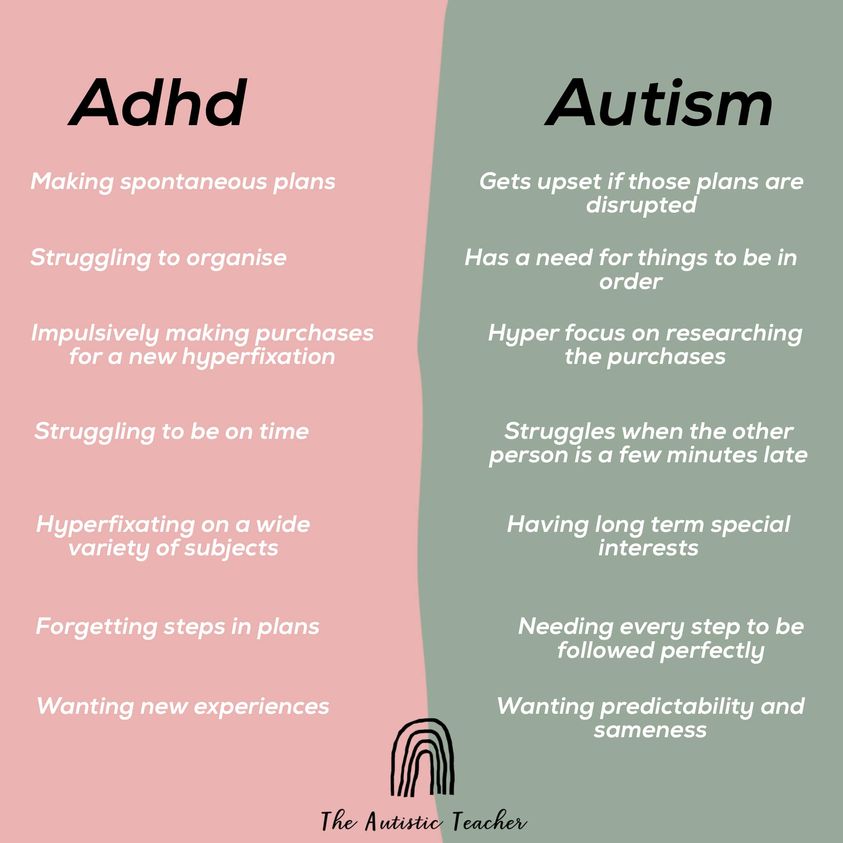
    Found this graphic on my facebook feed, from the page The Autistic Teacher. It made me consider which of the two sides I fall on for each item:

    • Probably more likely to get upset if plans disrupted, especially as a child. Might occasionally make spontaneous plans, I’d need to mindfully observe myself to work this out
    • Struggle to organise, definitely
    • Impulsively spend!
    • Struggles when others are late (and likely to be early to compensate for bad time keeping)
    • Both: usually i’ll have a special interest I spend time almost casually engaging it, it’s very easy, it’s a low effort thing to spend time on. I’ll also have a range of hobbies that take effort to engage in, but that I can get fixated on
    • Forgetting steps in plans is more likely for me
    • Wanting new experiences, I love novelty.
  • Diagnostic report received

    After three months of waiting, I finally received my diagnostic report! It noted that my demand avoidance was ‘marked’ and causing ‘significant impact on my life’ which.. woah. I did not realise that it was that obvious and the impact so clear. Apparently the assessor had to make significant adjustments to the assessment process for me to be able to complete it, which I hadn’t noticed. It’s interesting that even though I feel as an adult, I fawn and mask, to a trained assessor my need for control was evident.

    It didn’t clearly state which subtype of ADHD I have, but did make references to both inattention and hyperactivity, so I assume it’s considered combined type. At the very least, I was right to identify hyperactivity in myself, as well as manic high energy – those two can be so difficult to distinguish! It didn’t help that during my last manic episode, I was exploring ADHD and explained manic high energy as ADHD. I will need to be careful to distinguish between the two in the future. Possibly noticing an increase in hyperactivity symptoms is a sign of hypomania for myself.