Category: therapy and trauma

  • relationship anarchy and being gentle with my selves

    I need alternative relationships – I’m demiromantic, for a start. We’ve been talking about the concept of relationship anarchy and all interpersonal relationships in a persons life being (close to) equal.

    For me, I would prioritise a queerplatonic (QPR) or romantic partner, but all my other relationships are equal. Family is not more important than friends for example. Discussing this helps me learn how to make these kind of approaches work healthily. I want to structure my social network that only those who can cope with being equal to everyone else remain in the network, over time, but first I need to build a stronger network in line with that principle.

    I’d hope to find a QPR or romantic partner, but that can come with time.

    I wanted to share a resource that was shared as part of the discussion: https://robynlposin.com/being-gentle-with-our-selves. It’s important to allow ourselves to be very gentle with ourselves in life, and to avoid what we need to avoid. Particularly for me, being gentle with ‘my selves’ is an important concept. I don’t want to push my inner child too hard, and I want to learn to work with my inner critic for example.

  • Stimming

    I’m genuinely surprised I haven’t already written about this. I think one of the biggest parts of my mask was suppressing my stims (and hyperactivity) – in truth I am a wriggly, fidgety stimmy being. Forever drumming my fingers, bouncing my left leg, spinning a fidget spinner. Oh how I wish I’d had fidget spinners as a child!

    I’m not sure if I ever flapped my hands as a child. I started to when I was dating an Autistic woman who had this stim, before I even realised I was Autistic. I would apologise for copying her, but find joining in irresistible. If we’d known about the ways the PDA profile differs from non-PDA autism, I think I’d have gained a diagnosis much sooner (as it was, she said.. “you definitely have sensory processing issues, but you lack the rigidity I’d expect”). Nowadays I tend to shake my hands rather than flap them, as I find that more satisfying.

    Unfortunately, a cost of masking my stims as a kid was developing a skin picking stim. Everything else got me told off, but an actually self-injurious stim was apparently fine? I will never understand. Since I was eight, I have literally skin picked every single day of my life. It’s proven near impossible to stop. I had been making an effort to pre-hospital and I probably ought to try again. I do use multiple much healthier stims now as well, and I hope that’s building an armoury against this stim. It seems to be helping me use the self-injurious stim less, but not yet stop using it at all.

    I’m so glad I rediscovered the joy of stimming. It should be an Autist’s birthright.

  • The intersection of trauma, ADHD and autism

    For many years, the main intrusive traumatic stress symptom I had was rumination. Turns out, an ADHD mind can hyperfocus on trauma, as pointed out by my therapist. My brain will hyperfocus for months, if not years on end on the events and meaning of my trauma – because autistic brains look for the why, and the reason. Unlike allistic brains, finding an explanation really helps autistic people let something be and understand something. Most therapists have said ‘what’s the point, what does the ‘why’ change?’, my current therapist understands that it’s different for autistics.

    It’s not a good thing to hyperfocus on trauma. It becomes the only thing I can think and talk about, which overwhelms the people around me. It’s prevented me from studying properly, and is the main reason I couldn’t study at university. It becomes very literally all consuming.

    Thankfully, understanding my ADHD and PDA helps – it’s the rhyme and reason as to why adults in my life became so forceful and abusive. It’s absolutely not an excuse, but it is an explanation. That alone means my brain has far less to puzzle out and want to make sense of.

  • sensory logging initial findings

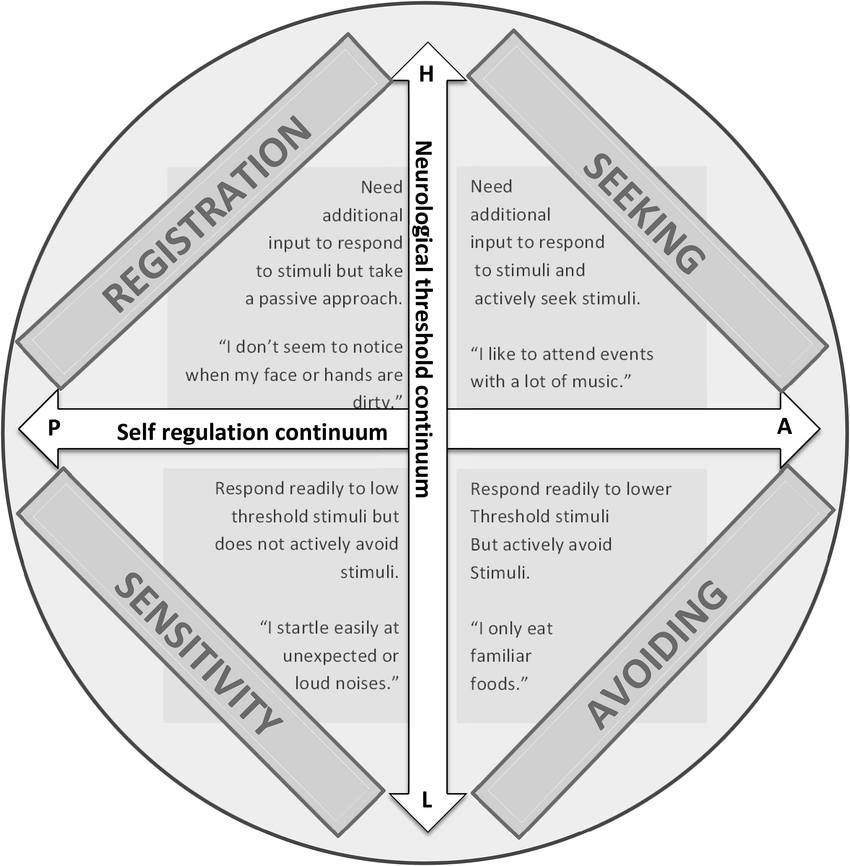
    What I’m noticing so far is that I’m a lot more either sensory sensitive, or low registration, than sensory seek or avoid. This seems inline with my therapist’s suggestion that if I’m those first two, and not actively using strategies to manage sensory input, then life becomes stressful and unenjoyable.

    We noticed that I hadn’t recorded much proprioceptive content. There were a few vestibular things I picked up on, such as being very nerve-y on stairs, struggling to balance, and swaying when sitting. The first of those, I had thought was linked to a trauma, but I suppose now it may not be. We also noticed a few items suggesting visual sensivity.

    Going forward, she’s encouraged me to focus on sense each day to capture more detail, and to hopefully with that focus notice more things involving that sense that happen each day.

  • (untitled)

    Right now I hate being a PDAer.

    My knee dislocated yesterday. Immediately went back into place, but not without agony.

    It’s possible I have a hypermobility condition and I definitely hate that. Can’t cope that this is likely to not be the last time this happens.

    PDAers are known for having intense mood swings. My mood has tanked today. I’m irritable, hostile, angry, tearful.

    My mood, as I’ve said before has been low recently. I’ve been struggling to find enjoyment in life, and worst still, identify when I’ve ever enjoyed life. It’s not a lie to say that every season of my life has been traumatic in it’s own way. A doctor on the first psych ward I was on identified my autistic traits.. and thought I had dysthymia alongside bipolar. I wonder if he might have been on to something. When I’m not manic, I’m low. I don’t really do ‘normal’.

    So today feels like a double whammy of mood disorders and PDA mood swing.

    I feel like no one likes the unmasked me. The intense moods. The demand avoiding. The very real lack of pleasure I experience in life. The verbal hyperactivity. The anxiety.

    I feel like a problem. I feel like time and time again I cause problems.

  • Notes from therapy

    I’ve been worrying for a while that I might be a ‘failure’ at my supported living, in that because I’m PDA as well as mentally ill (it’s mental health supported living), the staff won’t be able to support me to eventually live independently. Most people, when I bring this up, tell me that it’s a process and I’ll make progress over time. To have more self-belief that I can achieve this.

    Unsurprisingly, the person who understood the reason for my worry was my therapist. She understands how disabling PDA, autism and ADHD can be, and said it’s possible I may not be able to. She also stated that being unable to live independently is not a failing. At one point, she praised me for thinking about the future and I said most people tell me to stop trying to think so far into the future. I love that she knows that as an autistic person, I want some sense of certainty and predictability, so I will naturally try and plan the future so I can feel safe.

    We also discussed ways to try and meet independent living tasks. She suggested maybe deadlines would help, or maybe I need someone to say ‘this needs doing Now’. We considered entering tasks in a diary to see if they would create a deadline that helps, or if they create demands that hinder.

    I need to explore further whether using others for prompts is relying on not feeling safe to avoid demands from other people, and whether this is relying on a trauma response. I do agree with my therapist, healthy lies in choice – to comply, or avoid. PDA avoidance isn’t a choice, it’s a threat response generated by the neurotype. My response to demands of complying also does not feel like a choice, it feels like the The Only Safe Option, and it would be nice to feel safe enough to avoid. I suppose though, this should be being able to avoid as a choice.

    I talked about how since discovering PDA I worked on feeling safe enough to actually feel demand anxiety. Taking some time when faced with a demand and being curious about how it made me feel, gently, and discovering that yes, it’s stressful, there’s anxiety. I do wonder though, after the session, if I’m not feeling safe enough to feel demand anxiety in response to demands from other people. I think it might do me good to work on sensing the demand anxiety that arises during interactions, and creating safety to have choices, including the choice to avoid.

  • When nowhere is safe

    I’ve mentioned a couple of times now that I tend to resort to ‘fawning’ in response to external demands from other people. What does that mean exactly?

    Harry Thompson offers a good explanation.

    In his post, he describes the situation where the child is safe at home to retain control through demand avoidance. That wasn’t my situation. My parents went to greater lengths to force compliance than my school did (and my primary school teachers went far enough), including the use of violence.

    As a result, I’m an adult PDAer who doesn’t feel like I now meet the criteria of being skilled in social approaches to avoid demands. These never worked for me as a child, every adult I was in contact with would force compliance through abusive methods. So now, I don’t feel like these social methods ‘work’, nor do I usually feel safe to attempt to demand avoid. Instead, I learnt to fawn for control in all situations.

    Edited 8/3/23: I no longer recommend Harry Thompson as a resource.

  • Choice

    In a previous post, I asked ‘what does healthy look like for a PDAer?’

    My therapists opinion is that healthy looks like having choice. Freedom to choose to avoid or comply, rather than being ruled by nervous system activation and trauma responses.

    I suppose that means then, that it must always be an option to say no. There’s only true choice if you have the freedom to choose to refuse. I often don’t trust that there will be that freedom in interactions with other people, because so often growing up it was absolutely not an option. Perhaps practicing saying no more frequently would help me trust that I can do that.

    I wonder if I learnt to say ‘No’ more often, if it would help me choose to take on other demands in life as I’d feel more in control.

  • Therapy

    I’m lucky enough to have an autistic therapist, and it’s the most affirming thing I could imagine. I must have found her details a long time ago, they’d been lurking in my bookmarks for years until, during the process of understanding my PDA neurotype, I messaged therapists with a pretty strict set of requirements. Most baulked at them, but my current therapist understood completely and I knew she was the person I needed to be working with.

    She makes me feel ok to be me. Ok to be autistic, ADHD, PDA. Different. It’s so good to work with someone who doesn’t just affirm neurodiversity in the theoretical, but actually lives a neurodivergent life. Someone who understands what it’s like to be a little unidentified autistic kid, and the way that affects you as an adult.

    Something she shared recently really stuck with me: autistic distress doesn’t look like neurotypical distress and therefore it tends to go ignored. Adults believe the neurotypical kid in a dispute, doctors don’t realise how badly your past is affecting you as an adult.

    To me this feels like a small part in a larger bias against autistic people. I really struggled with this last year, before I was hospitalised – it was “autism awareness month” right at the beginning of my self-discovery journey which really didn’t help. It doesn’t feel to me that this world is very good at accepting autistic people as they are. Obviously, there’s things like ABA as an example of that.

    I think the reason I feel it so acutely is that when I was a kid, the adults around me did not like, let alone value, my autistic ADHD self. Compliance was forced, stimming and hyperactivity were stamped out of me, sensory issues were ignored. At primary school, I was ostracised and bullied, including by the teachers. Home wasn’t necessarily any better, or safer, and I learnt to mask constantly. I learnt, without even knowing, that who I actually was, was bad.

    So, I’m grateful to have a professional that sees me for who I am, and values that completely because she shares my autistic experience. Talking with her makes me feel so seen, as if for the first time. For an hour, I’m in a little bubble where we celebrate our autistic selves, whilst validating everything that can make autistic life so hard. If you can, find a therapist who shares your neurodivergence, it’s invaluable.