Category: therapy and trauma

  • Advice for the teens

    Hi, you teeny terror tots

    • learn to accept deadlines as a way to channel your passions
      • whether that’s uni, starting a business, cleanliness, whatever: deadlines are a part of life. Don’t take them too seriously, because the only ultimate one is actual death, but still
    • learn to tidy AND learn to clean
      • Anyway you can, anyway how
      • These are the skills that truly prevent self-neglect
    • I bet you’re a better cook than I am!
      • If not, start out with baking
    • Embrace your own personal form of brilliance
    • Learn to use some form of AAC
      • A big part of PDA is the language aspect, and AAC helps all humans communicate
      • even if it’s just a ‘I’m ok, I’m NOT ok’ wristband – you’ll help all your interpersonal relationships
    • Learn to be ok with your own company, and learn when you’re getting too intense about one specific person
      • No one loves being the focus of a special interest/a favourite person – not even your partner
    • Forge your own paths, please: we’ve all got ways to shine.
    • Also; let’s teach this world the beauty of stimming, eh?
  • Second day of leave

    NOTE: THE CONTENT OF THIS POST IS ALTERED BY A BIPOLAR MOOD EPISODE, AND DIFFERS FROM MY USUAL POSTING STYLE

    Wow, life with bipolar and PDA is hard.

    Life with bipolar, PDA, chronic pain, scoliosis, chiari malformation, probable EDS?

    Yes. Very much a disabled adult here. At the time I was under the RNOH, EDS was considered “zebra” – looking for zebras, when you hear hoofbeats and not thinking “horse”.

    I dislocate far, far too easily. I have congenital scoliosis. I had a brilliant surgery on my spine at 20 years old, and as a result am around 1-3″ taller than I would have ever been (genuinely not sure, people guess my tallest to be around 5’2″, I was 4’11”?) Standing tall as I can, I’m now about 2cm taller than I was – 150cm.

    Dyscalculia, I’d guess that makes my full height 5’1″? Yeah who cares lol. Doesn’t matter – I’m teeeeeny. Suffice to say, I’m 34, and full of disability.

    My honest advice, on this time to talk day, is: ALWAYS keep an eye on mood disorder symptoms in your kids. Do not assume ‘oh this is rejection sensitive dysphoria’, ‘oh this is PDA’ ‘oh this is ADHD’ ‘oh this is teenager time’. All kids are at risk of depression at the very least, all kids are vulnerable to abuse – of any kind, from anyone – and honestly, psych wards are a last resort type of place, for people at risk of SELF-neglect.

    You don’t want your 19 year old in such a place, trust me, let alone your vulnerable 24 year old.

    You definitely don’t want your teenager in a CAMHS unit.

  • Choice: an update

    I wrote this on November 1st 2022:

    In a previous post, I asked ‘what does healthy look like for a PDAer?’

    My therapists opinion is that healthy looks like having choice. Freedom to choose to avoid or comply, rather than being ruled by nervous system activation and trauma responses.

    I suppose that means then, that it must always be an option to say no. There’s only true choice if you have the freedom to choose to refuse. I often don’t trust that there will be that freedom in interactions with other people, because so often growing up it was absolutely not an option. Perhaps practicing saying no more frequently would help me trust that I can do that.

    I wonder if I learnt to say ‘No’ more often, if it would help me choose to take on other demands in life as I’d feel more in control.

    Two years on, I’ve made a lot of progress with this. I still find people don’t always listen to a no, but I do make an effort to say it more often. I also use AAC (augmentative, alternative communication) cards on a sunflower lanyard, and my PDA flipchart to explain my drive to avoid.

    The biggest difference I’ve noticed however, is in my avoidance of obligations. I can now ask myself “do I choose to avoid or to do this task?” and that makes a big difference, because often I’ll say: “yes I choose to do so!”

    But not always. Sometimes I say “no I choose to not do this” and allow myself to choose avoidance. I find this offers the most autonomy – being driven to always avoid is not autonomy nor control: it’s being reactive to our surroundings, always.

  • TW: SEXUAL ASSAULT

    Writing this after a trauma processing dream (not quite a nightmare thankfully)..

    One of the worst parts of mania is hypersexuality. You really want that type of activity at just the time you really can’t have it – because you’ve lost capacity.

    To put it bluntly, it’s not sex it’s rape.

    Do not have get sexual with a person who has not slept for 2 or more days. Especially do not if they’ve been awake for 4 or more: it is the same as if they were drunk, they CAN NOT consent.

    And quite frankly, at that point it’s obvious. At that length of time awake, anyone, bipolar or not will be clearly loopy.

    So yeah, mania is as traumatic as anything, and I’m left processing all of this.

  • Human needs

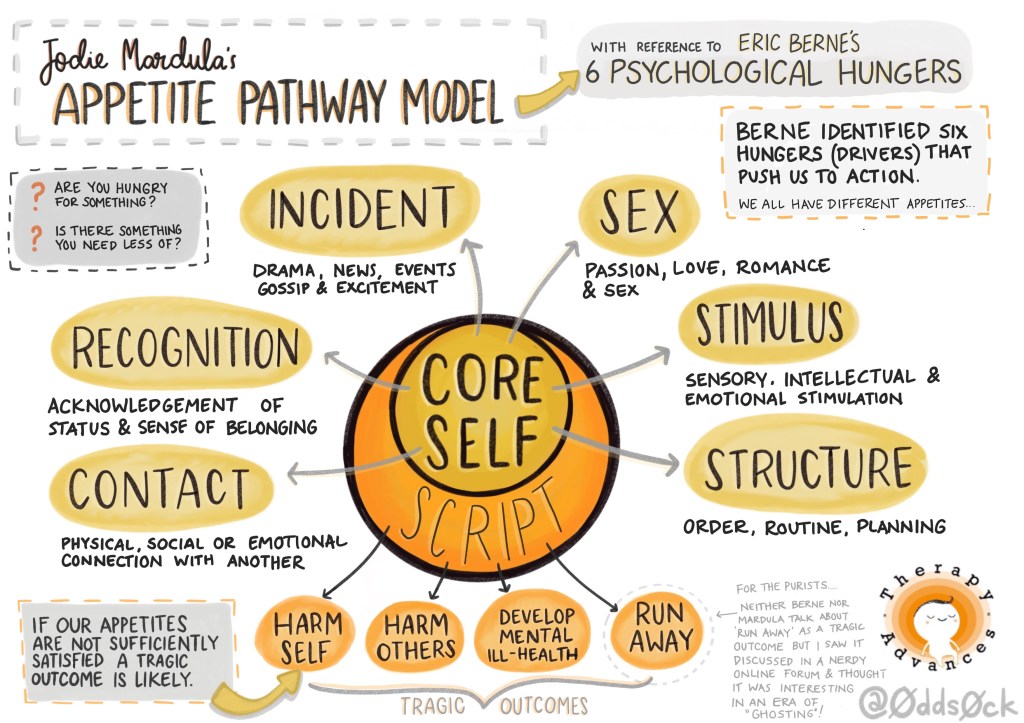
    This is an image from my therapists practice (that she comissioned). It shows the 6 types of needs that people have: contact, recognition, incident, sex, stimulus, and structure.

    For me, I find I have a high need for variety, intellectual and interpersonal stimulation (and nervous system stimulation), and an extremely high need for contact.

    Recognition, merely being recognised does not help my loneliness at all. Similarly, incident simply stresses me out.

    Where do you think you might stand?

  • responsibility update

    Still hitting the mark on responsible (apart from one or two minor wobbles). I saw the section 12 drs and aced it! So now I have all the meds I actually need and I feel calm and sleepy.

    Just managed a basic dinner, so that’s food in me.

    I’m doing pretty good!

  • Emotional flashback.. again

    I’ve been super anxious recently. My antipsychotic depot’s cause this each time so far outside of hospital, for Trauma Reasons. This weeks was better, in that I didn’t get a week of intrusion symptoms, but I did get nightmares the night before.

    I was also extra-sensitive to loneliness. I’m not entirely sure why that’s what came up. I suppose it might have been an emotional flashback. The feeling: all alone in a hostile space, post trauma.

    I emailed the PDA society, my therapist and SANEline, all of which have been good sources of support for me in the past. I also tried nightline for an immediate response, which has historically been the best helpline I’ve used (it’s by students, for students, term time in the UK). It wasn’t so helpful this time, and I should have ended the webchat much sooner – it amounted to a degree of emotional self-harm that night.

    Thankfully the email responses were a lot stronger. The PDA Society supporter urged me not to give up hope of making connections, though they edged on advising learning to mask better which I’m not 100% on board with. They talked about working with a professional and trusted family member/friend to work on mastering ‘social do’s and don’ts’. I can see some use for that, but it’d be nice to get advice on ‘here’s how PDAers meet people they can be themselves with’. I do appreciate them being able to supply recommendations for professionals that can support.

    SANEline suggested hobby groups, and offered questions for further thought. I still need to respond, it’s likely to be a validating discussion. That’s what I find SANEline are most useful for when I talk to them.

    My therapist had the best response, which is perhaps unsurprising given she knows me as an individual. She stated that perhaps humans are not the most reliable source of connection. As such, she suggested that maybe I need to spend some time at a Cat cafe to get some oxytocin. She also reminded me that I can brainspot in my own time to strengthen my brains awareness of my good qualities.

    So I put that into place after my depot injection. Headed straight to the local cat cafe. A kitty prompted clambered straight onto me and wanted to be held for hours. Definite oxytocin hit!

    Following that, I went to the local MH hub to talk to some humans that understand. Had a couple of in depth chats, some light hearted chatting, did a tiny bit of studying. As my therapist predicted, it wasn’t as secure a source of connection – but it was still valuable.

    Then, tonight I had too much demand anxiety to sleep. So, I put on my lava lamp for the first time since being here and chilled out. Over the time I: read my queer fantasy book, read up on developmental psychology to prepare for research assistant volunteering, used Finchcare, and sat and watched the lava lamp to the sound of a fire-scape video on youtube.

    That last activity made me fixate my gaze on the lava lamp, and I began to notice feeling unusually soothed. Gaze fixation is a big part of brainspotting, so I checked if there was another location where that sense of soothing increased. There wasn’t – at the angle I was sat at, my lava lamp seems to fall in my “soothe spot”. I tried it again later in a different room, and yup it’s the spot.

    So I haven’t done the exact brainspotting my therapist recommended, oddly enough – but I have done that! I also did the “injection trauma” spot before leaving my flat to get the depot injection, which does seem to help me cope.

    Now I’ve written it all out, it’s clear to me that was another layer of emotional flashback caused by depot injection. A shorter one this time. I attribute that to the process of brainspotting I’ve started on this trauma. It’s good to now have a brainspot I can use to soothe my way out of emotional flashbacks/help me through them till they end. It’s a reminder that there’s a good reason to meet the demand my therapist gave me to strengthen the neural re-wiring in my own time.

  • Brainspotting…

    …works wonders!

    I’ve been working with an Autistic/ADHD/Dyspraxic/Dyslexic therapist recently, who has a PDA kid on trauma therapy. The modality she uses with PDAers is brainspotting, which is a variant on EMDR. Personally I think it could be called ESDR or EFDR, eye stillness/fixation de-sensitisation and reprocessing therapy. It works on bilateral stimulation, focusing on bodily sensation and rating it (which makes it a somatic therapy) – I tend to picture my bodily sensations as colours – and eye fixations. During this, you think about or visualise either a positive resource, or your trauma, either increasing or decreasing the feeling respectively.

    Tbis therapy (along with lamotrigine) has helped my life hugely. I have a lot more faith in the universe, and feel more comfortable with spirituality. I will post more about this shortly. I feel able to experience enjoyment, and trust in myself. I feel better able to self-advocate, have better self esteem, and better internal communication.

    I won’t say ‘I recommend this’, all I can say is how much this has helped me. It’s really starting to turn my life around. I finally feel like there was a point to surviving.

  • Magickal evening

    This is officially the best ward I’ve ever been on.

    I got granted, along with another more well patient, the chance to go outside late at night – much later than we are usually allowed outside – to view the northern lights.

    Unfortunately, afaik, my phone was unable to pick up on the lights due to it’s make – but I saw the faint, very subtle red and grey swirls, stripes, flickers, and whorls. That’s a lot more meaningful to me – google and TV are full of the vibrant images that cameras pick up.

    I’ve wanted to see the Aurora Borealis since I was a little kid. As I’ve mentioned before on my blog, His Dark Materials pulled me through a lot of trauma as an 8 year old. I really related to Lyra – who displays strong PDA characteristics to my mind! – and the help she was provided by caring adults when that was lacking for me really helped me cope.

    So seeing them today, in the south of England, really made me very emotional. I’d thought I’d have to go on an expensive holiday and might never get to see them, and tonight changed all that!

    The moon was glowing down as a crescent, perhaps there was some magick afoot.

    Photo by Tobias Bjørkli on Pexels.com
  • PDA and dental care

    As a kid and teenager, I was prompted to brush my teeth regularly by my parents, who’d get very involved in the process. Unfortunately, when I reached 17/18 they abruptly stopped this, saying I was old enough now to manage this for myself.

    My PDA t0ok this as an opportunity to be avoidant. I would have benefitted from a much more gradated approach to being in charge of my own teethcare. It didn’t help that my parents had set the expectation that adults use adult toothpaste, which is a sensory hell for me, far too strong a flavour. Instead of being able to continue on with the habit, it turns out it was in no way a habit for me to brush my teeth, and I neglected to do so for about ten years. This was not helped by my worsening mental health, and ADHD, which both likely also contributed to this self-neglect for so long.

    Now, unfortunately, thanks to this, my gums are in a very bad way. I need to see a dentist soon because it’s gotten so bad. I’ve had quite a few bad experiences with outpatient procedures, including dental, because I don’t seem to respond well to local anaesthetic, in that it doesn’t cause me to go particularly numb – I can usually feel the entirety of the procedure, including all the pain.

    As a result, booking to see a dentist was very terrifying for me. I had a panic attack, cried and ended up very depersonalised (a form of dissociation in which your own person/body does not feel real to you). Thankfully I did manage to not be avoidant – more in terms of trauma avoidance here – and did book the dentist appointment. That was mainly because staff here at my hospital will be able to attend with me, otherwise I probably would have avoided seeing a dentist.