Category: stimming

  • Working with my brain, not against.

    The first benefit of discovering PDA and realising it applied to me was finding I could finally work “with” my brain. Meaning I could approach life in a way that didn’t leave me fighting with myself every step of the way. Dissociating from demand anxiety. Beginning to learn not to fawn (still working on this). Advocating for myself. Taking demand free time.

    This is true for my other neurodivergences as well (neurodevelopmental or otherwise).

    With dyspraxia, I find it easier to make progress on a craft when I work on a repetitive project. In knitting that was my blanket squares, in crochet it’s doing rows of double crochet that will eventually become an infinity scarf. (See my latest instagram post!) This drills the basic steps into my procedural memory (“muscle memory”). I also try to only learn one new stitch at a time with new projects, or maybe just one new skill – like a joining technique.

    I also focus on physical activity I find easier to coordinate. I don’t worry about team sports where I tend to let the team down. In fact, I don’t tend to bother with competitive sport at all.

    With dyscalculia, long before my diagnosis (but well after my suspicions), I learnt stats procedures “in words”. That is, I learnt the concepts in verbal form, rather than running the formulas over and over. This isn’t as easy to apply to numeracy (it’s hard to write out the concepts of the procedure for calculating a percentage I find.) It helped that Cardiff University taught the procedural concepts thoroughly. This meant I was able to verbalise the steps of a formula, rather than just being given the procedure as formulas. I probably need to practice looking at a formula and breaking it down into it’s constituent verbal concepts.

    With ADHD, it’s things like K.C. Davis’s “five things cleaning”. I struggle to sequence my actions, and approaches like this finally make it possible for me to tidy my room. It can also mean making sure I get more physical activity as this slows down my mind.

    When it comes to bipolar, it’s about working to get enough sleep. Taking meds religiously. Watching for warning signs.. but also keeping enough factors that promote well-being in your life.

    It’s also about meeting your sensory needs. I now know I find visual input very over-stimulating for example. So I wear sunglasses on sunny days. I go to smaller supermarkets where there’s fewer products and aisles. I allow myself to eat in a way that meets my sensory needs and don’t apologise for it.

    And on top of that, it’s allowing myself to stim and fidget. I was forever told to “sit still”, “stop fidgeting” as a kid. Now I know it’s a neurological need, and I meet it.

    Knowing you’re neurodivergent really is more than half the battle.
  • Struggles and self care

    Recently I’ve been struggling a little. Not so much with mood, more with anxiety, chronic understimulation (and comparative overstimulation), insomnia, and resulting distress. I am worried that the insomnia in particular will eventually affect my mood. Me and my psychiatrist do have a planned med to add in if my mood does wobble. He’s not a fan of polypharmacy, so is choosing to keep to just lamotrigine for now.

    Why just lamotrigine? Clopixol injections became way too much for me. Partially because I found it more demanding than tablets, partially because travel is making me increasingly anxious. Mainly though, because I have a lot of medical trauma and injections were causing me increasing distress.

    The anxiety is caused largely by my loneliness. I guess I forgot to mention that earlier. I feel, though it’s likely not true, that I struggle more than the average autistic person with making and sustaining connections. This is based on seeing most Autistic people talk about their romantic partner, their handful of close friends, and suchlike. I have none of those. I’ve also met a handful of people recently, and just can not form a bond with them. Maybe it’s six of one, half a dozen of the other (literally, equally our faults). It’s hard not to feel, though, that it’s solely because of everything listed in my autism report that concluded with “another reason El will struggle to make and keep friends”.

    This anxiety centres on the worries that:

    • nothing about this will ever change
    • is it because there is something inherently wrong with me
    • how will I ever enjoy life or find meaning

    Finally, the chronic understimulation of spending all my time alone when I am at home. Additionally, much of my time outside the house is spent alone, aside from around 4 hours at the local community hub. I have a pet theory that this severe understimulation is leading to an intolerance to any level of increased stimulation that occurs, whilst also in itself deteriorating my situation. I am not sure though, certainly I don’t expect there to be any research out there that would confirm that this is a phenomenon.

    So the end result of this is that last night I ended up experiencing a lot of distress. I had spent my sunday in a new way: getting a taxi ride to spend time in the local costa and entertain myself around people. A taxi because there is no bus provision here on Sundays. Very expensive, and not just because of the taxis.

    Overstimulation in comparison to my norm, for one. Also seeing a lot of people in groups, heightened my loneliness. I then tried reaching out to the few internet connections I had, but struggled with feeling to negative. Mainly because people responded in a way that suggested that. I texted a helpline, which vaguely helped.

    In the end, at 10pm I called my mum and she helped me co-regulate. This made the rest of my night awake – yes, the full night till 6am – manageable. Still awful though. I had been awake since 3:30pm the previous day, and had burnt through my ‘try this now to pass time’ capacity. So I spent numerous hours doing nothing but feeling crappy.

    I can see that now as taking much needed low demand time. Not quite “demand free” because my emotions felt demanding. However, it also meant I managed to “sit with” my emotions. I can recognise both of these as self-caring responses. Eventually I felt able to start to do little things to pass the time, and became sleepy at 6am.

    My self-care has continued today. I spent some time with family, and as planned, my mum is here with me now sleeping over the night. I have taken some demand free time. I have tried to move my tiktok feed to a more positive one. I also spent about half an hour simply sitting and playing with my collection of stim toys. I often forget how important stimming is to ADHD and autistic nervous systems. I’ve also spent time journalling.

    So tonight is a lot more bearable, even if I am still awake at the wrong time.

  • Neurodivergent distress coping

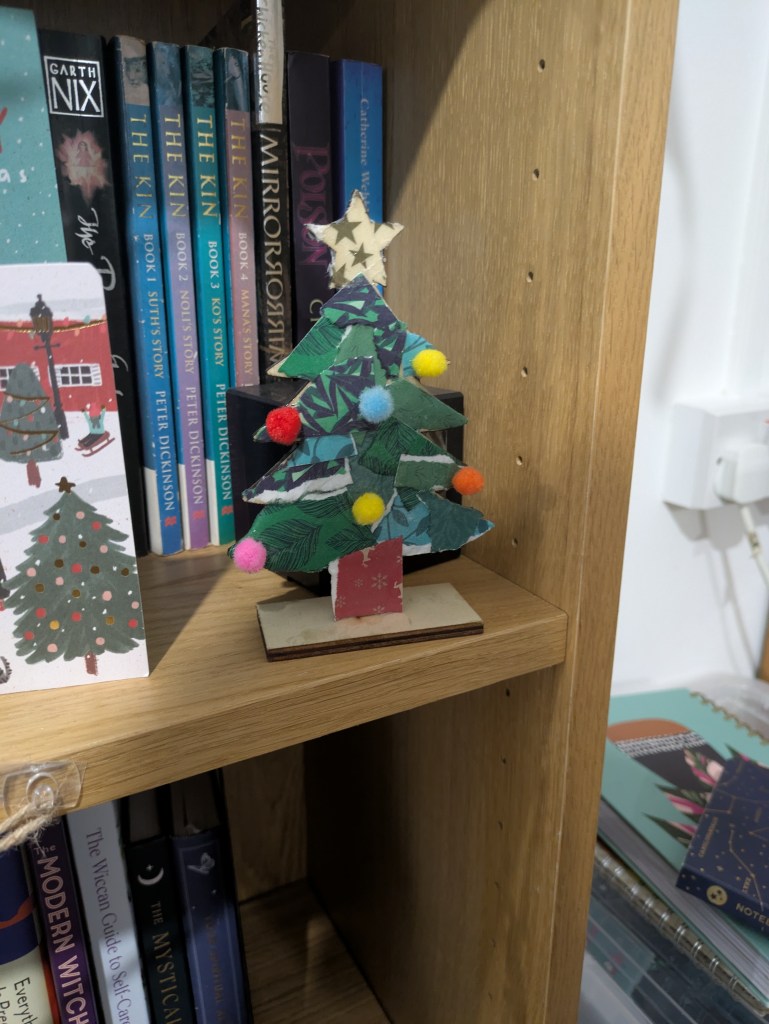
    I made this christmas tree decoration on a night I was really struggling:

    Now that’s not a brag. It was actually completely the wrong coping mechanism – it lead to my becoming so distressed I toppled my Christmas tree! No damage done, to me or the tree, so nevermind but still. Trees are not playthings!

    So I had to rethink the ways I was trying to cope: too much tv, crafting, distraction.

    What I needed:

    • stimming
    • sensory items like my weighted blanket
    • lava lamp
    • radio music
    • spotify music
    • taking a break from christmas
    • opposite action: opening some of my own presents that I’d bought for myself/one my mum got for me
    • radically accepting
    • a little clock for my kitchen so I could be aware that time is passing
    • engaging in special interests – and strewing them around the room for a low demand way to spark interest

    Using these methods has helped me work better with the home treatment team. With good communication about my being autistic and PDA with them, they did an excellent job of adapting their approach, and I’ve impressed a lot of them.

    You can cope with distress and crisis as a PDAer – you just need to work with your brain and not against it!

  • Emotional flashback.. again

    I’ve been super anxious recently. My antipsychotic depot’s cause this each time so far outside of hospital, for Trauma Reasons. This weeks was better, in that I didn’t get a week of intrusion symptoms, but I did get nightmares the night before.

    I was also extra-sensitive to loneliness. I’m not entirely sure why that’s what came up. I suppose it might have been an emotional flashback. The feeling: all alone in a hostile space, post trauma.

    I emailed the PDA society, my therapist and SANEline, all of which have been good sources of support for me in the past. I also tried nightline for an immediate response, which has historically been the best helpline I’ve used (it’s by students, for students, term time in the UK). It wasn’t so helpful this time, and I should have ended the webchat much sooner – it amounted to a degree of emotional self-harm that night.

    Thankfully the email responses were a lot stronger. The PDA Society supporter urged me not to give up hope of making connections, though they edged on advising learning to mask better which I’m not 100% on board with. They talked about working with a professional and trusted family member/friend to work on mastering ‘social do’s and don’ts’. I can see some use for that, but it’d be nice to get advice on ‘here’s how PDAers meet people they can be themselves with’. I do appreciate them being able to supply recommendations for professionals that can support.

    SANEline suggested hobby groups, and offered questions for further thought. I still need to respond, it’s likely to be a validating discussion. That’s what I find SANEline are most useful for when I talk to them.

    My therapist had the best response, which is perhaps unsurprising given she knows me as an individual. She stated that perhaps humans are not the most reliable source of connection. As such, she suggested that maybe I need to spend some time at a Cat cafe to get some oxytocin. She also reminded me that I can brainspot in my own time to strengthen my brains awareness of my good qualities.

    So I put that into place after my depot injection. Headed straight to the local cat cafe. A kitty prompted clambered straight onto me and wanted to be held for hours. Definite oxytocin hit!

    Following that, I went to the local MH hub to talk to some humans that understand. Had a couple of in depth chats, some light hearted chatting, did a tiny bit of studying. As my therapist predicted, it wasn’t as secure a source of connection – but it was still valuable.

    Then, tonight I had too much demand anxiety to sleep. So, I put on my lava lamp for the first time since being here and chilled out. Over the time I: read my queer fantasy book, read up on developmental psychology to prepare for research assistant volunteering, used Finchcare, and sat and watched the lava lamp to the sound of a fire-scape video on youtube.

    That last activity made me fixate my gaze on the lava lamp, and I began to notice feeling unusually soothed. Gaze fixation is a big part of brainspotting, so I checked if there was another location where that sense of soothing increased. There wasn’t – at the angle I was sat at, my lava lamp seems to fall in my “soothe spot”. I tried it again later in a different room, and yup it’s the spot.

    So I haven’t done the exact brainspotting my therapist recommended, oddly enough – but I have done that! I also did the “injection trauma” spot before leaving my flat to get the depot injection, which does seem to help me cope.

    Now I’ve written it all out, it’s clear to me that was another layer of emotional flashback caused by depot injection. A shorter one this time. I attribute that to the process of brainspotting I’ve started on this trauma. It’s good to now have a brainspot I can use to soothe my way out of emotional flashbacks/help me through them till they end. It’s a reminder that there’s a good reason to meet the demand my therapist gave me to strengthen the neural re-wiring in my own time.

  • Stimming

    I’m genuinely surprised I haven’t already written about this. I think one of the biggest parts of my mask was suppressing my stims (and hyperactivity) – in truth I am a wriggly, fidgety stimmy being. Forever drumming my fingers, bouncing my left leg, spinning a fidget spinner. Oh how I wish I’d had fidget spinners as a child!

    I’m not sure if I ever flapped my hands as a child. I started to when I was dating an Autistic woman who had this stim, before I even realised I was Autistic. I would apologise for copying her, but find joining in irresistible. If we’d known about the ways the PDA profile differs from non-PDA autism, I think I’d have gained a diagnosis much sooner (as it was, she said.. “you definitely have sensory processing issues, but you lack the rigidity I’d expect”). Nowadays I tend to shake my hands rather than flap them, as I find that more satisfying.

    Unfortunately, a cost of masking my stims as a kid was developing a skin picking stim. Everything else got me told off, but an actually self-injurious stim was apparently fine? I will never understand. Since I was eight, I have literally skin picked every single day of my life. It’s proven near impossible to stop. I had been making an effort to pre-hospital and I probably ought to try again. I do use multiple much healthier stims now as well, and I hope that’s building an armoury against this stim. It seems to be helping me use the self-injurious stim less, but not yet stop using it at all.

    I’m so glad I rediscovered the joy of stimming. It should be an Autist’s birthright.