Category: Sensory needs

  • Working with my brain, not against.

    The first benefit of discovering PDA and realising it applied to me was finding I could finally work “with” my brain. Meaning I could approach life in a way that didn’t leave me fighting with myself every step of the way. Dissociating from demand anxiety. Beginning to learn not to fawn (still working on this). Advocating for myself. Taking demand free time.

    This is true for my other neurodivergences as well (neurodevelopmental or otherwise).

    With dyspraxia, I find it easier to make progress on a craft when I work on a repetitive project. In knitting that was my blanket squares, in crochet it’s doing rows of double crochet that will eventually become an infinity scarf. (See my latest instagram post!) This drills the basic steps into my procedural memory (“muscle memory”). I also try to only learn one new stitch at a time with new projects, or maybe just one new skill – like a joining technique.

    I also focus on physical activity I find easier to coordinate. I don’t worry about team sports where I tend to let the team down. In fact, I don’t tend to bother with competitive sport at all.

    With dyscalculia, long before my diagnosis (but well after my suspicions), I learnt stats procedures “in words”. That is, I learnt the concepts in verbal form, rather than running the formulas over and over. This isn’t as easy to apply to numeracy (it’s hard to write out the concepts of the procedure for calculating a percentage I find.) It helped that Cardiff University taught the procedural concepts thoroughly. This meant I was able to verbalise the steps of a formula, rather than just being given the procedure as formulas. I probably need to practice looking at a formula and breaking it down into it’s constituent verbal concepts.

    With ADHD, it’s things like K.C. Davis’s “five things cleaning”. I struggle to sequence my actions, and approaches like this finally make it possible for me to tidy my room. It can also mean making sure I get more physical activity as this slows down my mind.

    When it comes to bipolar, it’s about working to get enough sleep. Taking meds religiously. Watching for warning signs.. but also keeping enough factors that promote well-being in your life.

    It’s also about meeting your sensory needs. I now know I find visual input very over-stimulating for example. So I wear sunglasses on sunny days. I go to smaller supermarkets where there’s fewer products and aisles. I allow myself to eat in a way that meets my sensory needs and don’t apologise for it.

    And on top of that, it’s allowing myself to stim and fidget. I was forever told to “sit still”, “stop fidgeting” as a kid. Now I know it’s a neurological need, and I meet it.

    Knowing you’re neurodivergent really is more than half the battle.
  • Demand avoidance and food

    Something my demand avoidance really affects is my relationship to food and eating. There’s also sensory issues involved, I’m very sensitive to taste and texture.

    Mostly though, my issues with eating stem from demand avoidance, particularly around preparing food. I swing between eating a lot of low effort junk food, and eating out too much for lunch, and then periods of eating very little of anything.

    The latter causes weight loss which always gains me praise, which makes it very appealing to repeat. The former causes weight gain, with the opposite societal effect – disapproval. Particularly from doctors, especially if I dare seek help for my chronic pain (which I tend to avoid and self-medicate for as minimally as possible).

    I find deciding what I’ll want to eat for the week ahead very difficult, and demanding. Even more than that, preparing a proper meal is too many demands for me, so I often eat take out or microwave meals.

    I’ve recently discovered, via tiktok, the idea of a “snackboard” which sometimes makes lunchtime a little easier – it provides variety in a meal and can get me eating fruit and pickled vegetables. Sometimes though, even preparing on of those feels too demanding.

    I really would prefer if, much like sleep, if food just wasn’t needed.

  • PDAfae discord

    I’m working on creating a PDAfae discord for those who would like a place to socialise with fellow PDAers/parents of PDAers.

    Overtime I will need some moderators to support this effort, please feel free to email me at PDAfaeATgmail.com (replace the AT with an @) to discuss this.

    I will also be sharing this on facebook, and in facebook groups, and instagram.

  • How I manage hygiene now

    So as a PDAer, obviously I’ve avoided this in the past. I went a decade without brushing my teeth regularly in my twenties – and now I face the consequences.

    As the PDA society’s recently shared graphics show, the consequences aren’t enough to motivate PDAers. In face it can make it harder.

    But what does help?

    Novelty can make a big difference. For me that’s:

    • Hismile flavoured toothpaste, keeping multiple flavours in stock
    • mixing up my toothbrushes
    • mixing up the time of day
    • getting dental cleans, with sedation to make up for what I can’t manage

    For kids:

    • take the expectation away entirely, even if it means it goes missed for a while.
    • look to see if you have a specialist NHS dental clinic for neurodivergent and anxious patients (for adults too – I’m on the waitlist for one!)
    • failing that, there are dental practices that specialise in anxious patients that can do a dental clean in a sensitive manner and xrays too
    • mix up the toothbrushes – that might mean letting them use (an appropriate softness) adult brush, or mixing up which themed kids brush they get

    Work with your dentist, obviously, to get the best care: but ultimately, brushing is better than not, and if you can’t, you can’t.

    When it comes to showers my tricks for me are:

    • wash every other day
    • keep them short and sweet OR take a long time to enjoy the heat of the water
    • use multiple big towels to keep warm, and because I dry in my bedroom, to keep the bed and floor dry (bathrooms are too cramped for me to co-ordinate drying properly in)
    • using condition and a wide toothed comb to detangle my hair (some find brushing UP works better than down)
    • I let my hair air dry, which has the benefit of not heat damaging it!

    You could also play music, request that no one ask you to shower (I live alone and get to shower on my own timetable), shower at the time that works for you, use smelly products OR unscented sanex/simple products. Use fancy scrubbing devices that meet your sensory needs. Get a dryrobe to wrap in to get immediately warm.

    There’s always a way to bring novelty and sensory accommodations in.

    However: sometimes all of the novelty and sensory needs meeting just won’t do it. You just have to drop the expectation entirely, without a ‘how do I get my PDAer to shower/brush their teeth?!’

  • Neurodivergent distress coping

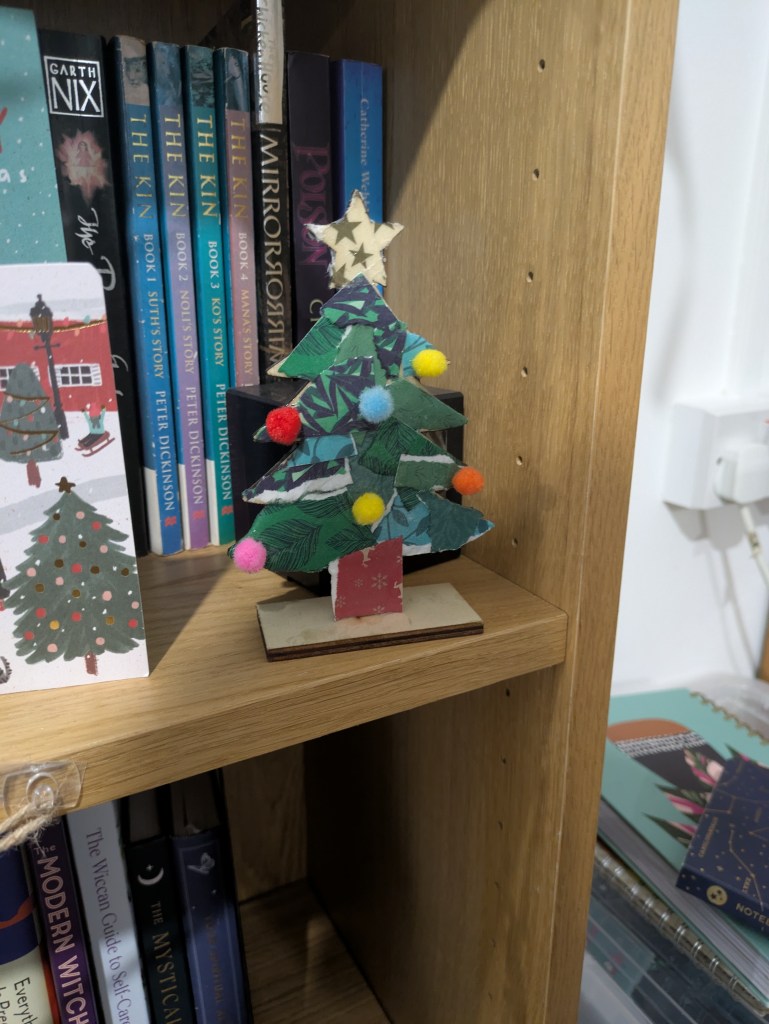
    I made this christmas tree decoration on a night I was really struggling:

    Now that’s not a brag. It was actually completely the wrong coping mechanism – it lead to my becoming so distressed I toppled my Christmas tree! No damage done, to me or the tree, so nevermind but still. Trees are not playthings!

    So I had to rethink the ways I was trying to cope: too much tv, crafting, distraction.

    What I needed:

    • stimming
    • sensory items like my weighted blanket
    • lava lamp
    • radio music
    • spotify music
    • taking a break from christmas
    • opposite action: opening some of my own presents that I’d bought for myself/one my mum got for me
    • radically accepting
    • a little clock for my kitchen so I could be aware that time is passing
    • engaging in special interests – and strewing them around the room for a low demand way to spark interest

    Using these methods has helped me work better with the home treatment team. With good communication about my being autistic and PDA with them, they did an excellent job of adapting their approach, and I’ve impressed a lot of them.

    You can cope with distress and crisis as a PDAer – you just need to work with your brain and not against it!

  • PDA and dental care

    As a kid and teenager, I was prompted to brush my teeth regularly by my parents, who’d get very involved in the process. Unfortunately, when I reached 17/18 they abruptly stopped this, saying I was old enough now to manage this for myself.

    My PDA t0ok this as an opportunity to be avoidant. I would have benefitted from a much more gradated approach to being in charge of my own teethcare. It didn’t help that my parents had set the expectation that adults use adult toothpaste, which is a sensory hell for me, far too strong a flavour. Instead of being able to continue on with the habit, it turns out it was in no way a habit for me to brush my teeth, and I neglected to do so for about ten years. This was not helped by my worsening mental health, and ADHD, which both likely also contributed to this self-neglect for so long.

    Now, unfortunately, thanks to this, my gums are in a very bad way. I need to see a dentist soon because it’s gotten so bad. I’ve had quite a few bad experiences with outpatient procedures, including dental, because I don’t seem to respond well to local anaesthetic, in that it doesn’t cause me to go particularly numb – I can usually feel the entirety of the procedure, including all the pain.

    As a result, booking to see a dentist was very terrifying for me. I had a panic attack, cried and ended up very depersonalised (a form of dissociation in which your own person/body does not feel real to you). Thankfully I did manage to not be avoidant – more in terms of trauma avoidance here – and did book the dentist appointment. That was mainly because staff here at my hospital will be able to attend with me, otherwise I probably would have avoided seeing a dentist.

  • Almond butter autonomy.

    It’s never a good start to a day when at 4am, after a night of pain and no sleep, you develop a craving for almond butter on toast… and have no means of having that for breakfast.

    I’m likely going to struggle to eat breakfast at all. My demand capacity is going to be quite a bit lower. It might seem odd, but a large part of that will be due to the loss of autonomy of the choice of what to eat, not pain or sleep deprivation. Of course, I’d probably cope better if my stress cup wasn’t filled by those things – see Tomlin Wilding’s page for information on ‘cups’.

    Odd as it may seem though, the simple lack of the food I actually want for breakfast – and the inability to pop to a shop beforehand to pick it up, or that it wouldn’t be listed on deliveroo groceries, is a problem. I’m already grumpy just thinking about breakfast without my autonomous choice. Nothing else is going to be a good substitute, which is not ideal when pain has already reduced my appetite.

    Sigh. I foresee a taxi ride to the nearest big supermarket today.

  • Sensory logging

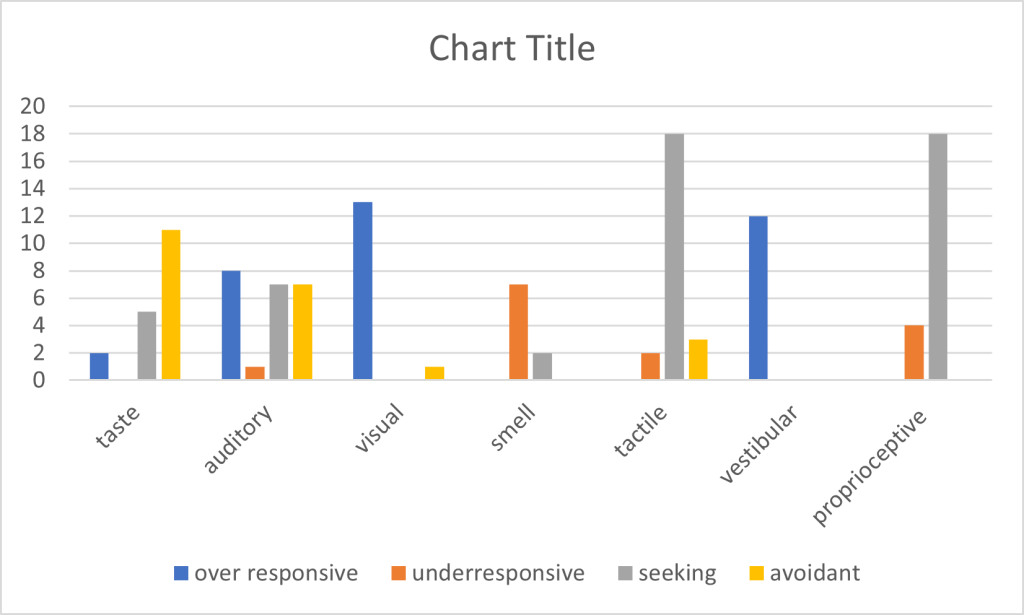
    Back in December I wrote about my intial findings from the sensory log my therapist recommended I keep.

    I never got around to sharing what I found as a result.

    As this shows, I’m over-responsive/avoidant in all my senses, except for smell (which is severely underresponsive for me), tactile and proprioceptive, where I tend to seek out sensory experiences.

    In my auditory sense, I seek out experiences that are under my control, and avoid sensory input that is not under my control – or easily experience overwhelm. My sense of taste is similar, but mostly I am avoidant.

    It seems I would benefit from learning how to be visually and vestibular avoidant, in particular. I’m not sure how to do this though.

  • Stimming

    I’m genuinely surprised I haven’t already written about this. I think one of the biggest parts of my mask was suppressing my stims (and hyperactivity) – in truth I am a wriggly, fidgety stimmy being. Forever drumming my fingers, bouncing my left leg, spinning a fidget spinner. Oh how I wish I’d had fidget spinners as a child!

    I’m not sure if I ever flapped my hands as a child. I started to when I was dating an Autistic woman who had this stim, before I even realised I was Autistic. I would apologise for copying her, but find joining in irresistible. If we’d known about the ways the PDA profile differs from non-PDA autism, I think I’d have gained a diagnosis much sooner (as it was, she said.. “you definitely have sensory processing issues, but you lack the rigidity I’d expect”). Nowadays I tend to shake my hands rather than flap them, as I find that more satisfying.

    Unfortunately, a cost of masking my stims as a kid was developing a skin picking stim. Everything else got me told off, but an actually self-injurious stim was apparently fine? I will never understand. Since I was eight, I have literally skin picked every single day of my life. It’s proven near impossible to stop. I had been making an effort to pre-hospital and I probably ought to try again. I do use multiple much healthier stims now as well, and I hope that’s building an armoury against this stim. It seems to be helping me use the self-injurious stim less, but not yet stop using it at all.

    I’m so glad I rediscovered the joy of stimming. It should be an Autist’s birthright.

  • Mania recovery milestone

    During my mania last year, I lost all my saved music on Spotify, because paranoid delusions caused me to delete my account.

    It royally fucking sucked.

    Finally, I’ve started finding music that makes me feel as good as the music I had before. It had been a dreary year listening to music that only half ‘worked’. Trying yet another playlist, saving the best that I could find. Hoping my discover weekly would catch on to my taste.

    My friend recommended that I search for a song and then let it autoplay – so much better results!

    An hour in, and I’m back to my dance stimmy, sensory seeking self!