Category: neurodivergence

  • Life is boring..

    .. life feels boring?

    Is life boring?

    It definitely feels it recently. Life has been feeling same-y, repetitive, lacking anything truly pleasurable, or worthwhile.

    I’ve also been sleeping a lot – regular 12+ sleeps, with very low demand capacity, struggling to cook, or want much food.

    Sounds like mild depression to me.

    So maybe life isn’t boring, but depression is making it seem that way. That’s what I’m hoping, because if that’s the case, there’s tangible things I can do about it.

    Though, part of me suspects that it’s also that human society is badly set up.. if you want to get out of the house and do something, what can you do?

    Shop? spend money you don’t have on things you don’t need

    Cafe? Park? Library? Cinema? It’s a limited range of options.

    OR

    There’s go down a pub… and we wonder why drinking is so common in society.

    It’s hard to think what there is to plan to go out and do with my time, that could be some spontaneous fun. I think that’s part of what I’m lacking, something different, out of the ordinary, spur of the moment… but it’s so hard to think what that could look like.

    All the options just feel like another part of the mundanity.

    I don’t know if depression is the reason that mundanity feels so oppressively unbearable, or not. If it’s not, I don’t know what to do about that feeling.

    But working on making sure I’m looking after my mood sounds like a place to start, and nothing has to be fixed all at once. It’s a journey… and yesteday (I write this at 3am), getting some sunshine, spending time with friends … and making plans with a local healthwatch* to do work around Autistic and learning disabled people stuck in prisons and ATUs was definitely a step along that journey. Definitely feels like a bigger step than the previous day which was made up of lonely sleeping and dozing (that horrible half asleep state where you want to just pop downstairs and see people you no longer live with). But I try to remember the value of rest, and perhaps that day of doziness was just as important and restorative – and prepared me for the day I had yesterday.

    *If you’re in the UK, you can find your local healthwatch here.
  • Untypical, by Pete Wharmby

    When I was discovering my neurodevelopmental differences (I don’t say neurodivergences, as I include bipolar in that, which I already know about), I started processing all the trauma that was associated with them. It left me with the feeling that neurotypical society was deeply hostile towards neurodivergents, particularly Autistics.

    So I knew I wanted to read the recent release based on the tagline alone: “How the world isn’t built for Autistic people, and what we should all do about it”. It promised acknowledgement and validation, and that’s exactly what the book delivers. It also offered a sense of hope, that there’s things that can be done, that this hostility isn’t unavoidable.

    My brain isn’t braining very well recently, so it’s hard to find the words to express everything I feel about this book, but I heartily recommend it!

  • “Excessive mood swings”

    The week since my trip to London has ended up being very low demand. I’ve mainly just slept and watched tv on my laptop. It’s not felt great, but I suppose I just needed the downtime. I’ve avoided all my household tasks, including ordering in food a few times. It’s so useful to be able to understand these periods in the framework of demand capacity and anxiety.

    I definitely experience the mood fluctuation component of PDA, on top of my bipolar mood swings, and trauma related emotional flashbacks. PDA seems to mean that if I feel lonely, it’s extremely lonely, down is extremely down, excited is extremely excited. I don’t seem to do ‘small’ emotions. Recently I’ve been more mindful of those swings, noticing when they come to an end and when they shift. It’s helping me notice that the bad times aren’t permanent, and that it’s all cyclical. I seem to swing between productive, energised times with more demand capacity… and low energy, low mood times where I easily feel overwhelmed with lots of demand anxiety. It’s something that my previous bipolar medication, sodium valproate, really flattened and looking back I can see how zombified I was on that med – it doesn’t feel surprising that I pulled myself off of it really. Risperidone seems like a much better med for preventing psychotic mania, whilst not preventing my natural emotions.

    Sometimes “excessive mood swings” are really difficult to cope with, especially the ways low moods feel so very low. It’s infinitely preferable to experience them though, than to be completely flat.

  • Impatience

    I’m feeling a sense of diffuse impatience tonight. There’s nothing specifically I’m impatient for, which is a bit strange. It’s a general eagerness to start making progress on my goals. To start gaining research experience, to start making progress in working to better the lives of my fellow AuDHDers, PDAers, and wider neurodivergents. To get involved in Mad Pride campaigning. To find how I can support the lives of people who are more permanently non-speaking than I was.

    There’s a million and one dreams, hopes, ambitions and desires bubbling inside of me. It’s just knowing how to enact them in a real sense – and knowing that I have my limits and can only achieve so much. I need to work out what I’m best suited to, where my efforts will be most effective. I need to find out what opportunities there are for ‘making a difference’, or what opportunities I can create.

    It’s the effort of years and I am only just at the beginning. ADHD has always made me a very impatient person, and the days where there’s no progress to be made, that you just have to live through are always very frustrating to me. It’s so hard to not feel that they are a waste of time, even though during them I can make progress on the living skills that will support me through all the upcoming years of work. The fundamentals are not interesting, and my brain wants to skip over them to the good part. Basic skills like money management (fundamental if you want to start your own business, which is something about which I have little seedlings of ideas growing). Or the self-care that might help me look after myself and avoid burnout (or recover from it). None of that can afford to be neglected, even if it isn’t sexy.

  • Non-speaking, briefly

    Something I haven’t mentioned here is that during my stay in a psychiatric ward in 2021-22, I had a brief experience of being non-speaking. I was very manic at the time, and my mind was super busy, so I’m not even sure I was always fully aware that I wasn’t actually saying anything. I do remember pointing to make decisions on what to eat in the dining room though.

    Something that stands out is being told ‘you’re a really good speaker’ by two people when I slowly started to talk again. In general.. lots of people treated me like I had intellectual disability because I wasn’t speaking. One lady did buy me ear defenders, as recommended by her autistic kid… but also a peppa pig colouring book. It definitely feels like most people assumed I was childlike in that phase of my stay. Something else that stands out is my psychiatrist saying the period where I wasn’t talking was ‘scary’, which is hard to know how to interpret.

    I’ve been told that this is likely a form of situational mutism (by L, who previously worked as a speech and language therapist, and also my therapist). L suggested that probably speaking became too great a demand for me, which makes a lot of sense. I have definitely thought about how speaking is a huge demand since this experience, and one that doesn’t feel possible to avoid… but also a degree of tempting to avoid, just sometimes.

  • Neurodiversity is Not the medical model!

    I just left a ‘neurodiversity’ research webinar because it was the co-opted, medical model version of neurodiversity, where apparently there’s debate what counts as neurodivergence.

    There is no debate. The term has a definition: any brain that diverges from typical. Mental illness. Acquired brain injury. Neurodevelopmental. Etc.

    It’s deliberately a non-pathologising term for those differences, which means you can’t use neurodiverse ‘disorder’ or ‘condition’ as phrasing.

    This really winds me up, and is everything I don’t want to be as a researcher, activist, or neurodivergent person.

  • Neurokindred

    Something I really feel the lack of now I know more about my neurodivergences is the presence of neurokin in my life. When it comes to the bipolar, I have my neurokin there, one friend with bipolar, another with schizoaffective (and another with schizophrenia), and this feels so good. It’s good to have people who understand being hospitalised, or being psychotic and experiencing delusions. It’s also good that one of those friends is also autistic and ADHD, so I’m not completely alone.

    I’m going to an ADHD support group tomorrow night, so hopefully I will meet some more neurokin there. I also joined an online autism peer support group, which was a great experience earlier this month. I will blog about both of these in the near future.

    What feels particularly lacking is PDA neurokin. We’re not the most common of people, and often we like to interact online. Dannii at PDAourway often refers to her neurokin friends and it always induces a pang of longing for me.. to have numerous friends who are true neurokin, in being PDA and ADHD. It’d be good to have people in my life who truly understood the PDA experience, rather than who were learning about it.

  • Pomodoro stream

    Found another little thing that helped today, probably more so with ADHD avoidance and motivation issues than PDA. I think if my demand anxiety had been high, this wouldn’t have been so successful. I found a streamer on twitch doing pomodoros of 50 minutes followed by ten minute breaks. That’s longer than I can usually motivate myself to focus on something, but the body doubling effect of working alongside a streamer and her audience really helped.

    It definitely helps too to think of table tops and table legs (credit to Harry Thompson for that metaphor). When it comes to household care tasks, they’re the table leg towards the table top of eventually being considered independent enough to get a cat. I’ve come a long way on that goal, the main thing now is to learn to a. sustain the progress and b. keep on top of care tasks even during periods of blips. I’m no longer needing support sessions to achieve basic tidying care tasks, which I’m really proud of.

    Edited 8/3/23: I no longer recommend Harry Thompson as a resource.

  • (untitled)

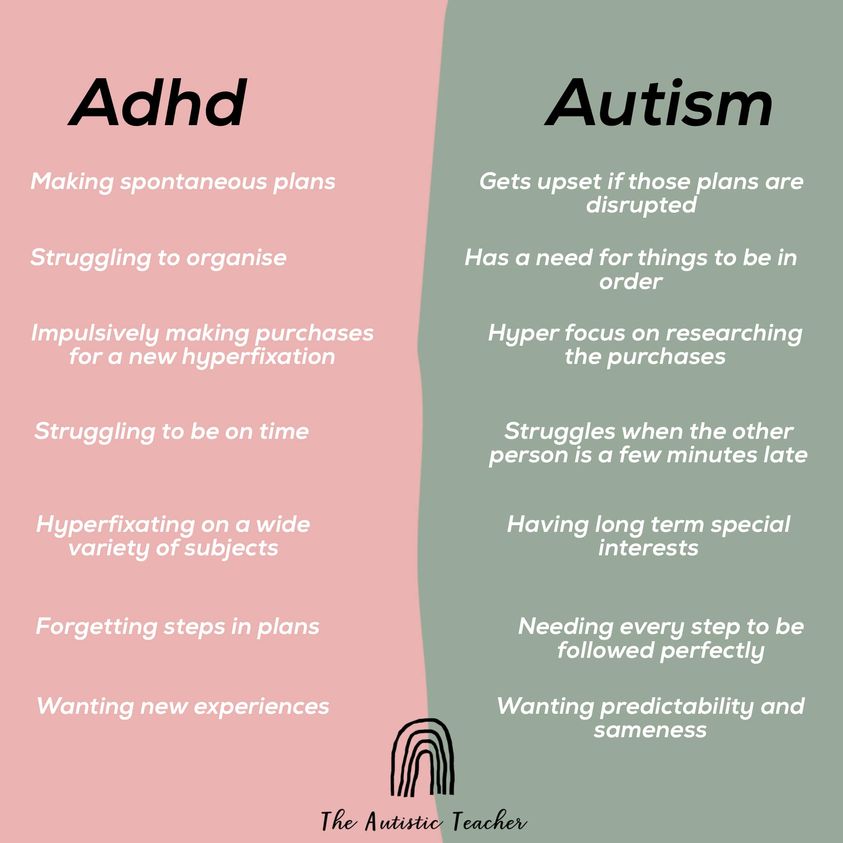
    Found this graphic on my facebook feed, from the page The Autistic Teacher. It made me consider which of the two sides I fall on for each item:

    • Probably more likely to get upset if plans disrupted, especially as a child. Might occasionally make spontaneous plans, I’d need to mindfully observe myself to work this out
    • Struggle to organise, definitely
    • Impulsively spend!
    • Struggles when others are late (and likely to be early to compensate for bad time keeping)
    • Both: usually i’ll have a special interest I spend time almost casually engaging it, it’s very easy, it’s a low effort thing to spend time on. I’ll also have a range of hobbies that take effort to engage in, but that I can get fixated on
    • Forgetting steps in plans is more likely for me
    • Wanting new experiences, I love novelty.
  • Diagnostic report received

    After three months of waiting, I finally received my diagnostic report! It noted that my demand avoidance was ‘marked’ and causing ‘significant impact on my life’ which.. woah. I did not realise that it was that obvious and the impact so clear. Apparently the assessor had to make significant adjustments to the assessment process for me to be able to complete it, which I hadn’t noticed. It’s interesting that even though I feel as an adult, I fawn and mask, to a trained assessor my need for control was evident.

    It didn’t clearly state which subtype of ADHD I have, but did make references to both inattention and hyperactivity, so I assume it’s considered combined type. At the very least, I was right to identify hyperactivity in myself, as well as manic high energy – those two can be so difficult to distinguish! It didn’t help that during my last manic episode, I was exploring ADHD and explained manic high energy as ADHD. I will need to be careful to distinguish between the two in the future. Possibly noticing an increase in hyperactivity symptoms is a sign of hypomania for myself.