Category: neurodivergence

  • What if..

    I’m not actually autistic?

    What if PDA is it’s own neurotype?

    What if it’s an epigenetic related neurotype – i.e. rooted in neurodivergent trauma, but inheritable mainly through the mother line?

    What if being a super social PDAer actually makes you allistic, but also highly neurodivergent?

    What if PDA can be researched enough to prove this? What if I’m not able to, when I know so much about my own hypotheses, methods I’d use..

    What if there’s a point I have to give up, and hand over my passion to another researcher because I’m not able?

    What if, though, it does all work out? What if I can work this hard? What if I can become a truly high flying PDAer – with all my disabled complexity?

    What if, what if, what if?

    One’s thing for sure, I agree with that Newcastle Uni research that the PDA brain has an “intolerance for uncertainty”!
  • Advice for the teens

    Hi, you teeny terror tots

    • learn to accept deadlines as a way to channel your passions
      • whether that’s uni, starting a business, cleanliness, whatever: deadlines are a part of life. Don’t take them too seriously, because the only ultimate one is actual death, but still
    • learn to tidy AND learn to clean
      • Anyway you can, anyway how
      • These are the skills that truly prevent self-neglect
    • I bet you’re a better cook than I am!
      • If not, start out with baking
    • Embrace your own personal form of brilliance
    • Learn to use some form of AAC
      • A big part of PDA is the language aspect, and AAC helps all humans communicate
      • even if it’s just a ‘I’m ok, I’m NOT ok’ wristband – you’ll help all your interpersonal relationships
    • Learn to be ok with your own company, and learn when you’re getting too intense about one specific person
      • No one loves being the focus of a special interest/a favourite person – not even your partner
    • Forge your own paths, please: we’ve all got ways to shine.
    • Also; let’s teach this world the beauty of stimming, eh?
  • Finally home for good!

    NOTE: THIS POST IS AFFECTED BY THE REMANTS OF A SEVERE MOOD DISORDER, AND AS SUCH THE CONTENT VARIES FROM MY USUAL POSTING

    Oh gosh I felt so trapped on that ward. I literally had to run away from my discharge meeting because of that feeling – I needed to move, move move move move.

    Thankfully I know that coffee helps my brain, but that ideally it should not have milk in it (obviously!).

    Now I have my sensible meds, a sensible care co (lovely woman, B), sensible times to take them, a sensible psychiatrist in the community – and a sensible way to get diagnoses I need.

    I’ve had to defer a module at the OU which genuinely makes me very upset – but no worries, I can restart and do better than I was. It was a “bridge” module between level one and level two, which only makes me all the more determined – I will graduate this time, and probably in double time. I’ve studied full time before, I can do so again haha. For now I just need to finish the module I started and focus on the *maths content* – because everything else from that module is revise-able.

    Genuine study advice for anyone struggling: build in time to review. That’s what gets things into long term memory. My maximum working memory is literally SIX, and that’s where I get stuck – I have trouble holding things in my working memory to get to short term, to long term. My verbal working memory is better than my numerical as well, which might literally be stuck at 3 (working memory is 5 +/- 2, after all).

    As it goes, I’ll keep typing about specifically my life – here, substack, instagram, facebook. That’s all I can offer, my experience, my ways to cope: PDA style.

  • Second day of leave

    NOTE: THE CONTENT OF THIS POST IS ALTERED BY A BIPOLAR MOOD EPISODE, AND DIFFERS FROM MY USUAL POSTING STYLE

    Wow, life with bipolar and PDA is hard.

    Life with bipolar, PDA, chronic pain, scoliosis, chiari malformation, probable EDS?

    Yes. Very much a disabled adult here. At the time I was under the RNOH, EDS was considered “zebra” – looking for zebras, when you hear hoofbeats and not thinking “horse”.

    I dislocate far, far too easily. I have congenital scoliosis. I had a brilliant surgery on my spine at 20 years old, and as a result am around 1-3″ taller than I would have ever been (genuinely not sure, people guess my tallest to be around 5’2″, I was 4’11”?) Standing tall as I can, I’m now about 2cm taller than I was – 150cm.

    Dyscalculia, I’d guess that makes my full height 5’1″? Yeah who cares lol. Doesn’t matter – I’m teeeeeny. Suffice to say, I’m 34, and full of disability.

    My honest advice, on this time to talk day, is: ALWAYS keep an eye on mood disorder symptoms in your kids. Do not assume ‘oh this is rejection sensitive dysphoria’, ‘oh this is PDA’ ‘oh this is ADHD’ ‘oh this is teenager time’. All kids are at risk of depression at the very least, all kids are vulnerable to abuse – of any kind, from anyone – and honestly, psych wards are a last resort type of place, for people at risk of SELF-neglect.

    You don’t want your 19 year old in such a place, trust me, let alone your vulnerable 24 year old.

    You definitely don’t want your teenager in a CAMHS unit.

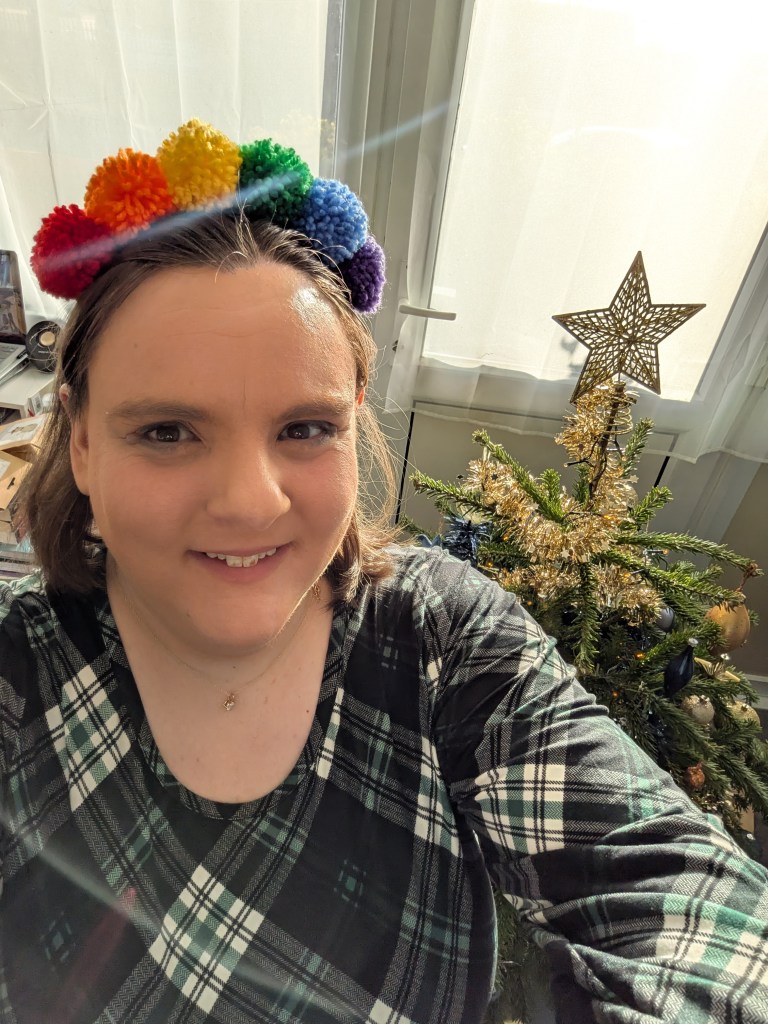
  • Christmas eve 2024!

    I missed posting last year because I was unwell with mania right up until early January this year. When I look back at my 2022 post, I realise now that it still wasn’t the most normal of Christmas Eve’s because of the supported housing. I’ve since realised they were unsupportive and discriminatory towards my autism, likely because of the word “pathological”.

    So I’m actually counting this as my first normal Christmas Eve since 2019. My own flat – not a supported place -, large enough to truly decorate without clutter. The supported housing flat was a studio flat with a wall in the middle, meaning I was effectively living in the space of my now living room. That alone made me depressed.

    So, this year? Gut issues from lamotrigine, but I went for an early morning walk and got medicine for that. I also got to fuss a lovely boxer, and meet a hyper spaniel.

    I’ve got my Christmas lights on. For the first time ever, I decided to try a simmer pot – smelled amazing. I delivered a gift to neighbours who took care of me as I was having a post traumatic stress reaction (that built into mania).

    As ever this Christmas, I’ve got radio on, for company, Christmas music, and normal music mixed up together. It’s a nice background.

    I’ve also got NORAD santa tracker going. Childish, maybe, but I prefer to call it childlike. It’s a bit of fun that I’ve done for a few years now.

    It’s strange adapting to Christmas Eve alone, back in 2019 and 2020 I was with family for all of advent, now I only see them on a handful of days. I’m learning how to enjoy days solo, and see the magic in alone time.

  • Choice: an update

    I wrote this on November 1st 2022:

    In a previous post, I asked ‘what does healthy look like for a PDAer?’

    My therapists opinion is that healthy looks like having choice. Freedom to choose to avoid or comply, rather than being ruled by nervous system activation and trauma responses.

    I suppose that means then, that it must always be an option to say no. There’s only true choice if you have the freedom to choose to refuse. I often don’t trust that there will be that freedom in interactions with other people, because so often growing up it was absolutely not an option. Perhaps practicing saying no more frequently would help me trust that I can do that.

    I wonder if I learnt to say ‘No’ more often, if it would help me choose to take on other demands in life as I’d feel more in control.

    Two years on, I’ve made a lot of progress with this. I still find people don’t always listen to a no, but I do make an effort to say it more often. I also use AAC (augmentative, alternative communication) cards on a sunflower lanyard, and my PDA flipchart to explain my drive to avoid.

    The biggest difference I’ve noticed however, is in my avoidance of obligations. I can now ask myself “do I choose to avoid or to do this task?” and that makes a big difference, because often I’ll say: “yes I choose to do so!”

    But not always. Sometimes I say “no I choose to not do this” and allow myself to choose avoidance. I find this offers the most autonomy – being driven to always avoid is not autonomy nor control: it’s being reactive to our surroundings, always.

  • Post solstice hygge

    Gosh I had a lovely “hygge” tonight with family. Hygge is a loanword from Danish, meaning a dark night, twinkly nights, good company (and good food and alcohol)

    Me and my mum cooked a starter and main, we had cheesecake, or cheese and crackers for dessert, so many snacks. Played a runthrough of a new board game I had in my yule stocking (a personal tradition), and a general knowledge quiz to finish up.

    I’m leaning into Christmas in a big way this year, as it’s the most normal Christmas I’ve had since 2019 (covid, mania, supported housing, mania, all got in the way of “normal”). It’s so nice to be well enough to be at home, to host an event even if prepping was so super demanding it took me 8 hours to complete getting ready (due all the the demand free time and pacing needed to cope).

    That’s the essence of a PDA christmas – you do it your own way. Lean in, or avoid most of it. Do it but in an unorthodox way. Adhere religiously to the rules of Christmas. Cling film wrapped presents.

    Whatever works for you, and the PDAers in your life.

    What worked for us mainly was that I set a “no expectations” rule – aside from no shoes in the flat. Other than that, we didn’t expect things of each other, and everyone was much happier. We made our own drinks, we did what we offered to help with, we’ve left the washing up for me and my carers to work on tomorrow (within reason).

    The Yuletide magic that I’ve been waiting for!

  • How I manage hygiene now

    So as a PDAer, obviously I’ve avoided this in the past. I went a decade without brushing my teeth regularly in my twenties – and now I face the consequences.

    As the PDA society’s recently shared graphics show, the consequences aren’t enough to motivate PDAers. In face it can make it harder.

    But what does help?

    Novelty can make a big difference. For me that’s:

    • Hismile flavoured toothpaste, keeping multiple flavours in stock
    • mixing up my toothbrushes
    • mixing up the time of day
    • getting dental cleans, with sedation to make up for what I can’t manage

    For kids:

    • take the expectation away entirely, even if it means it goes missed for a while.
    • look to see if you have a specialist NHS dental clinic for neurodivergent and anxious patients (for adults too – I’m on the waitlist for one!)
    • failing that, there are dental practices that specialise in anxious patients that can do a dental clean in a sensitive manner and xrays too
    • mix up the toothbrushes – that might mean letting them use (an appropriate softness) adult brush, or mixing up which themed kids brush they get

    Work with your dentist, obviously, to get the best care: but ultimately, brushing is better than not, and if you can’t, you can’t.

    When it comes to showers my tricks for me are:

    • wash every other day
    • keep them short and sweet OR take a long time to enjoy the heat of the water
    • use multiple big towels to keep warm, and because I dry in my bedroom, to keep the bed and floor dry (bathrooms are too cramped for me to co-ordinate drying properly in)
    • using condition and a wide toothed comb to detangle my hair (some find brushing UP works better than down)
    • I let my hair air dry, which has the benefit of not heat damaging it!

    You could also play music, request that no one ask you to shower (I live alone and get to shower on my own timetable), shower at the time that works for you, use smelly products OR unscented sanex/simple products. Use fancy scrubbing devices that meet your sensory needs. Get a dryrobe to wrap in to get immediately warm.

    There’s always a way to bring novelty and sensory accommodations in.

    However: sometimes all of the novelty and sensory needs meeting just won’t do it. You just have to drop the expectation entirely, without a ‘how do I get my PDAer to shower/brush their teeth?!’

  • Low demand language

    I’m right at my beginning of learning how to use low demand language. I made a mistake with Sally Cat, for which I apologise! Sorry Sally Cat! I have to remember: don’t tell PDAers how to view their situation, they won’t appreciate it!

    My therapist is recommending declarative language:

    • I notice
    • I wonder
    • I get to
    • I have time to
    • I get to take a break from X by doing Y

    These are just little baby steps to changing from the demanding language I grew up with, to the language that will benefit me – and benefit my relationships with fellow PDAers!

  • New homeschooling legislation

    I just heard this discussed on the radio 2 early breakfast news broadcast: new legislation stating parents won’t be able to homeschool if their homes are “unsafe or unsuitable”.

    Sounds great to the general populace, but do we know what that will mean in practice? Will PDA sibling interactions, or meltdowns come under “unsafe”? Will PDA accommodations lead to a decision of “unsuitable”?

    Now, this is all conjecture on my part, but I am worried. I hope the PDA society will have thoughts on this and ideas on how to support families through this shift – or better still, reassurance that this won’t affect our community!