Category: low demand living

  • Advice for the teens

    Hi, you teeny terror tots

    • learn to accept deadlines as a way to channel your passions
      • whether that’s uni, starting a business, cleanliness, whatever: deadlines are a part of life. Don’t take them too seriously, because the only ultimate one is actual death, but still
    • learn to tidy AND learn to clean
      • Anyway you can, anyway how
      • These are the skills that truly prevent self-neglect
    • I bet you’re a better cook than I am!
      • If not, start out with baking
    • Embrace your own personal form of brilliance
    • Learn to use some form of AAC
      • A big part of PDA is the language aspect, and AAC helps all humans communicate
      • even if it’s just a ‘I’m ok, I’m NOT ok’ wristband – you’ll help all your interpersonal relationships
    • Learn to be ok with your own company, and learn when you’re getting too intense about one specific person
      • No one loves being the focus of a special interest/a favourite person – not even your partner
    • Forge your own paths, please: we’ve all got ways to shine.
    • Also; let’s teach this world the beauty of stimming, eh?
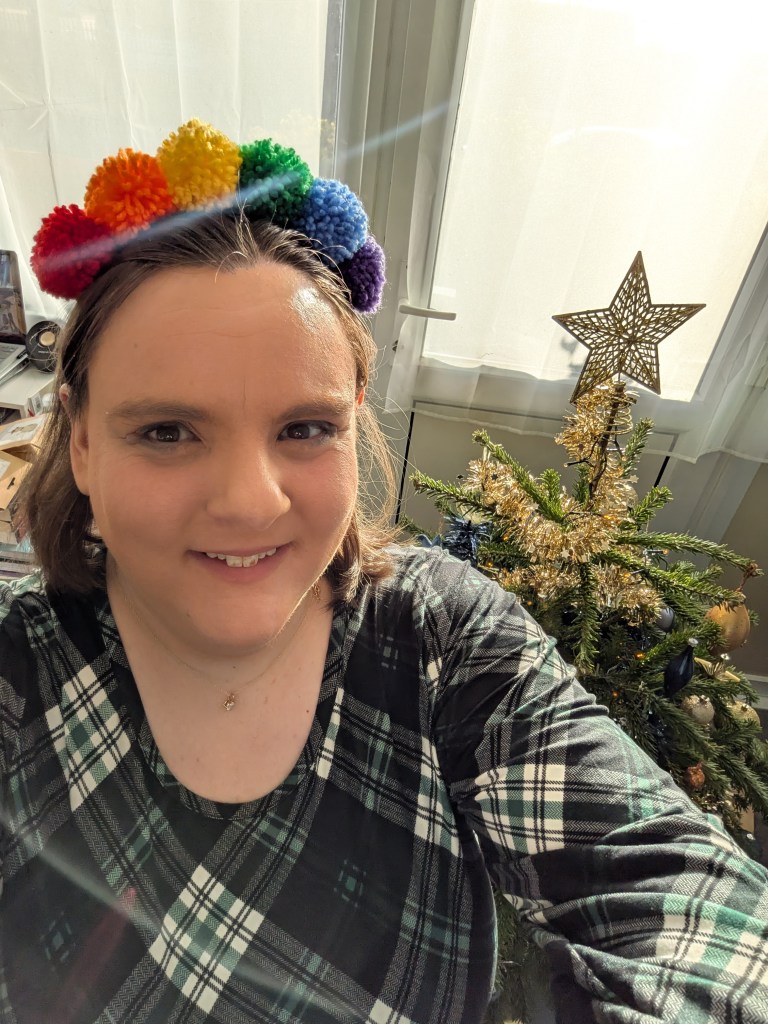
  • Christmas eve 2024!

    I missed posting last year because I was unwell with mania right up until early January this year. When I look back at my 2022 post, I realise now that it still wasn’t the most normal of Christmas Eve’s because of the supported housing. I’ve since realised they were unsupportive and discriminatory towards my autism, likely because of the word “pathological”.

    So I’m actually counting this as my first normal Christmas Eve since 2019. My own flat – not a supported place -, large enough to truly decorate without clutter. The supported housing flat was a studio flat with a wall in the middle, meaning I was effectively living in the space of my now living room. That alone made me depressed.

    So, this year? Gut issues from lamotrigine, but I went for an early morning walk and got medicine for that. I also got to fuss a lovely boxer, and meet a hyper spaniel.

    I’ve got my Christmas lights on. For the first time ever, I decided to try a simmer pot – smelled amazing. I delivered a gift to neighbours who took care of me as I was having a post traumatic stress reaction (that built into mania).

    As ever this Christmas, I’ve got radio on, for company, Christmas music, and normal music mixed up together. It’s a nice background.

    I’ve also got NORAD santa tracker going. Childish, maybe, but I prefer to call it childlike. It’s a bit of fun that I’ve done for a few years now.

    It’s strange adapting to Christmas Eve alone, back in 2019 and 2020 I was with family for all of advent, now I only see them on a handful of days. I’m learning how to enjoy days solo, and see the magic in alone time.

  • Choice: an update

    I wrote this on November 1st 2022:

    In a previous post, I asked ‘what does healthy look like for a PDAer?’

    My therapists opinion is that healthy looks like having choice. Freedom to choose to avoid or comply, rather than being ruled by nervous system activation and trauma responses.

    I suppose that means then, that it must always be an option to say no. There’s only true choice if you have the freedom to choose to refuse. I often don’t trust that there will be that freedom in interactions with other people, because so often growing up it was absolutely not an option. Perhaps practicing saying no more frequently would help me trust that I can do that.

    I wonder if I learnt to say ‘No’ more often, if it would help me choose to take on other demands in life as I’d feel more in control.

    Two years on, I’ve made a lot of progress with this. I still find people don’t always listen to a no, but I do make an effort to say it more often. I also use AAC (augmentative, alternative communication) cards on a sunflower lanyard, and my PDA flipchart to explain my drive to avoid.

    The biggest difference I’ve noticed however, is in my avoidance of obligations. I can now ask myself “do I choose to avoid or to do this task?” and that makes a big difference, because often I’ll say: “yes I choose to do so!”

    But not always. Sometimes I say “no I choose to not do this” and allow myself to choose avoidance. I find this offers the most autonomy – being driven to always avoid is not autonomy nor control: it’s being reactive to our surroundings, always.

  • Post solstice hygge

    Gosh I had a lovely “hygge” tonight with family. Hygge is a loanword from Danish, meaning a dark night, twinkly nights, good company (and good food and alcohol)

    Me and my mum cooked a starter and main, we had cheesecake, or cheese and crackers for dessert, so many snacks. Played a runthrough of a new board game I had in my yule stocking (a personal tradition), and a general knowledge quiz to finish up.

    I’m leaning into Christmas in a big way this year, as it’s the most normal Christmas I’ve had since 2019 (covid, mania, supported housing, mania, all got in the way of “normal”). It’s so nice to be well enough to be at home, to host an event even if prepping was so super demanding it took me 8 hours to complete getting ready (due all the the demand free time and pacing needed to cope).

    That’s the essence of a PDA christmas – you do it your own way. Lean in, or avoid most of it. Do it but in an unorthodox way. Adhere religiously to the rules of Christmas. Cling film wrapped presents.

    Whatever works for you, and the PDAers in your life.

    What worked for us mainly was that I set a “no expectations” rule – aside from no shoes in the flat. Other than that, we didn’t expect things of each other, and everyone was much happier. We made our own drinks, we did what we offered to help with, we’ve left the washing up for me and my carers to work on tomorrow (within reason).

    The Yuletide magic that I’ve been waiting for!

  • How I manage hygiene now

    So as a PDAer, obviously I’ve avoided this in the past. I went a decade without brushing my teeth regularly in my twenties – and now I face the consequences.

    As the PDA society’s recently shared graphics show, the consequences aren’t enough to motivate PDAers. In face it can make it harder.

    But what does help?

    Novelty can make a big difference. For me that’s:

    • Hismile flavoured toothpaste, keeping multiple flavours in stock
    • mixing up my toothbrushes
    • mixing up the time of day
    • getting dental cleans, with sedation to make up for what I can’t manage

    For kids:

    • take the expectation away entirely, even if it means it goes missed for a while.
    • look to see if you have a specialist NHS dental clinic for neurodivergent and anxious patients (for adults too – I’m on the waitlist for one!)
    • failing that, there are dental practices that specialise in anxious patients that can do a dental clean in a sensitive manner and xrays too
    • mix up the toothbrushes – that might mean letting them use (an appropriate softness) adult brush, or mixing up which themed kids brush they get

    Work with your dentist, obviously, to get the best care: but ultimately, brushing is better than not, and if you can’t, you can’t.

    When it comes to showers my tricks for me are:

    • wash every other day
    • keep them short and sweet OR take a long time to enjoy the heat of the water
    • use multiple big towels to keep warm, and because I dry in my bedroom, to keep the bed and floor dry (bathrooms are too cramped for me to co-ordinate drying properly in)
    • using condition and a wide toothed comb to detangle my hair (some find brushing UP works better than down)
    • I let my hair air dry, which has the benefit of not heat damaging it!

    You could also play music, request that no one ask you to shower (I live alone and get to shower on my own timetable), shower at the time that works for you, use smelly products OR unscented sanex/simple products. Use fancy scrubbing devices that meet your sensory needs. Get a dryrobe to wrap in to get immediately warm.

    There’s always a way to bring novelty and sensory accommodations in.

    However: sometimes all of the novelty and sensory needs meeting just won’t do it. You just have to drop the expectation entirely, without a ‘how do I get my PDAer to shower/brush their teeth?!’

  • Low demand language

    I’m right at my beginning of learning how to use low demand language. I made a mistake with Sally Cat, for which I apologise! Sorry Sally Cat! I have to remember: don’t tell PDAers how to view their situation, they won’t appreciate it!

    My therapist is recommending declarative language:

    • I notice
    • I wonder
    • I get to
    • I have time to
    • I get to take a break from X by doing Y

    These are just little baby steps to changing from the demanding language I grew up with, to the language that will benefit me – and benefit my relationships with fellow PDAers!

  • New homeschooling legislation

    I just heard this discussed on the radio 2 early breakfast news broadcast: new legislation stating parents won’t be able to homeschool if their homes are “unsafe or unsuitable”.

    Sounds great to the general populace, but do we know what that will mean in practice? Will PDA sibling interactions, or meltdowns come under “unsafe”? Will PDA accommodations lead to a decision of “unsuitable”?

    Now, this is all conjecture on my part, but I am worried. I hope the PDA society will have thoughts on this and ideas on how to support families through this shift – or better still, reassurance that this won’t affect our community!

  • Avoiding an ATU as a PDAer

    Ways NHS 111 have supported me:

    The moment I tell them ‘bear with me I’m autistic’ they do know how to alter their communication. If you’re lucky enough to have a diagnosis with a PDA modifier, they actually do have a degree of understanding of what that means.

    They will likely still be quite demanding to call – but if you are facing a dangerous crisis and don’t fancy heading to hospital, try and meet them. They take the “least restrictive option” and as in my case, can treat you in your own home.

    It’s best to lean on friends and family, but if it’s the middle of the night and things have *worsened*, call 111 every time something gets worse. Short of that, SHOUT is textcare, and there are multiple email support lines: saneline, samaritans being just a couple. There’s loads of suicidal crisis lines, papyrus, CALM, samaritans – but these need you to be actively suicidal. You can also contact the PDA Society helpline if you need PDA specific advice – but they are not a crisis line and will respond at a delay. The NAS also have webpages on where to turn in crisis – I would link but the website is currently down.

    Yes! All of this is demanding!

    BUT: all of this is better than any length of time in a psychiatric unit as a PDAer. They are restrictive, demanding beyond belief and very controlling. If you need to be in one, they’ll help – but if you can do any of this and stay at home, you’ll keep your control and autonomy.

  • Neurodivergent distress coping

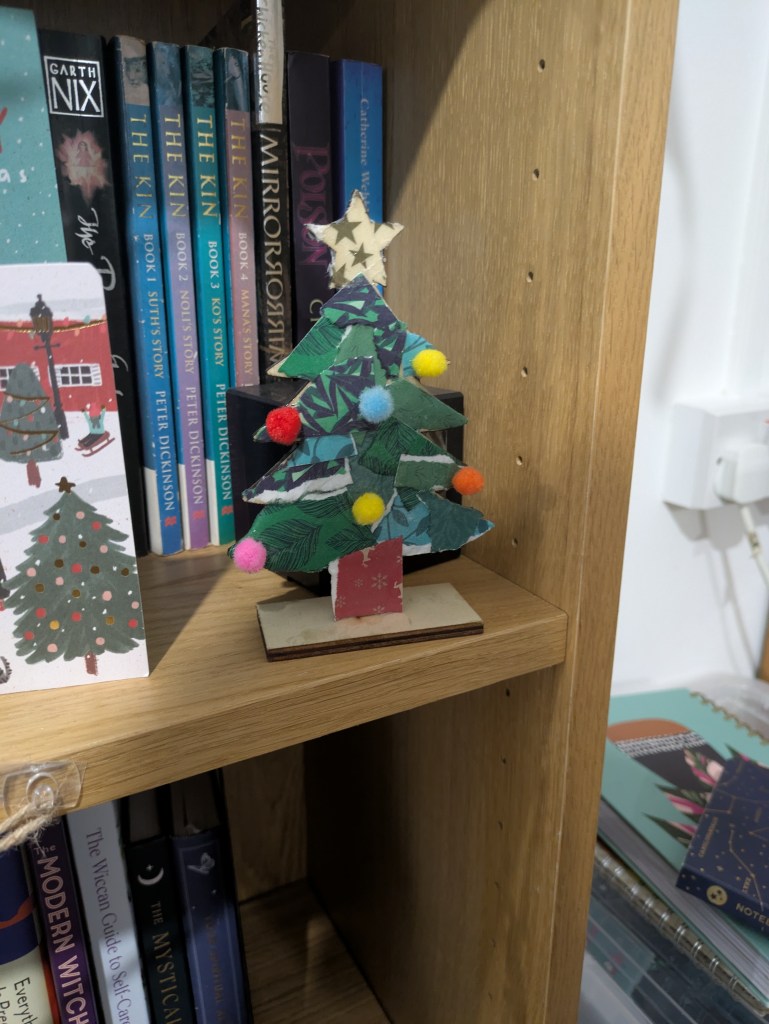
    I made this christmas tree decoration on a night I was really struggling:

    Now that’s not a brag. It was actually completely the wrong coping mechanism – it lead to my becoming so distressed I toppled my Christmas tree! No damage done, to me or the tree, so nevermind but still. Trees are not playthings!

    So I had to rethink the ways I was trying to cope: too much tv, crafting, distraction.

    What I needed:

    • stimming
    • sensory items like my weighted blanket
    • lava lamp
    • radio music
    • spotify music
    • taking a break from christmas
    • opposite action: opening some of my own presents that I’d bought for myself/one my mum got for me
    • radically accepting
    • a little clock for my kitchen so I could be aware that time is passing
    • engaging in special interests – and strewing them around the room for a low demand way to spark interest

    Using these methods has helped me work better with the home treatment team. With good communication about my being autistic and PDA with them, they did an excellent job of adapting their approach, and I’ve impressed a lot of them.

    You can cope with distress and crisis as a PDAer – you just need to work with your brain and not against it!

  • Life planning

    Now I have the meds I need, I can calmly think through life planning as a positive activity.

    To do this, I never use smart goals, they confuse me. Let alone the demands of the requirements they have!

    So instead, I just do very informal notes:

    Learn to drive

    • autonomy
    • need to concentrate
    • need to not dissociate

    I do this via different categories, e.g. bipolar and goals, ADHD and goals. Yours may vary, if you wish to give this a try.

    Following that, I review some time later – probably quite some time later, as in years. I cross off the things that no longer matter, tick off progress, throw away things that have been completely solved. It gives me such a sense of achievement!