Category: lived experience

  • Neurodivergent distress coping

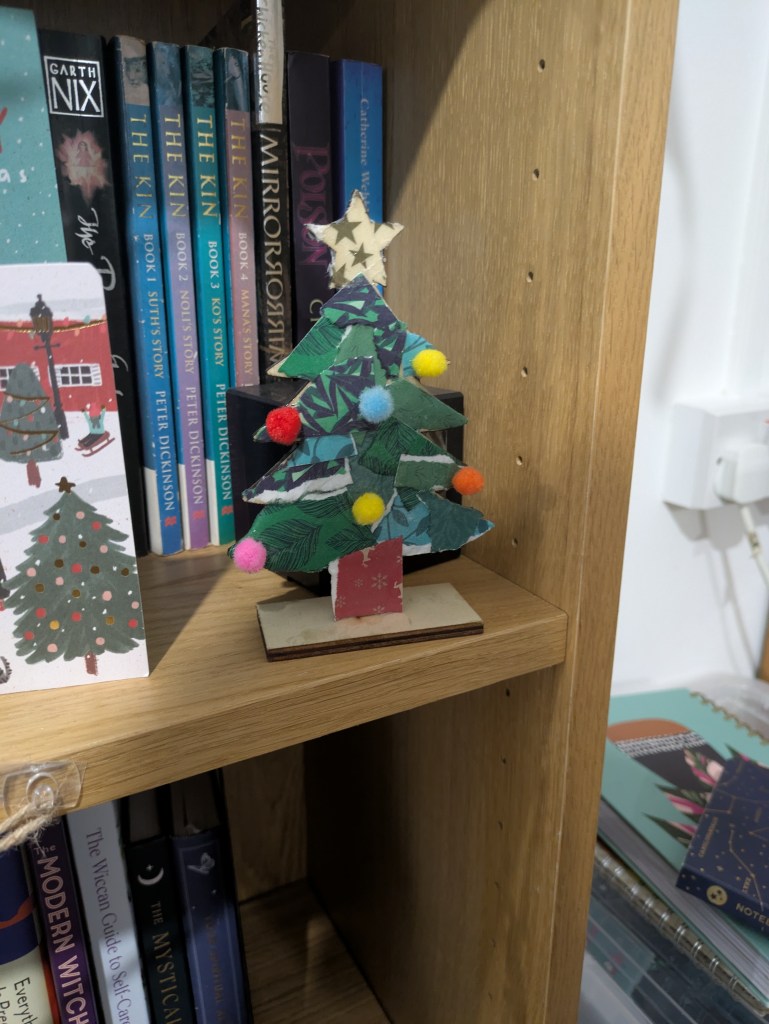
    I made this christmas tree decoration on a night I was really struggling:

    Now that’s not a brag. It was actually completely the wrong coping mechanism – it lead to my becoming so distressed I toppled my Christmas tree! No damage done, to me or the tree, so nevermind but still. Trees are not playthings!

    So I had to rethink the ways I was trying to cope: too much tv, crafting, distraction.

    What I needed:

    • stimming
    • sensory items like my weighted blanket
    • lava lamp
    • radio music
    • spotify music
    • taking a break from christmas
    • opposite action: opening some of my own presents that I’d bought for myself/one my mum got for me
    • radically accepting
    • a little clock for my kitchen so I could be aware that time is passing
    • engaging in special interests – and strewing them around the room for a low demand way to spark interest

    Using these methods has helped me work better with the home treatment team. With good communication about my being autistic and PDA with them, they did an excellent job of adapting their approach, and I’ve impressed a lot of them.

    You can cope with distress and crisis as a PDAer – you just need to work with your brain and not against it!

  • Friendship gets easier with practice

    Recently I made a post on my instagram about one of my biggest autistic traits is difficulty making, and keeping friends. I’d now state that as biggest PDA trait – but also I’m finding that contact with 111 option 2 is helping me shift my communication, boundaries and locus of control.

    That is to say, I am more aware of what I can control and what I can’t – which really helps with intolerance of uncertainty. It also reduces the anxiety driven need for control.

    I am also better able to stand up for myself but also take responsibility for my own actions, because 111 definitely expect that of you. Once you start doing that, they are very able to work with PDA and autism, actually. They will adapt their communication, and expectations as far as a non-autism specialist service can.

    The outcome of all this is that I am much more selective in who I keep in my life – which makes for friends who actually want to check in on me and see me in person (which as a socially motivated PDAer, I need! )

  • responsibility update

    Still hitting the mark on responsible (apart from one or two minor wobbles). I saw the section 12 drs and aced it! So now I have all the meds I actually need and I feel calm and sleepy.

    Just managed a basic dinner, so that’s food in me.

    I’m doing pretty good!

  • How I take responsibility through mania

    I have a ten year plan: buy a flat with two bedrooms and adopt a kid (likely allistic, to lower demands on myself! Gotta do what’s right for the kid!)

    So, when I have bipolar 1 with psychosis, obviously that means a LOT of self-responsibility.

    Turns out, I’m capable of that! I’ve been calling 111 every time my mental health noticeably worsens, and aiming to only do so then.

    In between I’ve been brainstorming autism/neurodivergence related means of coping:

    • colouring
    • reading autism books
    • stimming
    • demand free time
    • listening to an audiobook
    • my kindle

    NOT:

    • crafting
    • knitting
    • TV

    They need to be low concentration, high stimulation for my ADHD. This is a very hard balance to find!

    That said, I am doing very very well. I managed to communicate my needs to a local community hub, telling them about the need for an ambulance, and also to a local charity shop I wish to volunteer for. I also emailed for a dyspraxia lived experience role, admitting to my period of illness and hoping it’s brief.

    All in all, I’ve been very successful in looking after myself through a thankfully mild mixed episode. Clopixol is my wonder drug!

  • “Radio days”

    This is something I’ve discovered today after putting radio one on in the morning, keeping it on after my mum came to see me, and then returning to the radio when we got back. I’ve actually kept it on into the evening, so it’s been a whole day of radio shows.

    It’s actually very regulating for me. It’s like having background company, which reduces loneliness. It’s also lower demand than tv – you can tune your attention in and out. Pay close attention to the funny chat, let a song be pretty in the background.

    One thing is that sometimes you do have to ignore a song you don’t particularly enjoy. I found the giggles from the commentary made that worthwhile today.

    I think I will try and make time for radio days, much like I do for demand free time. I think they may become equally important for my mental health.

  • Emotional flashback.. again

    I’ve been super anxious recently. My antipsychotic depot’s cause this each time so far outside of hospital, for Trauma Reasons. This weeks was better, in that I didn’t get a week of intrusion symptoms, but I did get nightmares the night before.

    I was also extra-sensitive to loneliness. I’m not entirely sure why that’s what came up. I suppose it might have been an emotional flashback. The feeling: all alone in a hostile space, post trauma.

    I emailed the PDA society, my therapist and SANEline, all of which have been good sources of support for me in the past. I also tried nightline for an immediate response, which has historically been the best helpline I’ve used (it’s by students, for students, term time in the UK). It wasn’t so helpful this time, and I should have ended the webchat much sooner – it amounted to a degree of emotional self-harm that night.

    Thankfully the email responses were a lot stronger. The PDA Society supporter urged me not to give up hope of making connections, though they edged on advising learning to mask better which I’m not 100% on board with. They talked about working with a professional and trusted family member/friend to work on mastering ‘social do’s and don’ts’. I can see some use for that, but it’d be nice to get advice on ‘here’s how PDAers meet people they can be themselves with’. I do appreciate them being able to supply recommendations for professionals that can support.

    SANEline suggested hobby groups, and offered questions for further thought. I still need to respond, it’s likely to be a validating discussion. That’s what I find SANEline are most useful for when I talk to them.

    My therapist had the best response, which is perhaps unsurprising given she knows me as an individual. She stated that perhaps humans are not the most reliable source of connection. As such, she suggested that maybe I need to spend some time at a Cat cafe to get some oxytocin. She also reminded me that I can brainspot in my own time to strengthen my brains awareness of my good qualities.

    So I put that into place after my depot injection. Headed straight to the local cat cafe. A kitty prompted clambered straight onto me and wanted to be held for hours. Definite oxytocin hit!

    Following that, I went to the local MH hub to talk to some humans that understand. Had a couple of in depth chats, some light hearted chatting, did a tiny bit of studying. As my therapist predicted, it wasn’t as secure a source of connection – but it was still valuable.

    Then, tonight I had too much demand anxiety to sleep. So, I put on my lava lamp for the first time since being here and chilled out. Over the time I: read my queer fantasy book, read up on developmental psychology to prepare for research assistant volunteering, used Finchcare, and sat and watched the lava lamp to the sound of a fire-scape video on youtube.

    That last activity made me fixate my gaze on the lava lamp, and I began to notice feeling unusually soothed. Gaze fixation is a big part of brainspotting, so I checked if there was another location where that sense of soothing increased. There wasn’t – at the angle I was sat at, my lava lamp seems to fall in my “soothe spot”. I tried it again later in a different room, and yup it’s the spot.

    So I haven’t done the exact brainspotting my therapist recommended, oddly enough – but I have done that! I also did the “injection trauma” spot before leaving my flat to get the depot injection, which does seem to help me cope.

    Now I’ve written it all out, it’s clear to me that was another layer of emotional flashback caused by depot injection. A shorter one this time. I attribute that to the process of brainspotting I’ve started on this trauma. It’s good to now have a brainspot I can use to soothe my way out of emotional flashbacks/help me through them till they end. It’s a reminder that there’s a good reason to meet the demand my therapist gave me to strengthen the neural re-wiring in my own time.
  • Module begins

    It’s the first week of the module, and I’m a week ahead. That’s because the website opens before the module commences, not because I’m superhuman and studied two weeks in the first week of term.

    It definitely feels better to be a week ahead. There’s less sense of pressure, and if I can keep up this way, I can take a rest week if I need to. I’m not sure if it’s going to be possible to get any further ahead with this module. Every week involves a lot of notetaking, so cramming two weeks into one would be very intense.

    I feel more confident now that I’ve managed a week of study in an actual week. Prior to the module starting it had taken me two or so weeks to complete the first weeks study – I think having the actual time pressure helped me register the importance.

    I like that this module moves frequently between sciences, that will keep my brain engaged and curious. I have to think about it little bit by little bit, because thinking all the way to May makes me feel rather overwhelmed. Instead, I’m trying to think in terms of tutor marked assignment (TMA), by TMA. Taking each one in turn, and focusing on the work each one needs as they come up.

    The TMAs on this module are lengthier than I’ve been used to on my previous module – rather more demanding! With gentle self care, perseverance and persistence, I shall tackle each one with mindfulness of demand anxiety. I foresee a lot of demand free time in my future!

  • Gamification

    I use this a lot to help me get tasks done. It involves turning activities of daily living into a game – scoring points, getting rewards (if that works for you), growing a character, going on quests.

    I find the best rewards for me are ones that aren’t part of the real world. For example, I use Finchcare, which is a little app with a finch, where the rewards allow you to dress up your finch, or decorate their little home. It’s not pushy – it does ask you to set a streak, but this feature is pretty ignorable. It doesn’t nag you to complete tasks, you can turn notifications off, it just celebrates what you do get done. I have tasks that are just there to be avoided, if I’m honest. If you’re interested, and would like to start with a micropet, my friend code is F9AQBHSE5D.

    The other main form of gamification I use is Habitica. In this one, you have a little pixel character, that again you can earn ways to dress them up. You can also set real life rewards, if that happens to work for you. There’s also quests to go on, to defeat monsters. This really helped me for a long time to carry out cleaning, and such tasks. I might use it again to encourage myself in my studies. I do tend to set fewer dailies, because these give damage when not completed, which can become demanding.

    I find the novelty of a little game a good way to work around perceived demands. It especially helps when there’s little to no consequence to skipping a task, but a boon to completing it.

  • Maths in words

    I want to share my method I found during my stats class at Cardiff University that seems to work for me when it comes to learning maths procedures.

    It involves focusing on learning the procedure in words. Focusing on the concepts, expressed verbally. Writing these out as a questionnaire was a great way for my mum to help me revise for my stats exam, and I managed to get a first!

    To use an example from my current studies:

    How do you convert a time expressed in years to one expressed in seconds?

    Multiply the time in years, as in expressed in standard form, by the amount of seconds in a year, as expressed in standard form. This gives the amount of seconds in each year in your original total.

    I don’t want to practice using the formulas – including the numerals leads to errors. I was always told I was ‘overcomplicating things’. However, it’s more that I simply can not use formulas unless I actually grasp the underlying concept – and so long as I revise the concept of the procedure, I don’t seem to even need to practice the formula to use it!

    I hope this might be of use for someone else out there (and please correct me if I’ve gotten the concept wrong in the example given, I’ve typed it out from memory from only having begun to work with it).

  • “what would I freely choose to do now?”

    I experienced a lot of demand anxiety today. I had been very disconnected from my demand anxiety after the stress of nearly entering supporting accommodation, and the results of that – which were very serious and quite triggering, so I will not be detailing that here.

    I was sat in the library, around other people, which in itself helped me enter ‘doing things mode’. Watching others apply themselves seems to help switch me into that mode, much like wearing shoes and proper day clothes is known to help some PDAers. Initially I journalled after thinking ‘I have the freedom to write whatever I choose’ – a similar approach to that taken by Dr Gloria Dura Vila in my assessment.

    I then thought of the question in the title, and started brainstorming anything I’d choose to do if it were possible. My first answer was ‘run away to the arctic’ which wasn’t acheiveable, but did make me feel better. As I wrote more, I generated thoughts that I could act on, such as create a research plan, and write a short story.

    I think this will be really good for times when I’m very bored, but my brain is saying ‘No!’ to everything, or days like today, where I really want to be doing, but everything feels very anxiety inducing. Something about starting with the impossible, and then teasing out the possible really helps, and focusing on free choice is key.