Category: autism

  • High demand capacity

    I’m having a rare day of low demand anxiety/high demand capacity. Seems slightly odd after the demand that I fix the ways I didn’t meet standards in a room inspection within three days – it has to be said yesterday that made me extremely anxious and tanked my mood.

    I guess a good 17 hour sleep was exactly what I needed in that state, after being awake for 28 hours (fairly common for me). It seems to have restored things, and I can make sense of why the things need to be done, so that helps with the demand anxiety. It also helped that when I wrote out the tasks involved, it was less than I had estimated. Also, a local autism charity offered support to get the more difficult tasks done, after I called them for support in the anxious, dysphoric state.

    What’s been really awesome though, is that I’ve had capacity for hobbies. So far today I’ve knitted a little, played a solo TTRPG called Ironsworn, and played a board game with a friend and staff at the supported housing. After writing this post, I’m going to pick back up a book I haven’t touched in over a month.

    Days like this are rare, and very treasured when they occur.

  • Untypical, by Pete Wharmby

    When I was discovering my neurodevelopmental differences (I don’t say neurodivergences, as I include bipolar in that, which I already know about), I started processing all the trauma that was associated with them. It left me with the feeling that neurotypical society was deeply hostile towards neurodivergents, particularly Autistics.

    So I knew I wanted to read the recent release based on the tagline alone: “How the world isn’t built for Autistic people, and what we should all do about it”. It promised acknowledgement and validation, and that’s exactly what the book delivers. It also offered a sense of hope, that there’s things that can be done, that this hostility isn’t unavoidable.

    My brain isn’t braining very well recently, so it’s hard to find the words to express everything I feel about this book, but I heartily recommend it!

  • Inside our autistic minds

    I’d avoided watching this. Partly from all the discussion about it, and from someone asking me if I’d watched it… so of course that expectation was paralysing. Mainly though, because of fear of a mainstream documentary just being shit.

    It wasn’t.

    It really, really wasn’t.

    Flo’s video to her mum had me in tears. I’ve asked my mum to watch it, because of that scene (well, the whole thing).. that scene felt like everything I’d say to my mum if I could find the words and courage. I related so hard to everything Flo had experienced and expressed. Being obviously different from a young age, but not knowing why. Knowing you needed to be more like everyone else.

    The sense that who I truly was, was Wrong.

    With PDA and the way it differs from non-PDA autism, for years I felt that autism didn’t even fit. That I definitely felt odd, and different, and struggled socially… but couldn’t possibly be Autistic. I was just Wrong. Not struggling as much as Autistics would, seeming to just be a failing neurotypical. Discovering that PDA explains the space of ‘surface social skills, but still impaired’ was life-changing. Finding that I do have a place in the community of neurodivergents feels like coming home to my own people. My neurokin.

    Not only coming home to my own people, but coming home to myself. My stims. My hyperactivity – and knowing the benefits of expressing it through physical activity. My intense interests. My demand anxiety. My rollercoaster emotional experience. My ability to roleplay. My need for control. Myself.

    It’s so good to know that I am Autistic, and to find content that reflects my experience back to me. Not just this documentary, but all the content on social media. Books written by Autistic people (I recently pre-ordered Untypical by Pete Wharmby and will review it here when it arrives). The play I saw in July last year, Atypical Rainbow.

    But also learning about the experiences of people elsewhere on the spectrum. The documentary also focused on Murray, a non-speaking Autistic man with apraxia. His film made me think of the kids at the school I worked with, and my hopes that they are introduced to spelling to communicate. It made me think of my period of situational mutism, where I too had so many thoughts – I was manic, so many many racing delusional thoughts! There was a lot going on in my internal world that no one had any idea about. Murray expressed himself beautifully and eloquently through his film, clearly an intelligent young man.

    There’s nothing like the magic of neuro-affirming creations by, and interactions with my neurokin. I wish we could all grow up with this from a young age, instead of experiencing behavioural modification, bullying, and abuse forcing us into hiding our true selves.
  • Stimming

    I’m genuinely surprised I haven’t already written about this. I think one of the biggest parts of my mask was suppressing my stims (and hyperactivity) – in truth I am a wriggly, fidgety stimmy being. Forever drumming my fingers, bouncing my left leg, spinning a fidget spinner. Oh how I wish I’d had fidget spinners as a child!

    I’m not sure if I ever flapped my hands as a child. I started to when I was dating an Autistic woman who had this stim, before I even realised I was Autistic. I would apologise for copying her, but find joining in irresistible. If we’d known about the ways the PDA profile differs from non-PDA autism, I think I’d have gained a diagnosis much sooner (as it was, she said.. “you definitely have sensory processing issues, but you lack the rigidity I’d expect”). Nowadays I tend to shake my hands rather than flap them, as I find that more satisfying.

    Unfortunately, a cost of masking my stims as a kid was developing a skin picking stim. Everything else got me told off, but an actually self-injurious stim was apparently fine? I will never understand. Since I was eight, I have literally skin picked every single day of my life. It’s proven near impossible to stop. I had been making an effort to pre-hospital and I probably ought to try again. I do use multiple much healthier stims now as well, and I hope that’s building an armoury against this stim. It seems to be helping me use the self-injurious stim less, but not yet stop using it at all.

    I’m so glad I rediscovered the joy of stimming. It should be an Autist’s birthright.

  • “Excessive mood swings”

    The week since my trip to London has ended up being very low demand. I’ve mainly just slept and watched tv on my laptop. It’s not felt great, but I suppose I just needed the downtime. I’ve avoided all my household tasks, including ordering in food a few times. It’s so useful to be able to understand these periods in the framework of demand capacity and anxiety.

    I definitely experience the mood fluctuation component of PDA, on top of my bipolar mood swings, and trauma related emotional flashbacks. PDA seems to mean that if I feel lonely, it’s extremely lonely, down is extremely down, excited is extremely excited. I don’t seem to do ‘small’ emotions. Recently I’ve been more mindful of those swings, noticing when they come to an end and when they shift. It’s helping me notice that the bad times aren’t permanent, and that it’s all cyclical. I seem to swing between productive, energised times with more demand capacity… and low energy, low mood times where I easily feel overwhelmed with lots of demand anxiety. It’s something that my previous bipolar medication, sodium valproate, really flattened and looking back I can see how zombified I was on that med – it doesn’t feel surprising that I pulled myself off of it really. Risperidone seems like a much better med for preventing psychotic mania, whilst not preventing my natural emotions.

    Sometimes “excessive mood swings” are really difficult to cope with, especially the ways low moods feel so very low. It’s infinitely preferable to experience them though, than to be completely flat.

  • Non-speaking, briefly

    Something I haven’t mentioned here is that during my stay in a psychiatric ward in 2021-22, I had a brief experience of being non-speaking. I was very manic at the time, and my mind was super busy, so I’m not even sure I was always fully aware that I wasn’t actually saying anything. I do remember pointing to make decisions on what to eat in the dining room though.

    Something that stands out is being told ‘you’re a really good speaker’ by two people when I slowly started to talk again. In general.. lots of people treated me like I had intellectual disability because I wasn’t speaking. One lady did buy me ear defenders, as recommended by her autistic kid… but also a peppa pig colouring book. It definitely feels like most people assumed I was childlike in that phase of my stay. Something else that stands out is my psychiatrist saying the period where I wasn’t talking was ‘scary’, which is hard to know how to interpret.

    I’ve been told that this is likely a form of situational mutism (by L, who previously worked as a speech and language therapist, and also my therapist). L suggested that probably speaking became too great a demand for me, which makes a lot of sense. I have definitely thought about how speaking is a huge demand since this experience, and one that doesn’t feel possible to avoid… but also a degree of tempting to avoid, just sometimes.

  • Neurokindred

    Something I really feel the lack of now I know more about my neurodivergences is the presence of neurokin in my life. When it comes to the bipolar, I have my neurokin there, one friend with bipolar, another with schizoaffective (and another with schizophrenia), and this feels so good. It’s good to have people who understand being hospitalised, or being psychotic and experiencing delusions. It’s also good that one of those friends is also autistic and ADHD, so I’m not completely alone.

    I’m going to an ADHD support group tomorrow night, so hopefully I will meet some more neurokin there. I also joined an online autism peer support group, which was a great experience earlier this month. I will blog about both of these in the near future.

    What feels particularly lacking is PDA neurokin. We’re not the most common of people, and often we like to interact online. Dannii at PDAourway often refers to her neurokin friends and it always induces a pang of longing for me.. to have numerous friends who are true neurokin, in being PDA and ADHD. It’d be good to have people in my life who truly understood the PDA experience, rather than who were learning about it.

  • (untitled)

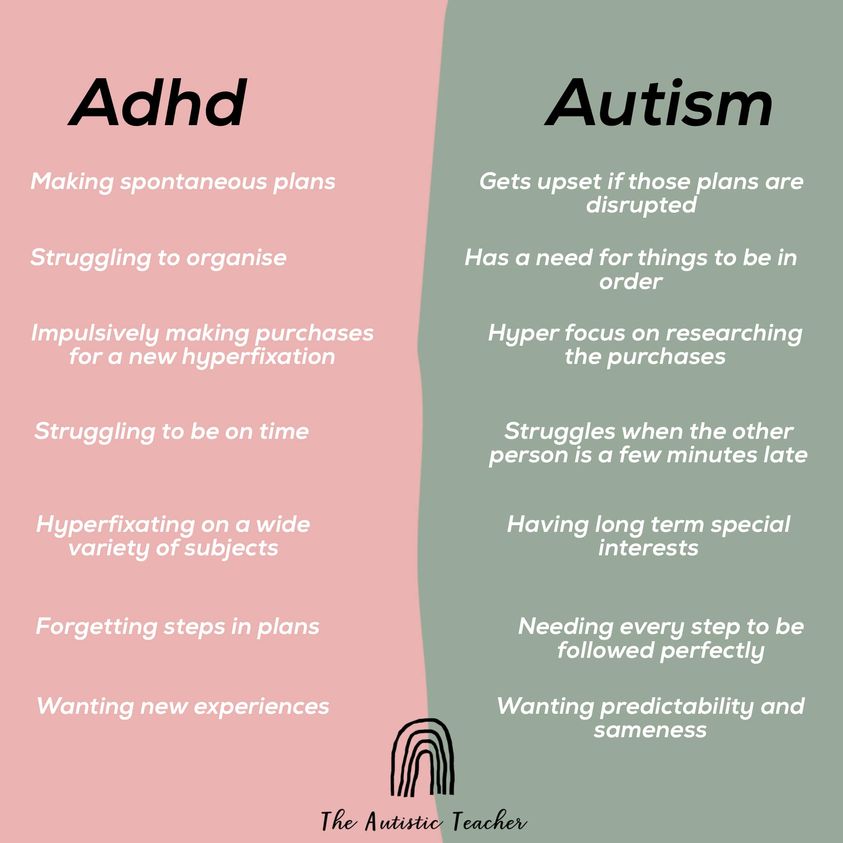
    Found this graphic on my facebook feed, from the page The Autistic Teacher. It made me consider which of the two sides I fall on for each item:

    • Probably more likely to get upset if plans disrupted, especially as a child. Might occasionally make spontaneous plans, I’d need to mindfully observe myself to work this out
    • Struggle to organise, definitely
    • Impulsively spend!
    • Struggles when others are late (and likely to be early to compensate for bad time keeping)
    • Both: usually i’ll have a special interest I spend time almost casually engaging it, it’s very easy, it’s a low effort thing to spend time on. I’ll also have a range of hobbies that take effort to engage in, but that I can get fixated on
    • Forgetting steps in plans is more likely for me
    • Wanting new experiences, I love novelty.