Author: plumfae

  • My demand cup, three months on

    Last time I posted about this, it was still feeling pretty small, and easily filled. I think with time, I’m slowly managing to increase the capacity of my demand cup back to the kind of volume it had pre-hospitalisation. Definitely having more autonomy over my life is helping with that. Wards are awful places for me as an ADHD PDAer… dreadfully understimulating, and total loss of autonomy. They’re necessary when I’m deep in psychosis and have no capacity (in the legal sense) and/or insight, but I hope that in future I will be discharged from them much quicker if I ever need them again. This is the advantage of supported housing, because you’re part of the community and have all the freedoms that come with that, just with some extra support.

    My emotional cup is pretty stable, which also helps. I’m not losing capacity in my demand cup because of overflowing emotion from that cup. I’ve also been taking a little demand free time recently, and it definitely helps me recuperate. The novelty of coping techniques worked well, it’s unsure yet if they only worked because they were novel or if they are long term ways to help myself cope with demands.

    When I was hypomanic, I was learning to tune into my demand anxiety for the first time – pausing to notice, how does this expectation, or requirement, make me actually feel, before undertaking the task. I believe I had learnt to dissociate from this demand anxiety, faced with the unsafety of listening to it and attempting to avoid. I learnt that demands very much do incude demand anxiety, and I had been attempting to learn how to balance this with achieving tasks, for example, I usually found I had more demand capacity in the mornings. Unfortunately, circumstances during this time meant that nearly all the communal household tasks in a shared house ended up falling on me, which overloaded me and likely contributed to my mental health crisis. That disrupted my process of learning to understand how to work with my usual demand capacity and anxiety, and rerouted me into working to regain demand capacity for the past 8.5 months. That might perhaps be a useful exercise to mindfully do again, so I can notice when my demand anxiety is higher and why. See if mornings are still an easier time to achieve tasks, and what if any other discoveries I might make.

    Something that needs work is:

    “PDAers need safe people around them, which means people who fundamentally understand that they are not giving everyone a hard time, they are not just lazy or trying to get out of helping or working, they are struggling and need even more love and support. One person is a necessity but having more than this is the only way a PDAer can really thrive.”

    (Tomlin Wilding)

    I find that as PDA is so little known, there’s very few people who get it at all. Ultimately that can feel like, because no one gets PDA, no one gets ‘me’, and that feels very lonely. Staff at my supported living are definitely a long way from understanding this, in group activities there’s often an air of ‘you’re not getting out of it, join in!’ It’s my hope that training from the PDA society might help them move to a place where they do get this, which would be a massive benefit.
  • Happy 2023!!

    It’s a new year, and for once, I’m excited for it. I’m also really happy with the year I’ve left behind. It didn’t have a great start, being sent back to the acute ward from the rehab ward (that is somewhere I would advise is not the right place for any PDAer.. you will not have enough autonomy on a ward to properly regain functioning. I’d definitely recommend supported housing over that), catching covid on that acute ward. I spent ten days isolating in a very understimulating room in January this year, and three months on an understimulating ward. The other problem with being on a ward for 9 months, was that on the acute ward there was next to no demands and as Isaac explains in this video, the longer you go without meeting demands the harder they become to meet.

    So when I was discharged in April last year, to this supported accommodation, I had a double sided problem. I was vastly understimulated – that degree of bored where it’s painful, but also completely out of demand capacity. I spent most of April and May just watching tv in my bed to recuperate (something that would never have been acceptable on the rehab ward, who wanted me to go from no demands on the acute ward, to cooking for myself, cleaning my bedroom, doing my laundry – basically immediately fully functioning). The tv provided just enough low demand stimulation to address one side of the problem, and over time I added in more and more demands. Eventually, I started spending time outside in the garden, which is where my friendships here blossomed. Over time, I started knitting blanket squares, which I am still working on at a very slow, undemanding rate, with the aim of eventually sewing them up into a massive blanket. I also started volunteering at a local charity shop, which provided me with work experience, socialising and something to do with my time.

    A highlight of 2022 that occured around this time was seeing Atypical Rainbow at the Turbine Theatre, near Battersea Power Station, for my 32nd birthday. It was a play about a young autistic actor, and his gay coming out, his experiences as a young boy, his families experience. It was deeply moving, and had me in tears by the end. I think it meant a lot to my mum as well, as she also strongly related to the experiences depicted.

    Not long after this I started my first job (finally well enough to work, this is a big new step for me!) at a local SEN school. I loved the kids, and helping them communicate was a big passion of mine. I learnt though, that I think I’d rather work with adult neurodivergents, in peer support, and also possibly in research into neurodivergence, particularly PDA. Unfortunately, this job had to come to an end in late November. For the end of the year, I’ve been rediscovering twitch streams, and having a very christmassy December. It’s been special, having my own place to decorate how I wanted for Christmas for the first time.

    Going into 2023, I have some worries (family medical issues), and some big hopes. I have four big goals for 2023 which I hope I can achieve. I would absolutely love if this year, I could:

    • return to university – planning on studying the open degree at the OU. This degree has a module where you use previous open educational resource courses towards the module, and I’ve been making a start on these.
    • learn to drive – planning on automatic lessons
    • find a new job – have already been applying, and attended one interview at the end of 2022
    • get involved with ‘survivor’ research in mental health and neurodivergence – to that end, I’ve had some mentorship with the Survivor Research Network, and joined some lived experience panels at Healthwatch and found out the details for my local hospital trusts lived experience panels.

    So clearly, in going on 9 months, I’ve regained a lot of capacity. I’ve also found a lot of things that fit within my personal PDA flow, or act as table legs to that table top. I’m excited for 2023, it’s been a good two hours so far lol, and I’m hopeful for some real wins this year.

  • Christmas Eve

    It’s officially the Christmas period here in the UK now. Today I’m planning on baking with a friend, tomorrow I head to my parents for The Day. It should be a nice, quiet, chill couple of days. My mum and I plan on knitting ornaments for a Christmas Day activity as last year we knitted a wreath and it made for a lovely day. It’s nice to have something to do other than food and presents. It feels like being a kid again, who got to play with presents on Christmas afternoon. (My spellcheck is insisting I capitalise christmas, and that makes me want to refuse!) I’ve found that adult christmasses lack that aspect that childhood christmasses had – most of the presents aren’t something you can interact with that day.

    This is much better christmas than last year. I live in my own flat, rather than on a ward, and that means I have a lot more autonomy. I’ve proved I can handle working, which is a big step this year. I’ve made new friends, and made stronger connections with old friends. I’ve been able to enjoy an advent, rather than just christmas day itself. It’s lovely. I realised a couple of weeks ago, this is my first normal christmas since 2019, and it’s really rather special.

    Merry Christmas to everyone who checks in here! And for any PDAers, far be it from me to order that you must have a merry christmas, have any kind of day you like at all tomorrow.

  • Uncertainty

    One of the key traits of a PDA profile is ‘intolerance of uncertainty’ and for me that’s never stronger than when it applies to uncertainty about what my future looks like. Right now, that’s because of a job interview I had yesterday. I did the best I could, but was also honest about my disabilities, and it could go either way. That means I don’t know what I’ll be doing in two weeks time. Whether life will continue much as it is now, or if I’ll have a new job to adjust to. Somehow it’s worse because it’s relatively close that a big change might take place.

    It’s leaving me feeling out of control. As a result I have very little demand capacity today. Earlier I struggled to get myself to respond to hunger by eating, because my body was expecting food. I used my support meeting to ask for help with the uncertainty, but the staff only know the advice that works for allistic mentally ill people i.e. they gave advice that placed expectations upon me. I may have responded to being given puzzle sheets to ‘keep my mind busy’ by putting them straight in the bin: exerting autonomy is more reparative for me right now than a suggested distraction technique.

    I wish more people had my therapists level of understanding, as she would have known how to help. Or even just to validate my experience, without aiming to fix it. I just need my autonomy re-affirming, and reminders of what I do have control over. Uncertainty is difficult, and maybe always will be. I haven’t seen much discussion of what helps PDAers cope with it, and I’d be intrigued to know what my neurokin do to cope.

  • (untitled)

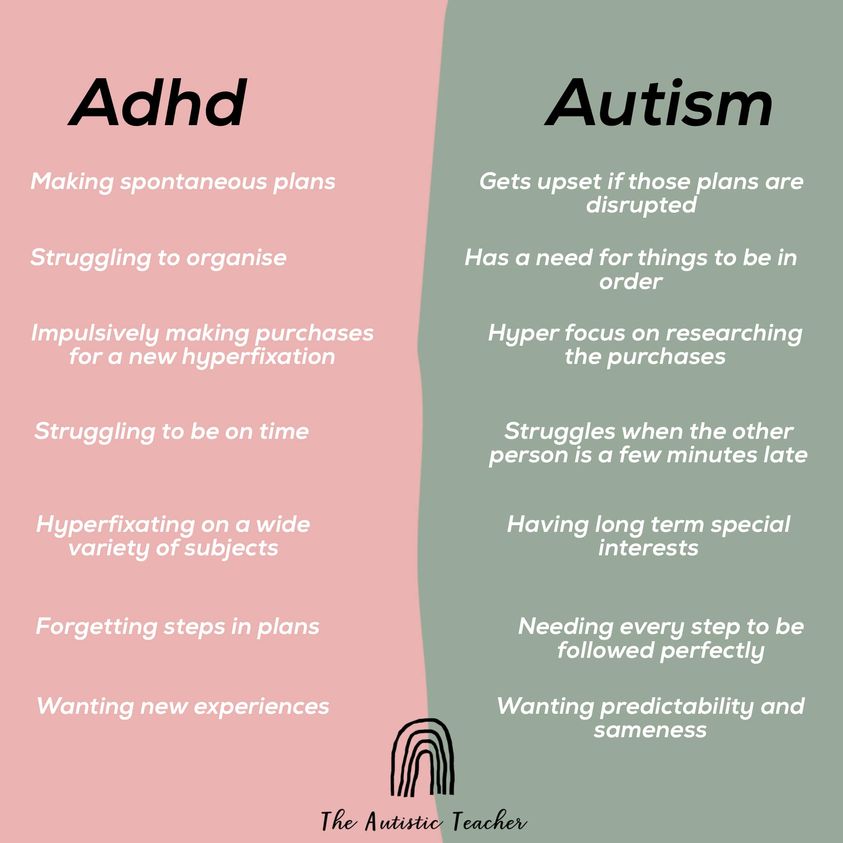
    Found this graphic on my facebook feed, from the page The Autistic Teacher. It made me consider which of the two sides I fall on for each item:

    • Probably more likely to get upset if plans disrupted, especially as a child. Might occasionally make spontaneous plans, I’d need to mindfully observe myself to work this out
    • Struggle to organise, definitely
    • Impulsively spend!
    • Struggles when others are late (and likely to be early to compensate for bad time keeping)
    • Both: usually i’ll have a special interest I spend time almost casually engaging it, it’s very easy, it’s a low effort thing to spend time on. I’ll also have a range of hobbies that take effort to engage in, but that I can get fixated on
    • Forgetting steps in plans is more likely for me
    • Wanting new experiences, I love novelty.
  • (untitled)

    If you’re looking for a place to donate this Christmas, I’d like to suggest Christmas for CAMHS. It’s a charity which organises safe and appropriate Christmas gifts for young people on mental health wards.

    The charity explains the need for fundraising for this population:

    “Christmas For CAMHS was originally set up because volunteers saw a huge disparity in the way CAMHS units were treated over the festive period compared to other NHS services for children and young people. We wanted to do something to change that.

    Children are admitted to CAMHS units to receive support and treatment for mental health issues, such as psychosis or depression or eating disorders like anorexia. There are no official figures for how many children will spend the festive season in CAMHS units across the UK, though we often give gifts to over 1500 young people. While many members of the public and corporate donors give Christmas gifts to children’s hospitals or children’s wards in general hospitals, CAMHS units, which are usually based away from other services, are often forgotten, or not known about. We don’t think this is right.”

    Christmas on a ward sucks for any child, but Christmas on a ward where it isn’t marked at all sucks even more. If you agree, please consider donating.

  • Metanoia

    At one point when manic in a session with L, my lived experience worker, I said ‘this is a metanoia’. She replied that that was cool, because she has a tattoo of metanoia in the greek characters, due to having had her own metanoia.

    I was definitely using such fancy speak because of being high as a kite, but I wasn’t wrong. “The term has been used in psychology since late 19th century, when the American philosopher and psychologist William James, often labelled as the “Father of American psychology” used it to refer to a fundamental and stable change in an individual’s life-orientation which is followed by a positive re-building” and that’s exactly what the past 2 years have been.

    It was a process beginning in November 2020, when my then boyfriend told me he wasn’t sure if he’d believe his child if they disclosed abuse. That was the trigger for my eventual mental health crisis I believe, and it certainly made me re-examine a lot of things. At the time, I felt like my needs were ‘too much’ to merit consideration, because historically I’ve needed a lot more than most people and most partners haven’t comprehended why. So I didn’t handle the situation well, and became very mentally unstable.

    It was after that though that I found Chime to Thrive, on the NSUN website in a list of places they had awarded grants to. I initiated contact with L in the hopes of her advocating around my trauma symptoms, but instead we identified that I had as yet unidentified neurodevelopmental differences. During my time working with her, I was becoming increasingly manic, and she was exceedingly patient with me and my difficult symptoms at the time. Looking back, it’s crazy how the mania led me to just simply trust in the process, that the increasing self-awareness was leading to significant changes and ‘positive re-building’.

    Thankfully, given that I was unfortunately very unsafe at one stage in my manic episode prior to being hospitalised, that process really has given me the chance to work on positive re-building. I managed to self-advocate that I needed supported accommodation in my first ward, which lead to the rehab ward being the option chosen rather than temporary accommodation. When that failed, an occupational therapist on the ward conducted an activities of daily living assessment, which secured me the supported accommodation I needed.

    Since living here, I’ve had a safe place to struggle with functional care tasks whilst I regain demand capacity. I’ve had the safe space to practice and learn strategies that help me manage demands. I’ve realised that I can handle working, so long as it feeds the PDA current do so. I’ve realised that my long term goals would be either to research PDA, from a lived experience perspective, or to work as lived experience peer support for neurodivergent adults. Towards that goal, last night I had a mentorship session with two ladies from the Survivor Researcher Network, in order to gain advice on how I might pursue that goal.

    It’s been a long, difficult and at times scary process, but I’m glad that manic me was able to trust. It was worthwhile.

  • Pretty big success

    For whatever reason, I’ve had a lot more demand capacity recently. Might be something to do with not having work at the moment (transport became untenably expensive), so I have a lot of spare time to get bored in. I’ve been trialling new strategies to help, and they’re making a real difference.

    The first thing that helped was setting a timer for five minutes and giving myself permission to stop after those five minutes if I wanted to. That was a long enough period of time that I could make a real difference in one small area of the flat. It’s a great strategy if I’ve got a middling amount of demand capacity.

    What I didn’t expect to be so effective was roleplaying being a carer. I pretended I was looking at someone else’s flat. Someone else in need of help. Looked, and thought ‘what would help you, pretend person, if I handled it today?’ Then whatever I felt I wanted dealt with was the pretend person’s ‘request’ and that just got me over the hump of demand avoidance. If I’m doing it because ‘I’m helping someone else’ in my head, it’s more like ‘Elliott the Carer’ is tackling the demand, and the threat response lowers.

    So today when I had my support session, especially given that I’d started preparing dinner beforehand, my keyworker was astounded. It was so nice that she was proud of me, but seemed to understand that there may be backwards steps after this rather than a new sustained way of being. I don’t think I’ve reached the stage yet where I will definitely sustain this way of functioning over time. I think it’s a lot more likely that I will have a good time, then a bad, in cycles.

    I think the ‘answer’ will be learning my own ebb and flow. Learning when I just can not, and allowing myself to avoid, learning how to get enough recuperation to rebuild demand capacity, and learning strategies that allow me to make progress when I’m doing a little better in terms of my demand cup.

  • Diagnostic report received

    After three months of waiting, I finally received my diagnostic report! It noted that my demand avoidance was ‘marked’ and causing ‘significant impact on my life’ which.. woah. I did not realise that it was that obvious and the impact so clear. Apparently the assessor had to make significant adjustments to the assessment process for me to be able to complete it, which I hadn’t noticed. It’s interesting that even though I feel as an adult, I fawn and mask, to a trained assessor my need for control was evident.

    It didn’t clearly state which subtype of ADHD I have, but did make references to both inattention and hyperactivity, so I assume it’s considered combined type. At the very least, I was right to identify hyperactivity in myself, as well as manic high energy – those two can be so difficult to distinguish! It didn’t help that during my last manic episode, I was exploring ADHD and explained manic high energy as ADHD. I will need to be careful to distinguish between the two in the future. Possibly noticing an increase in hyperactivity symptoms is a sign of hypomania for myself.

  • Mania recovery milestone

    During my mania last year, I lost all my saved music on Spotify, because paranoid delusions caused me to delete my account.

    It royally fucking sucked.

    Finally, I’ve started finding music that makes me feel as good as the music I had before. It had been a dreary year listening to music that only half ‘worked’. Trying yet another playlist, saving the best that I could find. Hoping my discover weekly would catch on to my taste.

    My friend recommended that I search for a song and then let it autoplay – so much better results!

    An hour in, and I’m back to my dance stimmy, sensory seeking self!