If you’re looking for new PDA resources, Sally Cat’s content is one I can highly recommend.
Author: plumfae
-
Sensory logging
Back in December I wrote about my intial findings from the sensory log my therapist recommended I keep.
I never got around to sharing what I found as a result.
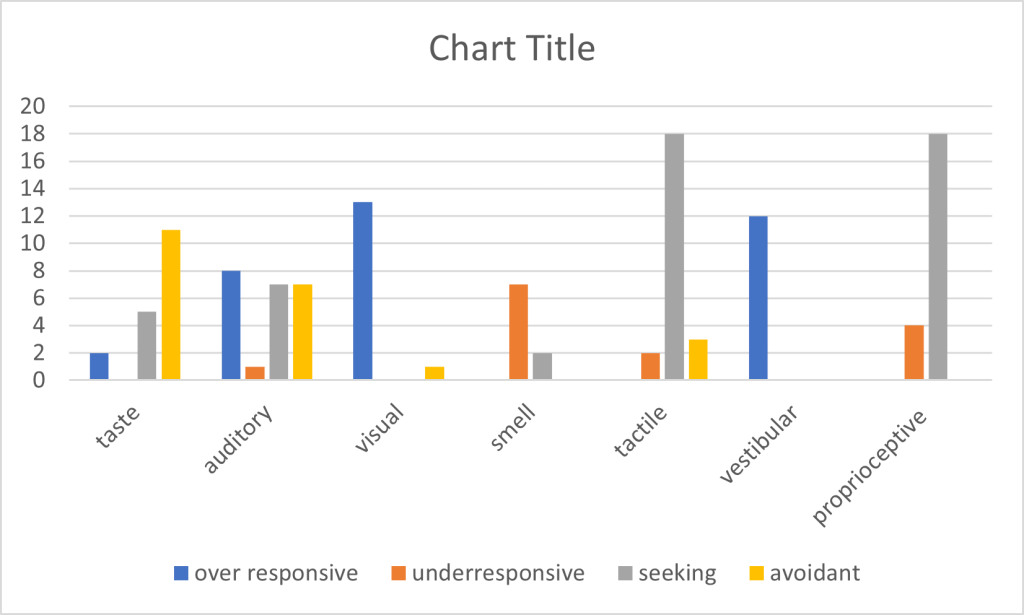
As this shows, I’m over-responsive/avoidant in all my senses, except for smell (which is severely underresponsive for me), tactile and proprioceptive, where I tend to seek out sensory experiences.
In my auditory sense, I seek out experiences that are under my control, and avoid sensory input that is not under my control – or easily experience overwhelm. My sense of taste is similar, but mostly I am avoidant.
It seems I would benefit from learning how to be visually and vestibular avoidant, in particular. I’m not sure how to do this though.
-
Happy Autistic Pride day!
It’s the last 15 minutes of World Autistic Pride day, so I just wanted to quickly note that.
It was nice, my non-autistic friend said ‘happy Autistic pride day’ today 😀
-
My second chance.
Metanoia pays off, it seems.
That’s a word I’ve used here before: the idea of profound lasting positive change after a breakdown, esp. psychotic breakdown.
I’ve just been approved for a student loan to return to university! I had worried due to previous study and overpayments I wouldn’t be, so things had been uncertain and stressful. It’s so good to have the certainty about what I will be doing come October 7th.
It will be the Open Degree at the Open University, which in short refers to multidisciplinary study – lots of all the sciences for me, social and life/physical. Lots of modules on mental health, autism and ADHD, biology, sociology. It’s so exactly my area of interest – this is what I did my A levels in, bio, sociology and psych and I loved those.
2021’s psychotic breakdown really did lead to massive change for me. I got the actual care I needed from it, and rescued from stagnation where I didn’t feel competent to try anything. I also didn’t know what my goal, or aim was. It had been clinical psychology, and I lost that. Lost interest in it as well.
I didn’t have anything to replace it though, till I added the world of neurodevelopmental difference to my knowledge of neurodivergence (including mental ill health in that). Until I reframed everything as ‘neurodiversity’ and ‘examples of neurodivergence’ – that was a real paradigm shift. I also learnt how vital lived experience is and the power it holds, from working with my lived experience practictioner. But also from the wealth of lived experience shared on social media.
That gave me a drive to pursue after I started recovering. A HCA on the first ward that year said logically SFE should provide funding, otherwise they make no return on their investment in me. That provided the spark to reconsider university study, the hope it might be possible.
Sometimes living alone is lonely, but it provides me with the space I need to study without others around me. I have good meds, I have new diagnoses, I can get new accommodations. I understand myself better and what works for me. I have trauma therapy finally. The OU puts out so much needed and helpful guidance on how to study, and the level one modules are a gentle start. I get to study slowly.
Things should be much better this time, so I am very, very excited for my second chance.
-
Low demand lifestyle?
Am I living a low demand lifestyle? What defines low demand, and how would I tell?
I’m not claiming I have answers to those, but it is something I want to think about – how many demands are there in my life.
Living in “move on” supported housing creates demands, because you have to meet expectations to be considered ready to move on. Thus that prevents me from living a truly low demand life. I do have a lot more autonomy here than I had at the rehab ward though, which is good.
There’s also demands on me because, well. My reason for needed supported housing is more along the lines of autistic skill loss/learning to cope with demand avoidance/executive function issues, than it is mental health issues related. So the support I am offered does not meet my needs, which leaves me to work out how to regain skills on my own.
I am learning ways to approach doing things that lessens the sense of demand. Whether that’s having an algorithm as to how to tidy or clean (to remove microdemands), avoiding things until it sinks in I don’t have to do them, and other techniques I’ve mentioned on this blog before.
I think once I am living independently I will actually be able to have a much more low demand lifestyle. I will not have anyone setting expectations on me, and can just work to my own desires – and work on not seeing expectations on myself. I will hopefully by that point be a lot more skilled at regaining skills, and coping with traits of my neurodivergence.
So right now, I don’t quite have as low demand a lifestyle as I might benefit from, which is hard when I’m meant to be in a supportive environment. I’d suggest PDAers looking into getting this kind of support: refuse “rehab wards” for mental health if you are offered one, and be very very selective about which supported housing you accept, even if it means waiting for longer on an ATU.
-
A short history of friendship..
.. as a PDAer.
Which is to say, lengthy periods with no friends, or very few friends.
Primary school was a no friend time, except for abusive friends. I nearly made one friend near the end, but trauma caused by the abusive friends caused me to push her away self-protectively. I made a friend who attended my school via dance classes, so she was more a dance friend – she was several years below me, in classic early Autistic childhood friendship.
Outside of that, I was ostracised and bullied by the entire school of 70 kids (I grew up in a very small village). It was awful, and there’s not much more to be said about that.
In secondary school, the kids who lived in the town were much more bearable. I made friendships of varying closeness – though none were truly close. I didn’t really see any of them outside of school, except for one. I had people to spend time with in breaks, sit with in class, and that was the extent of most of my highschool friendships.
College is where friendship started really working for me. A girl approached me at the french taster session for upcoming sixth formers, and then when college started, I talked to her again. I dared to ask if I could come join her group of friends, she agreed and I suddenly had a group of friends! That made college a really fun place to be, with several of us dealing with mental health neurodivergences (and I suspect neurodevelopmental differences as well).
Unfortunately, I lost all of that group of friends over the course of two separate break ups, that ended up being acrimonious. Trauma, poor mental health, poor childhood modelling of relationships played into that.
At uni I was back to having very few, not very close friendships for the entire time. Making friends in a massive but impersonal university was impossible for Autistic me. I might have been able to make proper friends from the LGBT society, but never quite managed to. Networking is not a skill that comes naturally to me.
After uni I had another brief period of no friends. At the end of that period I had housemates for company – but they were not friends. Friends would have called an ambulance for me when I was manic.
Now I have a very small handful of friends, mainly at my supported housing scheme. I’m very selective about how gets to become and remain a friend, even if it means having fewer or no friends. I deserve friendships that truly meet my needs, and aren’t abusive – and some friendships have ended recently because of this.
-
A Kind of Spark Review
Juniper, 21st centur Scotland, is where we find Addie, and her older sisters Keedie and Nina. Keedie and Nina are twins, but Keedie has more in common with Addie; they’re both Autistic. Addie moves into Mrs Murphy’s class, a teacher Keedie has previously struggled with, and she introduces the subject of witch trials in 15th century Juniper – and Addie is filled with hyperempathy for these long ago women.
This book is a fantastic piece of Autistic representation I really wish had existed when I was 9 years old. It covers current issues facing the Autistic community today, such as long term hospitalisation, masking, stigma, and burnout. There are small infodumps on what these (and other aspects of the Autistic experience) are, which to me as an Autistic reader leant a real authenticity to the writing style – and yet, they’re never too long as to detract from the plot. The plot is relatively simple, as befits a YA novel, and that makes for a quick, joyful read. Even more so, the characters are enjoyable to spend an afternoon (as an adult reader) with.
The characters feel real, and have a real sense of depth to them. The mix of tension and affection between the sisters felt very true to teenage life, especially when siblings are neurodiverse. As much as Addie is a great character, I think Keedie is my favourite character, and I am intrigued to learn more about her in the upcoming prequel. Keedie faces her own challenges at the time of the story, but there’s clearly been an awful lot of challenges on the way to that point for her. She makes a fantastic older sister to Addie despite this.
The main theme of the book is that people shouldn’t have to face the challenges we do face (particularly women) for being different. Addie resonates with the women of the witch trials, realising that the way they are treated now for being Autistic is similar to the persecution experienced in the past, and that herself and her sister would have been victims to. It shows that we should acknowledge our wrong-doings and make whatever amends we can, when we have discriminated against those who we don’t understand.
I came to this book quite late, after it had already been adapted to TV for the BBC. I can definitely understand how it gained enough popularity with it’s target audience for that to happen. I’d recommend this book to any reader who wants a good comfort read for their inner Autistic child, or for anyone with an Autistic child who needs to see themselves in their stories.
-
The power of daydreaming
I used to daydream all the time as a young teen, usually on car journeys. I’d sometimes get back indoors and head to my bedroom to continue them as well. Since being a late teenager however, I’ve found sustaining daydreams much harder, and for years I stopped.
Recently I’ve been starting to daydream again. Today I made an active decision to spend a couple of hours indulging in a fantasy plotline in my head, just as I used to do when I was younger.
It was lovely. I forgot the world around me completely and all it’s stresses, to the point where it took a little while to re-orientate to the real world initially. A couple of hours later from then though, and I’m noticing a massive improvement to my mood, and demand capacity.
I had been feeling very stressed and upset recently, spending a lot of time dozing to avoid the world. That can be quite dissociative in it’s own right, hours will pass that feel like minutes.
However, purposefully engaging in a fantasy storyline felt a lot better for me. It felt like taking time out from the world in a structured, purposeful, creative way, rather than a despondant, avoidant way.
I rather get the feeling I should put work in to reconnect with this aspect of my PDA nature, and that it might just do me some good.
-
Mixed episode
As part of applying for disabled student’s allowance, I had to find my medical evidence to submit. One of these was my recent care plan from the CMHT (community mental health team).. and getting that out led to me deciding to google the ICD code my doctor had used.
It lead to a result that said ‘mixed episode’. Looking at my previous care plan, it had the same code, so my psychiatrist thinks I’ve been in this episode since at least November.
I’d identified that my pervasive boredom seemed like a depressive symptom (anhedonia, or lack of pleasure). I hadn’t realised that I also had hypomania symptoms alongside, but now that I reflect on it, it makes sense. It gets hard to differentiate ADHD hyperactivity from hypomanic symptoms, but there are definitely times when I’ve been seeming that way – but it’s very short lived. So I’d assumed ‘oh that’s ADHD’. Having researched mixed episodes, it seems nope, actually that was hypomania symptoms.
This is the first time I’ve been officially identified as experiencing mixed episodes. I think I might have had them all along though, especially early on in my bipolar journey. It’s frustrating that I’m about as ok as I could be, and I’m still in a mood episode. I don’t seem to get euthymic moods, just some degree of illness – usually a mild to moderate degree of depression in recent years.
I’m not sure whether this episode is preferable to a pure episode or not. It’s nice to have more energy than I would when depressed. It’s worrying to have any hypomanic symptoms, especially without having identified them myself. At least now I know that this is a pattern to watch out for as well, and that low mood isn’t a reason to not watch out for hypomania.
 PDA fae